A detailed analysis of expanding executive power in India, covering Article 123, 74, and 75, with insights on ordinance misuse, parliamentary accountability, and constitutional balance for UPSC preparation.
Syllabus Areas:GS II - Polity and Governance |
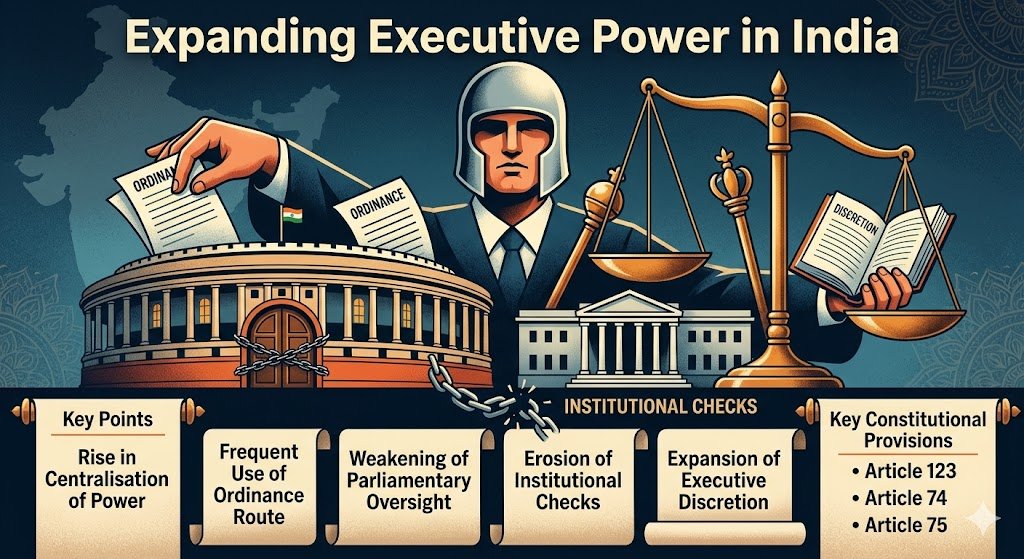
A recent editorial in The Hindu highlights the growing centralisation of executive authority in India, raising concerns about the weakening of institutional checks and balances. The issue has gained attention due to the increased use of ordinances, reduced parliamentary scrutiny, and the expanding scope of executive discretion in governance.
Key Points from the Editorial
1. Rise in Centralisation of Power
The executive, particularly at the Union level, is increasingly consolidating authority. Decision-making is becoming more top-down, reducing the role of deliberative institutions like Parliament and committees.
2. Frequent Use of Ordinance Route
The use of ordinances—meant to address urgent situations—has become more frequent.
-
Ordinances are issued under Article 123
-
They bypass parliamentary debate and scrutiny
-
This raises concerns about executive overreach
The concern is not legality, but habitual dependence on this route.
3. Weakening of Parliamentary Oversight
Parliament, the primary law-making body, is witnessing:
-
Reduced sittings
-
Limited debate on critical bills
-
Increasing passage of laws without detailed scrutiny
This undermines the principle of deliberative democracy.
4. Erosion of Institutional Checks
Institutions meant to act as checks—such as parliamentary committees, independent bodies, and even federal structures—are perceived to be weakening.
This leads to imbalance in the separation of powers
5. Expansion of Executive Discretion
There is growing reliance on:
-
Delegated legislation
-
Administrative rules
-
Executive notifications
These allow the executive to effectively legislate without legislative approval in many cases.
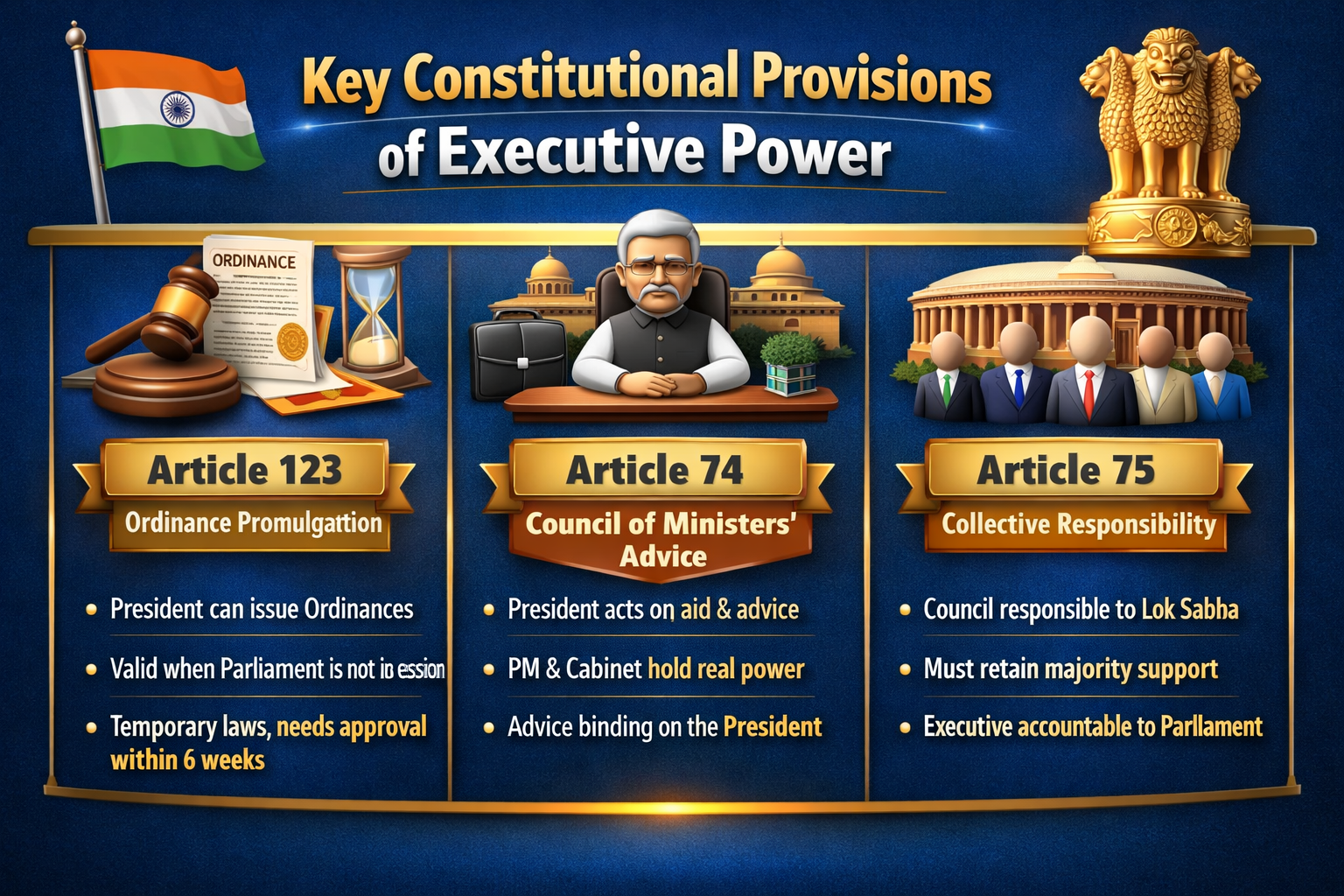
Key Constitutional Provisions:Article 123
Article 74
Article 75
|
Separation of Powers: Not Just Theory, But Safeguard
India does not follow a strict separation of powers, but it maintains a functional balance. This balance ensures that:
-
No institution becomes too powerful
-
Each organ can act as a check on the others
If the executive begins to dominate law-making and oversight processes, this balance gets disturbed, leading to concentration of power, which is inherently risky in a democracy.
Constitutional Morality: The Invisible Foundation
The Constitution cannot foresee every situation; therefore, it relies on constitutional morality, which means:
-
Respecting the spirit of democratic procedures
-
Exercising power with restraint
For example, even if issuing repeated ordinances is legally valid, doing so may violate constitutional morality because it avoids democratic deliberation.
Critical Evaluation
Why Some Support Strong Executive
A strong executive can:
-
Take quick decisions in crises
-
Ensure policy continuity
-
Overcome legislative delays
This is particularly relevant in a large and complex country like India.
Why This Trend is Concerning
However, unchecked expansion leads to:
-
Weak accountability mechanisms
-
Reduced transparency
-
Potential misuse of power
The real danger is not immediate authoritarianism, but gradual normalisation of reduced scrutiny.
Way Forward
-
Reinforce Parliamentary Culture: Parliament must function as a space for genuine debate, not just formal approval.
-
Institutionalise Committee Scrutiny: Major bills should mandatorily go through committees to ensure quality legislation.
-
Define Norms for Ordinance Use: Clear conventions should evolve to restrict ordinances to genuine emergencies.
-
Promote Decentralised Governance: States and local bodies must be meaningfully involved in decision-making.
-
Strengthen Democratic Ethos: Ultimately, institutions are as strong as the political culture that sustains them.
The expansion of executive power in India reflects a broader tension between efficiency and accountability. While a decisive executive is necessary for governance, democracy requires that such power be exercised within a framework of institutional checks, transparency, and public deliberation.
The long-term strength of Indian democracy will depend not merely on constitutional provisions, but on the willingness of institutions and political actors to respect the spirit of those provisions.