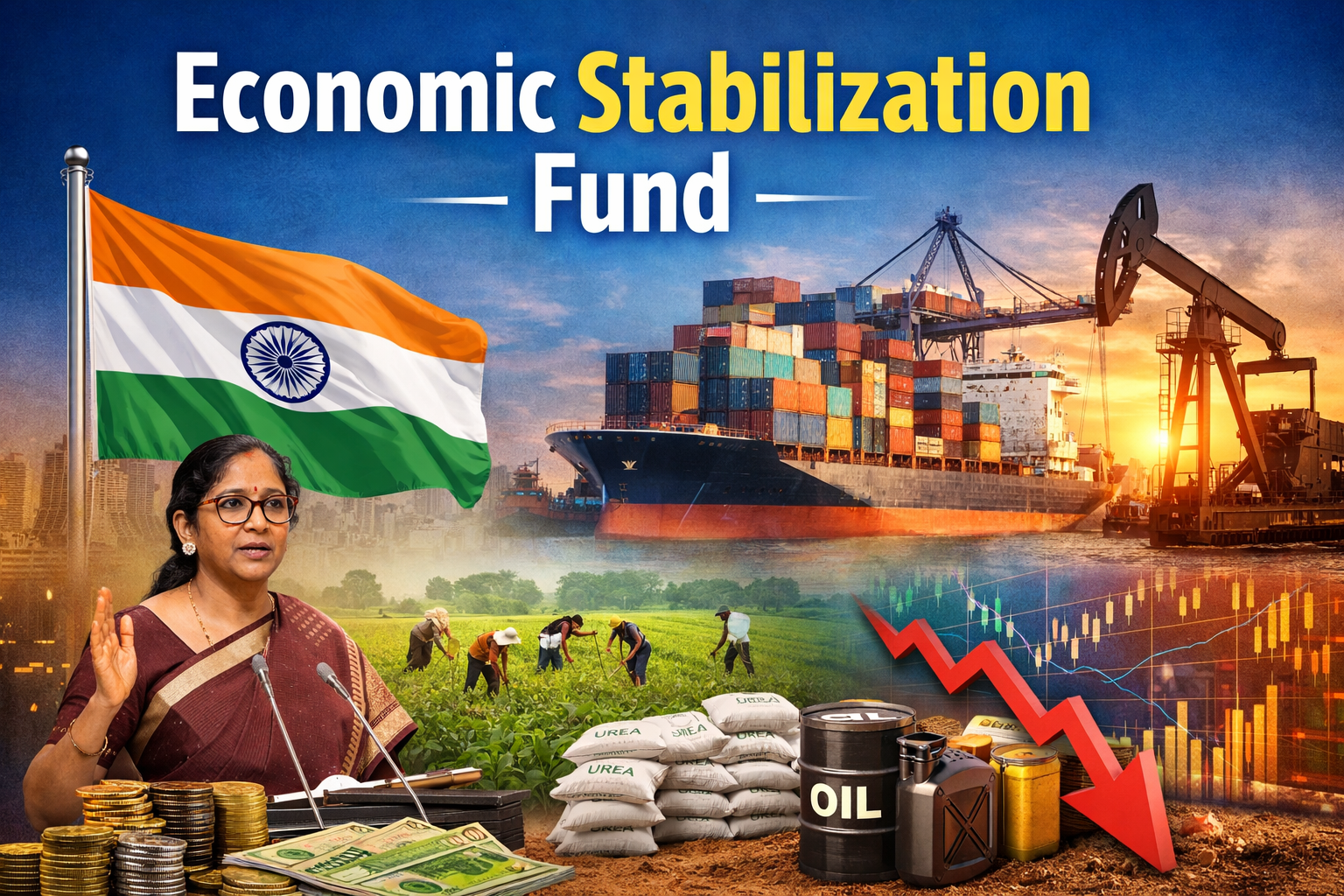
Economic Stabilization Fund (ESF): India’s ₹1 lakh crore shield against global shocks—explained with concepts, analysis, and UPSC relevance.
Syllabus Areas:GS III - Economy |
Amid rising geopolitical tensions—particularly due to ongoing Conflicts in West Asia—and increasing uncertainty in global markets, India has taken a proactive fiscal step. Finance Minister Nirmala Sitharaman recently announced the creation of a ₹1 lakh crore Economic Stabilisation Fund (ESF) in the Lok Sabha.
This move comes at a time when:
-
Global supply chains remain fragile
-
Energy prices are volatile
-
Inflationary pressures are building
-
Export sectors are demanding policy support
In this backdrop, the ESF represents an attempt by the government to anticipate economic shocks rather than merely react to them.
What is the Economic Stabilisation Fund (ESF)?
The Economic Stabilisation Fund (ESF) is a proposed financial buffer designed to help the government respond effectively to unexpected economic disruptions.
Objectives of ESF
-
Provide fiscal flexibility during crises
-
Enable quick government intervention without disturbing budget stability
-
Support sectors affected by external shocks
Scope
The fund will be used to address:
-
Global economic uncertainties
-
Supply chain disruptions
-
Sector-specific economic stress
-
Unexpected fiscal pressures such as subsidies or relief packages
The underlying idea is to create preparedness for unpredictable events, ensuring economic stability.
Also Read Financial Stability Report by RBI's
Funding Mechanism
The government has adopted a balanced approach to fund the ESF:
-
Initial allocation: Around ₹57,301 crore through fresh expenditure
-
Future funding: Through internal budgetary reallocations
This approach ensures that the fund is built gradually without putting excessive pressure on fiscal resources.
Supplementary Demand for Grants: Key Highlights
The ESF announcement was accompanied by the approval of ₹2.8 lakh crore in supplementary demands for grants by Parliament.
Major Allocations:
-
₹23,641 crore for Pradhan Mantri Garib Kalyan Anna Yojana to ensure food security
-
₹41,400 crore for defence services
-
₹19,200 crore for fertiliser subsidies
Out of the total, ₹2 lakh crore represents additional cash outgo.
Importantly, the government has maintained that this additional expenditure will not breach the fiscal deficit targets, reflecting a commitment to fiscal discipline.
Focus on Fertiliser Subsidy
The government has assured that there will be no shortage of fertilisers for farmers, with adequate financial provisions in place.
Significance:
-
Supports agricultural productivity
-
Prevents rise in food prices
-
Protects farmer incomes
Agriculture remains a critical sector in India, and ensuring input availability is essential for economic and social stability.
Global Context Behind the Move
The ESF has been proposed in response to multiple global challenges:
1. Geopolitical Conflicts
Ongoing tensions, particularly in West Asia, have led to:
-
Rising oil prices
-
Increased import costs
2. Supply Chain Disruptions
Global trade continues to face disruptions due to:
-
Conflicts
-
Logistics constraints
-
Post-pandemic adjustments
3. Inflationary Pressures
Higher fuel and input costs are contributing to:
-
Cost-push inflation
-
Reduced purchasing power
4. Export Challenges
Indian exporters are facing:
-
Weak global demand
-
Calls for policy support
Economic ConceptsFiscal Headroom: Refers to the government’s ability to increase spending during crises without destabilizing public finances. ESF helps create this capacity in advance. Counter-Cyclical Fiscal Policy: Governments increase spending during economic downturns and reduce it during growth phases. ESF enables timely intervention during slowdowns. Fiscal Deficit Management: Maintaining fiscal discipline is essential for macroeconomic stability. The ESF helps avoid sudden spikes in borrowing. Subsidy Support: Subsidies like fertiliser support help control inflation and protect vulnerable sectors, especially agriculture. Economic Shock Absorption: The ESF acts as a financial cushion, reducing the impact of sudden economic disruptions. |
Critical Analysis
Strengths
-
Promotes proactive economic planning
-
Enhances resilience against global shocks
-
Reduces dependence on emergency borrowing
-
Supports vulnerable sectors quickly
Concerns
-
Risk of reduced transparency if not properly monitored
-
Potential increase in fiscal burden over time
-
Requires strong governance and accountability mechanisms
Way Forward
For the ESF to be effective, the following steps are essential:
-
Clear guidelines for fund utilization
-
Strong institutional oversight
-
Regular audits and transparency
-
Coordination with monetary and structural policies
The Economic Stabilisation Fund (ESF) marks an important step in strengthening India’s fiscal framework. By shifting from reactive responses to anticipatory economic management, the government aims to build resilience in an increasingly uncertain global environment.
However, the long-term success of the ESF will depend on transparent governance, disciplined implementation, and timely deployment. If managed effectively, it can become a key pillar of India’s macroeconomic stability in the years to come.
Prelims Questions:
Q1. Consider the following statements regarding the Economic Stabilisation Fund (ESF):
-
It is aimed at providing fiscal support during economic shocks
-
It is funded entirely through external borrowings
-
It helps in maintaining fiscal deficit targets
Which of the above statements is/are correct?
(a) 1 and 3 only
(b) 2 only
(c) 1, 2 and 3
(d) 1 only
Answer: (a)
Q2. Which of the following can lead to cost-push inflation?
-
Supply chain disruptions
-
Increase in input costs
-
Excess money supply
Select the correct answer:
(a) 1 and 2 only
(b) 2 and 3 only
(c) 1, 2 and 3
(d) 1 only
Answer: (c)