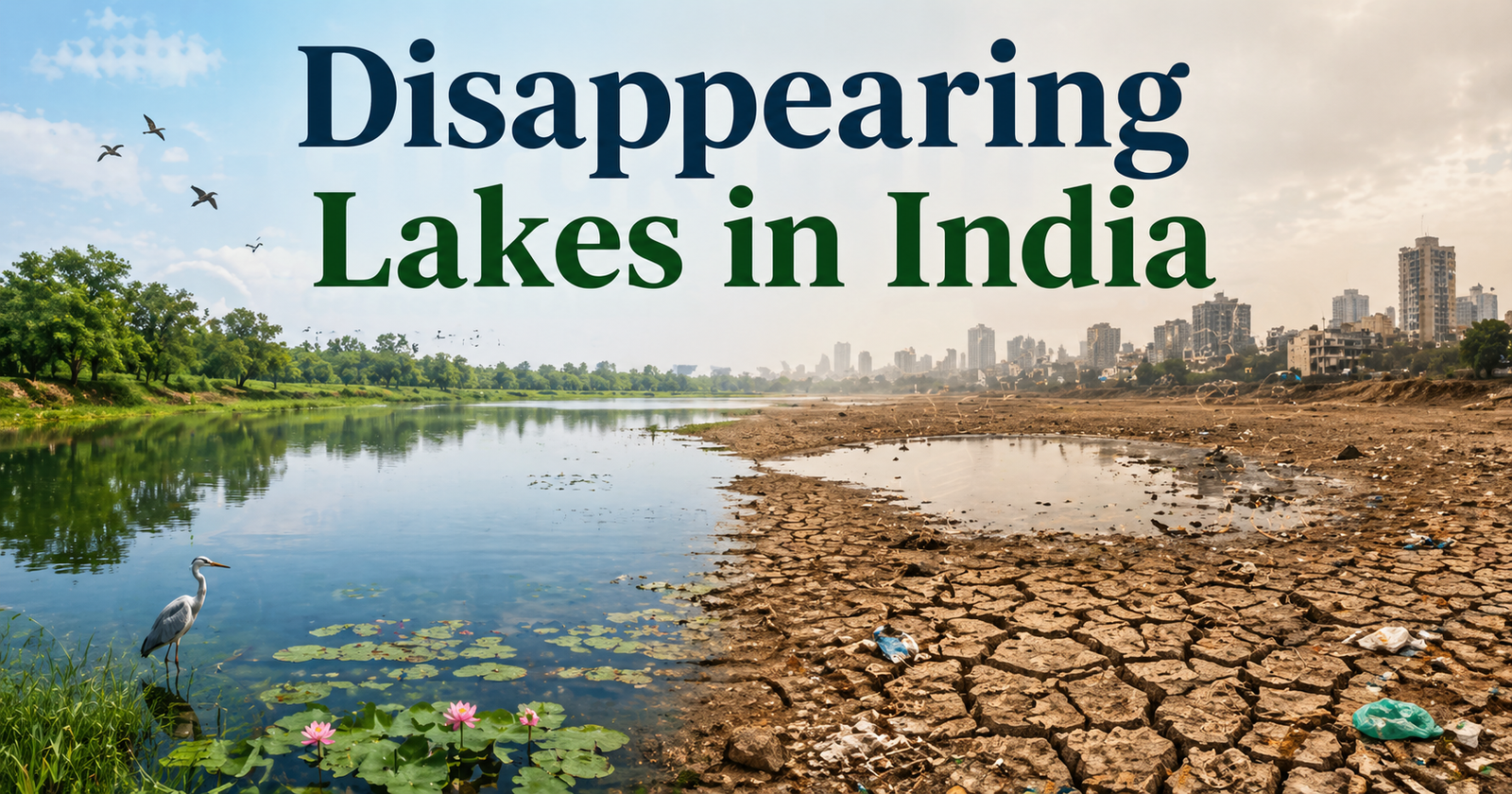
Explore the crisis of disappearing lakes in India, its causes, environmental impacts, water scarcity risks, biodiversity loss, and sustainable solutions for restoration.
Syllabus Areas:GS III - Environment and Ecology |
Lakes have historically played a vital role in India’s environmental balance, water security, biodiversity conservation, and cultural life. From the Dal Lake in Kashmir to Hussain Sagar in Hyderabad, from Loktak Lake in Manipur to Sambhar Lake in Rajasthan, lakes have supported livelihoods, agriculture, tourism, fisheries, and urban ecosystems for centuries. However, in recent decades, India has witnessed the alarming disappearance and degradation of lakes due to rapid urbanisation, pollution, encroachment, and climate change.
The shrinking of lakes is not merely an environmental concern; it has deep socio-economic and ecological consequences. Disappearing lakes threaten water availability, intensify urban flooding, destroy biodiversity, and undermine the quality of life of millions of people.
Importance of Lakes in India
-
Lakes serve multiple ecological and human functions.
-
They act as natural reservoirs storing freshwater for domestic, agricultural, and industrial use.
-
They help recharge groundwater tables and regulate local climates.
-
Lakes also function as habitats for birds, fish, amphibians, and aquatic plants.
-
Many lakes hold cultural and religious significance.
-
They are central to festivals, tourism, recreation, and traditional livelihoods.
-
In urban areas, lakes act as natural drainage systems, helping absorb excess rainwater and reducing flood risks.
-
Thus, lakes are essential components of sustainable ecosystems and resilient cities.
Why Are Lakes Disappearing in India?
1. Rapid Urbanisation and Encroachment
-
One of the biggest reasons for lake disappearance is unplanned urban growth.
-
As cities expand, lake beds and catchment areas are encroached upon for housing colonies, commercial buildings, roads, and infrastructure projects.
-
Several urban lakes in Bengaluru, Hyderabad, Chennai, and Delhi have shrunk significantly due to real estate pressure.
2. Pollution and Sewage Discharge
-
Many lakes have turned into dumping grounds for untreated sewage, industrial waste, plastics, and solid waste. This causes eutrophication, foul smell, decline in oxygen levels, and death of aquatic species.
-
Examples include Bellandur Lake in Bengaluru, which has repeatedly caught fire due to chemical pollutants and foam formation.
3. Climate Change and Irregular Rainfall
-
Changing rainfall patterns, prolonged droughts, and rising temperatures reduce lake inflows and accelerate evaporation. Seasonal lakes are particularly vulnerable to climate variability.
4. Siltation and Neglect
-
Poor maintenance leads to silt accumulation, reducing the storage capacity of lakes. Inflow channels and feeder streams are often blocked, cutting off water supply.
5. Invasive Species
-
The spread of invasive plants such as water hyacinth chokes many lakes, reducing oxygen levels and affecting biodiversity.
Socio-Ecological Implications of Disappearing Lakes
-
Water Scarcity
-
Lakes are important freshwater sources. Their disappearance increases dependence on groundwater, borewells, and distant river systems. This leads to over-extraction of groundwater and worsening water crises in urban and rural areas.
-
Cities like Bengaluru have experienced severe water shortages partly due to loss of interconnected lake systems.
-
Groundwater Recharge Decline
-
Lakes naturally recharge aquifers by allowing water to percolate into the ground. When lakes vanish, groundwater tables fall, increasing the cost and difficulty of water access.
-
This particularly affects farmers, low-income households, and peri-urban communities.
-
Urban Flooding: Paradoxically, cities facing water scarcity also experience flooding.
-
Lakes act as natural sponges during heavy rainfall. When they are encroached or filled, rainwater has nowhere to go.
-
The floods in Chennai and Bengaluru highlighted how destruction of wetlands and lakes worsened urban disasters.
-
Biodiversity Loss: Lakes support fish species, migratory birds, amphibians, reptiles, and aquatic plants.
-
Their degradation destroys habitats and weakens ecological food chains.
-
Wetland birds, turtles, frogs, and local fish populations decline sharply when lakes disappear.
-
Livelihood Loss: Many communities depend on lakes for fishing, lotus cultivation, tourism, boating, fodder collection, and small-scale agriculture.
-
The loss of lakes directly affects employment and incomes.
-
Traditional occupations linked to water bodies are gradually vanishing.
-
Public Health Risks: Polluted lakes become breeding grounds for mosquitoes and disease-causing organisms. Toxic water can contaminate nearby groundwater and pose serious health risks.
-
Loss of Cultural Heritage: Many lakes are associated with temples, rituals, festivals, and local identity. Their disappearance erodes community heritage and social memory.
Major Examples in India
-
Bengaluru Lakes: Once known as the “City of Lakes,” Bengaluru had hundreds of interconnected lakes. Many have disappeared due to urbanisation, while others suffer severe pollution.
-
Chilika Lake, Odisha: Though a lagoon rather than a conventional lake, Chilika demonstrates the importance of wetland restoration through community participation and scientific management.
-
Sambhar Lake, Rajasthan: India’s largest inland salt lake faces ecological stress due to illegal salt extraction, water diversion, and habitat degradation.
-
Loktak Lake, Manipur: Known for its floating phumdis, Loktak Lake faces threats from pollution, siltation, and hydrological changes.
Government Initiatives for Lake Conservation
-
National Plan for Conservation of Aquatic Ecosystems (NPCA): This scheme supports restoration and conservation of lakes and wetlands.
-
AMRUT and Smart Cities Mission: Some urban lake rejuvenation works have been taken up under these programmes.
-
Wetlands (Conservation and Management) Rules, 2017: Provides regulatory framework for wetland protection.
-
Jal Shakti Abhiyan: Encourages water conservation, rainwater harvesting, and rejuvenation of water bodies.
Challenges in Conservation
-
Fragmented institutional responsibility
-
Weak enforcement against encroachment
-
Lack of scientific lake mapping
-
Inadequate sewage treatment infrastructure
-
Poor public awareness
-
Political and commercial interests
Way Forward
-
Legal Protection for Urban Lakes: All lakes must be clearly demarcated, digitised, and protected from encroachment through strict legal action.
-
Integrated Urban Planning: Cities should treat lakes as critical infrastructure, not vacant land. Lake systems must be linked with stormwater management and land-use planning.
-
Sewage Treatment and Pollution Control: No untreated wastewater should enter lakes. Decentralised sewage treatment plants must be promoted.
-
Community Participation: Resident welfare associations, citizen groups, NGOs, and local bodies should jointly manage lakes.
-
Scientific Restoration: Desiltation, catchment treatment, biodiversity restoration, and revival of feeder channels must be based on expert ecological studies.
-
Climate Resilience Planning: Lake conservation should be integrated into climate adaptation strategies to manage droughts and floods.
The disappearance of lakes in India is a warning sign of unsustainable development. Lakes are not empty spaces waiting to be built upon; they are living ecosystems that sustain water, biodiversity, livelihoods, and urban resilience. Protecting and restoring lakes is essential for India’s environmental future and human well-being.