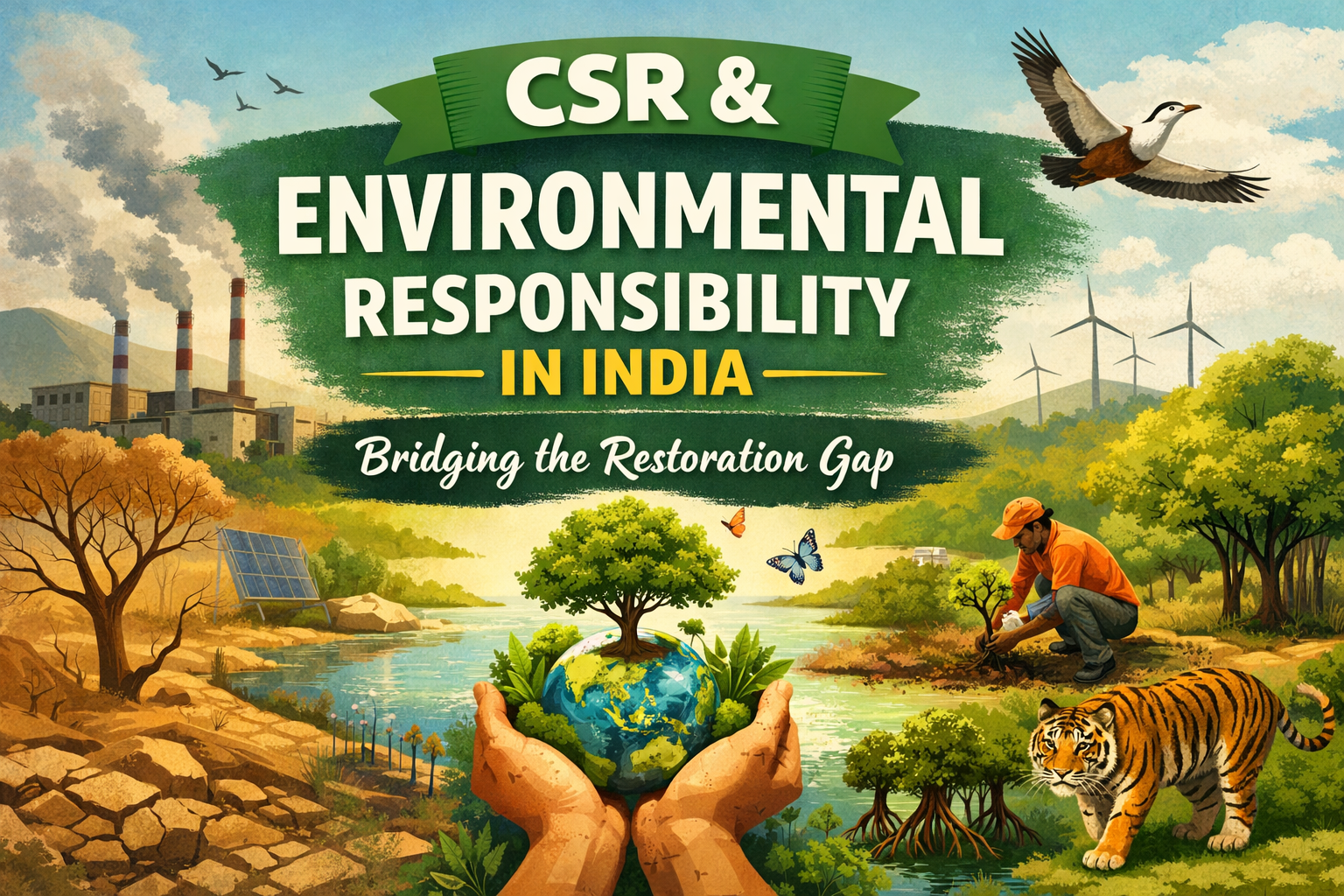
An in-depth analysis of CSR spending in India, highlighting environmental neglect, restoration challenges, and the Supreme Court’s mandate for sustainable, ecosystem-driven corporate governance
Syllabus Areas:GS III - Environment |
India’s Corporate Social Responsibility (CSR) framework has long been considered progressive, mandating companies to contribute towards societal development under the Companies Act, 2013. However, recent observations by the Supreme Court have brought renewed attention to a critical gap—the neglect of environmental responsibility within CSR spending.
The issue gained prominence after the Court examined the degradation of the Great Indian Bustard’s habitat due to industrial activities. By invoking Article 51A(g) of the Constitution, the Court emphasized that environmental protection is not merely voluntary philanthropy but a constitutional obligation. This marks a significant shift in how corporate environmental responsibility is perceived in India.
India’s CSR Model: Progressive but Imbalanced
-
India was among the first countries to legally mandate CSR spending, creating a structured pathway for corporate contributions to social development.
-
Over the years, CSR funds have significantly supported sectors like education, healthcare, and rural development.
-
However, this model has evolved with a clear imbalance.
-
While social sectors receive substantial attention, environmental sustainability remains relatively underfunded, despite growing ecological challenges such as climate change, pollution, and biodiversity loss.
Skewed CSR Spending: A Cause for Concern
An analysis of CSR expenditure over the past several years reveals a clear trend:
-
Education receives nearly 38% of CSR funds
-
Healthcare accounts for around 22%
-
Rural development attracts about 10%
-
Environmental initiatives, however, receive only 7–9%
This disparity reflects a broader corporate mindset that prioritizes immediate, visible social outcomes over long-term environmental sustainability.
The concern here is structural: environmental degradation directly affects economic growth, public health, and long-term development. Yet, it continues to be treated as a secondary priority.
Encouraging Examples: Proof of Possibility
Despite the overall trend, some corporations have demonstrated that impactful environmental CSR is achievable at scale:
-
Mahindra’s “Project Hariyali” has planted nearly 25 million trees, with a strong focus on survival rates rather than mere plantation numbers.
-
ITC’s social forestry initiative spans over 1.3 million acres, integrating ecological restoration with rural livelihoods.
-
The Tata Group has undertaken large-scale watershed management projects, improving water security.
-
Coca-Cola and Hindustan Unilever have implemented circular waste management systems.
-
JSW Group has contributed to mangrove restoration efforts.
These initiatives highlight that when approached strategically, environmental CSR can deliver measurable ecological and socio-economic benefits.
The Restoration Gap: A Structural Challenge
One of the most critical issues identified is the “restoration gap”—the mismatch between environmental damage caused by industrial activity and the investment made to restore ecosystems.
India has committed to restoring 26 million hectares of degraded land by 2030 under global initiatives like the Bonn Challenge. However:
-
Only 9.8 million hectares have been restored so far
-
Corporate contribution stands at a mere 2%
This indicates that corporate India has not yet assumed adequate responsibility for ecological restoration.
Why Corporates Avoid Environmental Projects
Several factors explain the limited corporate engagement in environmental restoration:
1. Preference for Quick Results
Companies often favor projects that:
-
Deliver immediate, visible outcomes
-
Are easy to measure and report
-
Enhance brand image quickly
Environmental restoration, by contrast, is:
-
Time-consuming
-
Complex
-
Less visible in the short term
2. Technical Complexity
Effective ecological restoration requires:
-
Expertise in soil science, biodiversity, and ecology
-
Continuous monitoring and evaluation
Most CSR implementing agencies lack these specialized skills, making such projects difficult to execute.
3. Misguided Approaches
Certain popular practices, such as Miyawaki plantations, are widely adopted due to their rapid growth and visual appeal. However, they often:
-
Ignore native species
-
Disrupt local ecosystems
-
Prioritize optics over ecological integrity
4. Urban Bias in CSR Projects
CSR initiatives are frequently concentrated in urban or semi-urban areas for visibility and accessibility. This results in:
-
Neglect of degraded forests and remote ecosystems
-
Limited impact on critical ecological zones
5. Weak Institutional Coordination
There is insufficient collaboration between:
-
Corporates
-
Forest departments
-
Academic institutions
-
NGOs
This fragmentation reduces the effectiveness and scale of restoration efforts.
Judicial Intervention: A Turning Point
The Supreme Court’s recent observations have fundamentally altered the narrative. By linking environmental protection to constitutional duty, the Court has:
-
Reframed CSR from voluntary charity to mandatory responsibility
-
Emphasized that businesses cannot operate in isolation from ecological concerns
-
Highlighted accountability for environmental damage caused by corporate activity
This judicial push signals a move toward integrating environmental responsibility into core business strategy.
The Way Forward: Reimagining CSR Strategy
1. Shift Towards Ecosystem Restoration
CSR must move beyond token initiatives and focus on:
-
Forest regeneration
-
Biodiversity conservation
-
Water resource management
2. Redefining Success Metrics
Instead of measuring CSR success by expenditure, companies should track:
-
Soil carbon levels
-
Water retention capacity
-
Biodiversity recovery
3. Strengthening Institutional Partnerships
Effective restoration requires collaboration between:
-
Government agencies
-
Research institutions
-
Civil society organizations
Such partnerships can ensure scientific planning and long-term sustainability.
4. Focus on Native Ecology
Restoration projects must:
-
Use indigenous species
-
Preserve ecological balance
-
Avoid short-term, cosmetic solutions
5. Ensuring Long-Term Financing
To sustain large-scale restoration efforts:
-
Dedicated restoration funds or escrow mechanisms should be created
-
Long-term financial commitments must replace one-time spending
6. Reforming Corporate Governance
Corporate governance frameworks must evolve to:
-
Prioritize environmental sustainability alongside profitability
-
Treat directors as custodians of ecological well-being
India’s CSR framework has laid a strong foundation for inclusive development, but its environmental dimension remains underdeveloped. The Supreme Court’s intervention has provided a critical opportunity to correct this imbalance.
For India to achieve its climate and sustainability goals, environmental responsibility must become a central pillar of corporate strategy rather than a peripheral obligation. Bridging the restoration gap is not just an ecological necessity—it is essential for ensuring long-term economic resilience and sustainable development.