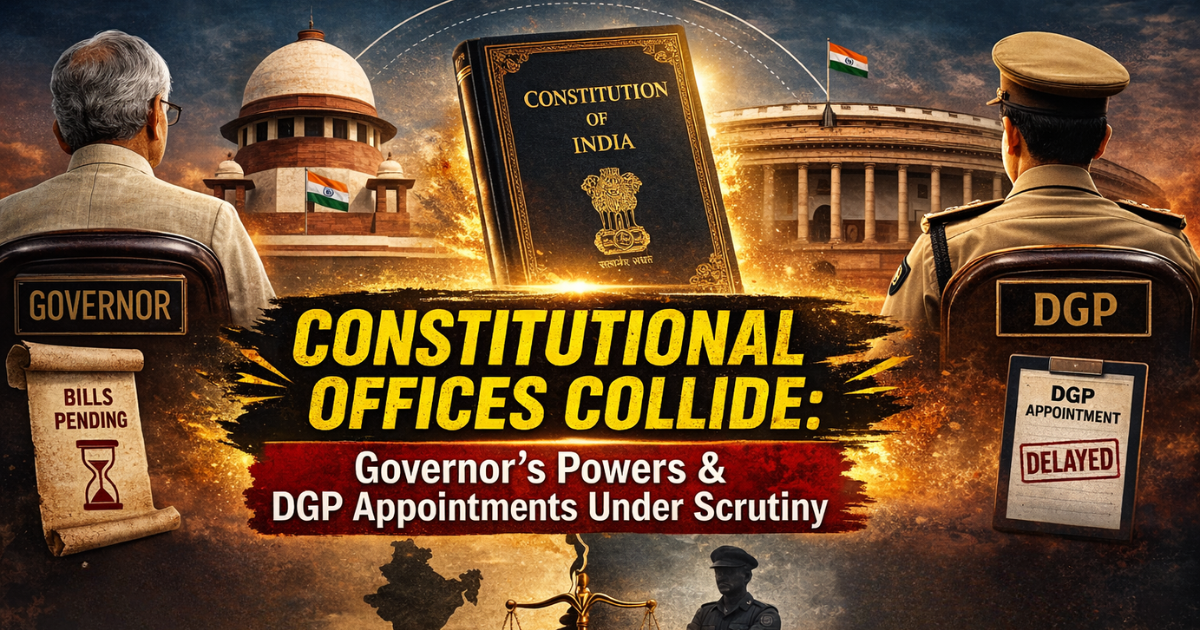
Explore the ongoing constitutional tensions between Governors and State Governments over bill assent and DGP appointments. Understand its impact on federalism, governance, and institutional integrity for UPSC preparation.
Syllabus Areas:GS II - Polity and Governance |
In recent months, multiple states have accused Governors of sitting indefinitely on bills passed by elected legislatures. Simultaneously, the Supreme Court of India has pulled up several states for delaying the appointment of regular Directors General of Police (DGPs) and continuing with “acting” appointments.
These are not routine administrative issues. They strike at the heart of India’s constitutional design:
A Silent Constitutional Tug of War
India’s Constitution carefully balances:
-
Elected governments (States)
-
Appointed authorities (Governor)
-
Independent institutions (Judiciary, Police)
But today, this balance is under visible strain.
Two issues illustrate this clearly:
-
Governor delaying assent to bills
-
States delaying regular DGP appointments
At first glance, they seem unrelated. But look deeper—they both reveal institutional friction and political incentives overriding constitutional morality.
Governor & The “Pending Bills” Problem
What Does the Constitution Say?
Under Articles 200 & 201, a Governor can:
-
Approve a bill
-
Withhold it
-
Return it (except Money Bills)
-
Reserve it for the President
Problem Begins At:
The Constitution does not specify any time limit.
This loophole has led to:
-
Bills pending for months (even years)
-
No clarity, no communication
-
Governance getting stalled
This is often called a “pocket veto” situation (though not formally defined in India).
Why This Matters
-
Laws passed by elected representatives get blocked indirectly
-
State policies (education, welfare, etc.) get delayed
-
Creates a perception: Governor acting as political agent of Centre
What Did the Supreme Court Say?
The Supreme Court of India stepped in recently and made a nuanced observation:
-
No strict timelines can be imposed
-
No automatic “deemed assent”
-
But indefinite delay is unacceptable
-
Judicial review is possible in extreme cases
“You have discretion—but not unlimited silence.”
Why DGP Appointment is a Big Deal
The DGP is not just a post—it is:
-
The head of state police machinery
-
Critical for law & order and internal security
If this position is unstable, governance itself becomes fragile.
What Rules Exist?
In the landmark Prakash Singh vs Union of India case, the Court mandated:
-
Selection from UPSC panel
-
Minimum 2-year fixed tenure
-
Insulation from political interference
What’s Happening in Practice
-
States appoint “acting DGPs” instead of permanent ones
-
Delay sending names to UPSC
-
Frequent transfers
The Court recently warned that states are deliberately bypassing reforms.
Major Concerns:
-
Weakens police independence
-
Encourages political interference
-
Affects rule of law at ground level
The Hidden Connection
These two issues point to the same underlying pattern:
Institutional Convenience vs Constitutional Discipline
|
Issue |
What is happening |
|
Governor |
Delaying decisions |
|
State Govt |
Avoiding fixed DGP appointments |
Both sides are stretching the system for strategic advantage
Way Forward: Fixing the System Without Breaking It
1. Introduce Reasonable Timelines: Not rigid—but enough to prevent misuse
2. Codify Conventions: Make practices legally binding, not optional
3. Strict Implementation of Police Reforms: No more “acting DGP” culture
4. Judicial Safeguards: Limited but firm intervention when required
5. Revive Cooperative Federalism: Less confrontation, more coordination
India’s constitutional balance depends not on rigid laws but on responsible conduct. Strengthening accountability, respecting federal spirit, and limiting discretion are essential to preserve democratic integrity and institutional trust.