Two-State Delusion
Syllabus Areas:
GS II - International Relations
Though the idea of the two-state solution remains popular internationally, in reality, it has never materialised for Palestinians.The Israel-Palestine conflict is one of the longest-running and most complex geopolitical disputes.
- UNGA Resolution 181 (1947) intended two states—Israel and Palestine - one Jewish, one Arab (Palestinian), on historic Palestine.
- Israel was established in 1948, but Palestinian statehood remains unrealized, despite multiple peace attempts (e.g., Oslo Accords, Camp David, etc.).
Who are Jews?
Jews are an ethno-religious group with a shared heritage based on:
- Religion: Judaism
- Ethnicity: Common ancestry (from ancient Hebrews/Israelites)
- Cultural identity: Jewish traditions, customs, and language (like Hebrew and Yiddish)
- Territory: Israel, Jerusalem
Who are Palestines?
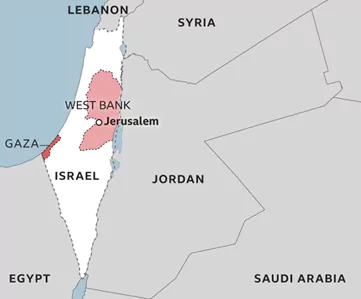
The Palestinians are the indigenous Arab people of the region known historically as Palestine, encompassing the modern-day territories of:
- The West Bank
- Gaza Strip
- East Jerusalem
They are ethnically Arab and mostly Muslim, though significant Christian and minority communities (such as Druze and Samaritans) also identify as Palestinians.
Two State Theory:
- After the Balfour Declaration (1917), Britain promised to establish a “national home for the Jewish people” in Palestine.
- This created growing tension with the indigenous Arab population, who also demanded independence.
- By the 1930s, Britain realized a single unified state might be unworkable
Peel Commission Report – 1937 (First official Two-State Proposal):
British Government’s Peel Commission was the first to formally propose partition.
Suggested:
- Creation of separate Jewish and Arab states
- A small area, including Jerusalem, would remain under British control.
This is considered the first concrete evolution of the Two-State Theory.
UN Partition Plan – Resolution 181 (1947):
Adopted by the UN General Assembly on November 29, 1947.
Proposed:
- Jewish State on ~56%
- Arab State on ~44%.
- Jerusalem as an international city (corpus separatum).
Aftermath of UN Resolution 181:
- Civil War (1947–1948):
- Massive violence erupted between Jews and Arabs in Palestine.
- Both communities engaged in armed attacks, retaliations, and expulsions.
- 1948 Arab-Israeli War:
- After Israel’s declaration of independence (May 14, 1948), five Arab nations invaded: Egypt, Jordan, Syria, Lebanon, and Iraq.
- Israel survived, expanded its territory beyond the UN-proposed borders.
- The Palestinian Arab state was never established.
- Nakba ("Catastrophe") – 1948:
- Over 700,000 Palestinians were displaced or fled.
- Villages were destroyed, and many became refugees — the beginning of the Palestinian refugee crisis
The ‘Two Israel States’ Reality
- Ironically, two states do exist, but both are controlled by
Israel:
- First State: Official Israel (on 78% of Palestine).
- Second State: A settler-messianic Halakha state rising on the 22% (i.e., the 1967-occupied territories).
- This second entity has semi-autonomous settler governance (e.g., Yesha Council, Shomron), militia, and budget — functioning as a parallel theocracy.
Diplomatic Hypocrisy & Genocidal Rhetoric
- Israeli officials and U.S. allies increasingly deny Palestinian existence (e.g., “there are no Palestinians”).
- Despite ongoing violence and settler expansion, the international community remains passive, offering no real accountability.
Palestinian Concessions vs. Israeli Aggression
- Oslo Accords marked a major Palestinian compromise — accepting a state on just 22% of historic Palestine.
- But the dream of even this minimal statehood is being suffocated by Israeli settlement expansion and military control.
What are the Oslo Accords?
The Oslo Accords refer to a series of landmark agreements between Israel and the Palestine Liberation Organization (PLO) in the 1990s, aimed at resolving the Israeli–Palestinian conflict through a two-state solution. They marked the first time both parties mutually recognized each other and agreed to negotiate directly.
Double Standards in Sanctions
- The world imposed 16,500 sanctions on Russia post-Ukraine war.
- Yet, no meaningful sanction has been imposed on Israel, despite the death toll exceeding 54,000 Palestinians.
- Unconditional support for Israel (especially military/intelligence aid) continues.
Prelims Questions:
- With reference to the United Nations General Assembly Resolution 181
(1947), which of the following statements is/are correct?
- It proposed the creation of separate Jewish and Arab states in historic Palestine.
- Jerusalem was to be placed under a special international administration.
- The Arab League unanimously supported the resolution.
- 1 and 2 only
- 2 and 3 only
- 1 and 3 only
- 1, 2 and 3
- Statement 1 is correct: UNGA Resolution 181 proposed the two-state solution with separate Jewish and Arab states.
- Statement 2 is correct: Jerusalem was to be under international administration (corpus separatum).
- Statement 3 is incorrect: The Arab League and Palestinian leadership rejected the resolution.
- Consider the following statements regarding recent developments in
the Israel-Palestine conflict:
- The idea of the "Halakha State" refers to a growing settler-led messianic entity within the occupied Palestinian territories.
- The international community has imposed comprehensive arms embargoes on Israel due to settlement expansion.
- The two-state solution was originally proposed in the Balfour Declaration.
Which of the above is/are correct?
- 1 only
- 1 and 2 only
- 1 and 3 only
- 2 and 3 only
Answer: A
Explanation:
- Statement 1 is correct: The "Halakha State" refers to an emerging parallel settler-messianic structure in the West Bank, supported by Israeli policy.
- Statement 2 is incorrect: There are no major arms embargoes imposed on Israel by major powers; military aid continues.
- Statement 3 is incorrect: The Balfour Declaration (1917) supported a Jewish national home, but didn’t propose a two-state solution.
Mains Question:
- “Without justice, there can be no peace.” In the context of the Israel-Palestine conflict, discuss. 150 Words 10 Marks
Select the correct answer using the code below:
Answer: A
Explanation: