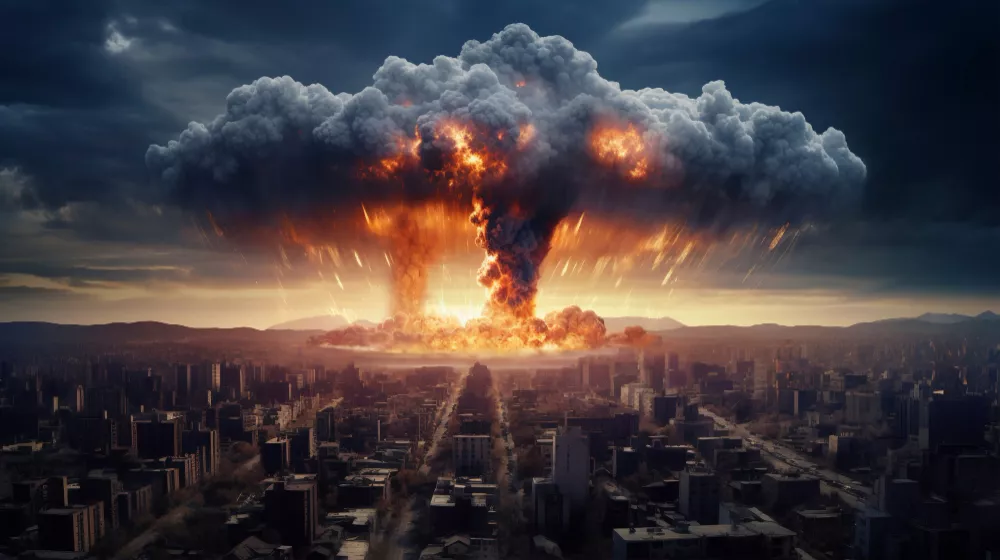
The Global Nuclear Order Under Strain
Syllabus Areas:
GS II - IR
GS III - Security
On 30 October 2025, U.S. President Donald Trump announced a plan to resume nuclear testing, claiming Russia and China were conducting tests.
The statement has triggered fears of a breakdown of the nuclear restraint architecture built over the last 80 years. Comes at a time when the global nuclear order is already fragile, with arms control treaties collapsing and geopolitical rivalries intensifying.
Why This Issue Has Exploded Into the Global Debate
The nuclear order built after 1945 rested on three pillars:
- Non-proliferation (NPT)
- Arms control (treaties between major powers)
- Deterrence norms + nuclear taboo
For decades, these mechanisms held reasonably well. But the
30 October 2025
announcement by U.S. President Donald Trump, claiming the U.S. will begin
nuclear testing, has provoked anxiety because nuclear explosive testing has
been the invisible “red line” respected by all major powers since the
1990s.
Breaking this line could collapse the entire global nuclear
restraint architecture.
The Paradox of the Current Nuclear Order
Why It Looks Like a Success Story
- Since 1945, no nuclear state has used nuclear weapons in war — despite the Korean War, Cold War crises, Kargil, Ukraine, Taiwan tensions.
- Global arsenals were reduced from 65,000 warheads (1970s) to ~12,500 today.
- Fears that two dozen countries would acquire nuclear weapons have not materialised — the nuclear club remains just nine states.
Why Nobody Is Celebrating
Despite these achievements, the system is extremely fragile:
- Arms control treaties are expiring.
- Nuclear weapon modernisation is accelerating.
- Norms like the Comprehensive Test Ban Treaty (CTBT) are eroding.
- Trust among great powers is collapsing.
In short: the structure is still standing, but the load-bearing beams are cracking.
Trump’s Announcement — What Exactly Was Said, and Why It Matters
On 30 October 2025, Trump posted that:
- The U.S. will start testing nuclear weapons “on an equal basis.”
- He implied Russia and China were secretly testing.
- He also claimed the U.S. is ahead of Russia and China in nuclear capability.
Two ambiguities make this highly destabilising:
(a) Was he referring to nuclear explosive tests?
True nuclear tests involve underground explosions
that generate
measurable seismic signals — and they are internationally condemned.
If the
U.S. resumes explosive testing, it breaks a 33-year moratorium.
(b) He cited the wrong department
He said “Department of War” — but nuclear test
sites are under the
Department of Energy, not the Pentagon.
This fuels confusion: is
this a real policy shift, or political posturing?
This ambiguity itself is dangerous because nuclear strategy depends on clarity and predictability.
Nuclear Modernisation Across the Big Three (U.S., Russia, China)
- United States
The U.S. has not tested explosively since 1992 but is:
- Designing new warheads (e.g. B61-13, W76-2).
- Developing a nuclear-armed submarine-launched cruise missile.
- Running the Stockpile Stewardship Programme to keep old warheads reliable without explosive testing.
This program uses advanced simulation, AI, laser-driven fusion experiments, etc. It maintains nuclear capability while avoiding explosive tests.
- Russia
Russia has carried out high-profile strategic weapon tests:
- Burevestnik nuclear-powered cruise missile (14,000 km range)
- Poseidon underwater nuclear-powered torpedo
These systems increase first-strike ambiguity — adversaries cannot predict what direction or domain an attack might come from.
- China
China has:
- Tested hypersonic glide vehicles capable of orbital-level manoeuvres.
- Developed dual-use rockets that can be presented as “satellite launch vehicles” but serve military roles.
With only 47 past nuclear explosive tests, China stands to gain enormously if testing resumes, because it needs fresh data to refine thermonuclear designs.
The CTBT Problem — Why the Treaty Is Stillborn
The Comprehensive Test Ban Treaty (CTBT), concluded in 1996, bans all nuclear explosions. However, 29 years later, it is still not in force.
Why? Because certain key states never ratified
Among the 44 states whose ratification is mandatory:
- S., China, Israel, Egypt, Iran have not ratified.
- Russia ratified but withdrew in 2023.
- India, Pakistan, North Korea have neither signed nor ratified.
So even though 187 countries signed it, the treaty is legally paralysed.
The treaty lacks clear definitions
The phrase “any nuclear weapon test
explosion” was never
defined.
The U.S. deliberately avoided defining:
- What yield counts as a test
- What a “nuclear explosion” means
Instead, the U.S., Russia, and China reached informal agreements about “zero-yield” — allowing
- sub-critical tests
- hydronuclear experiments as long as no self-sustaining chain reaction
This loophole weakens CTBT’s moral authority.
Disputes over alleged secret testing
The U.S. alleged Russia and China might be conducting low-yield tests. CTBTO monitoring network (300+ stations) denied these claims. This contradiction worsens mistrust, not clarity.
Trump Doubles Down: Second Statement on November 2
Trump again claimed that:
- Russia, China, Pakistan, and North Korea are conducting nuclear tests.
- He intends to match them.
The U.S. Secretary of Energy clarified:
- The U.S. will only conduct noncritical, non-nuclear explosive tests.
- Essentially: missile system tests, not nuclear detonations.
But because Trump’s own messaging is vague, the world is unsure which version is true — and uncertainty is destabilising in nuclear politics.
How New Technologies Are Intensifying Risks
- Low-yield nuclear weapons: These are designed to
be
“more
usable,” lowering the psychological barrier to nuclear use.
This undermines the nuclear taboo built since 1945. - Dual-use hypersonics
- Hypersonic missiles can carry nuclear or conventional warheads.
- Adversaries cannot distinguish between them during flight.
- This increases probability of miscalculation.
- Missile Defense revival
- S. exploring high-end defenses (referred to as “golden dome”).
- Missile defenses often trigger arms races — adversaries build more warheads or diversify attack modes to saturate defenses.
- Cyber and space disruptions
When nuclear command and control can be cyber-hacked or space assets can be blinded, doctrines become more aggressive:
- Launch-on-warning becomes tempting
- First-strike incentives increase
These raise the risk of nuclear use by accident, not intent.
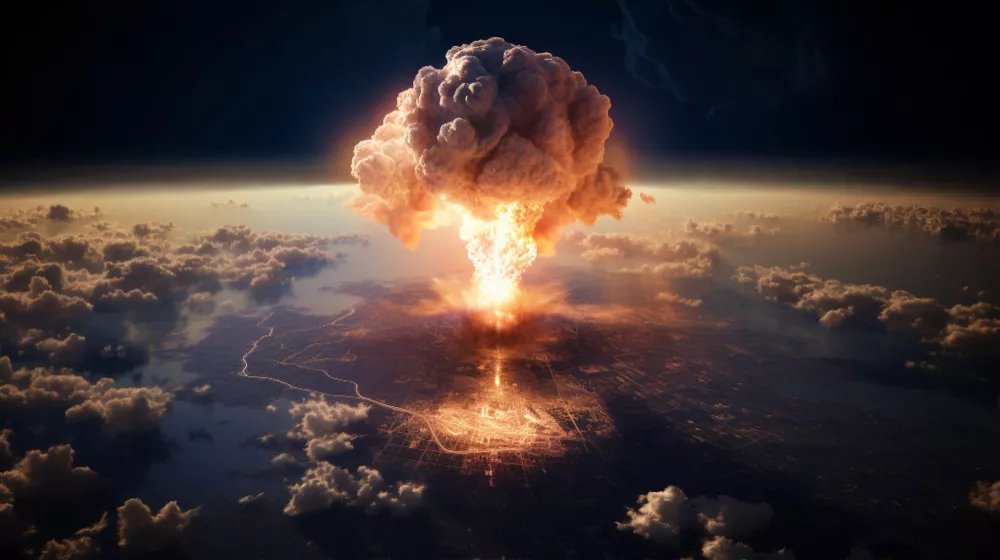
The Arms-Control Framework Is Collapsing
The only surviving U.S.–Russia nuclear arms treaty:
- New START
- Limits each side to 700 launchers and 1,550 deployed warheads
- Expires on 4 February 2026
There are no talks to renew or replace it.
Meanwhile:
- Russia is expanding unconventional systems.
- China is rapidly increasing its arsenal:
- Below 300 earlier → 600 now → likely 1000+ by 2030.
We are moving into an unregulated, unpredictable, trilateral nuclear competition.
India’s Position — Caught in the Crosswinds
India has kept a voluntary moratorium since 1998. But if major powers resume explosive testing:
India will be compelled to test because:
- Boosted fission devices need validation.
- The thermonuclear (fusion) device from 1998 was only tested once and remains contested.
- China will test — and Pakistan will follow.
Given China’s rapid modernization and deep strategic ties to Pakistan, India cannot afford reliance on outdated designs.
Thus, U.S.–Russia–China testing indirectly forces India’s hand.
Consequences for Global Norms
- Collapse of CTBT Norm
CTBT never entered into force but functioned as a moral and political norm.
If the U.S. openly tests:- Russia will immediately follow.
- China benefits the most and will eagerly test.
- India and Pakistan will also test.
- Other regional aspirants (Iran, South Korea, Saudi Arabia) may reconsider options.
A chain reaction begins — not of neutrons, but of geopolitical decisions.
- Unravelling of NPT
NPT’s legitimacy rests on:
- Nuclear weapon states restraining themselves.
- Non-nuclear states accepting restrictions.
If explosive testing resumes, this balance collapses.
We would see:
- More states hedging
- More clandestine programs
- Erosion of global trust
This is the nightmare scenario for non-proliferation.
Larger Philosophical Conclusion — Destabilising the Nuclear Taboo
Since 1945, humanity followed an unwritten rule:
nuclear weapons must
never
be
used.
It is not law; it is a taboo.
But new:
- low-yield weapons
- dual-use hypersonics
- weakening treaties
- ambiguous doctrines
- reckless political signalling all erodes the taboo.
The UN Secretary-General warns nuclear risks are “alarmingly high” — but major powers are not listening.
What the World Actually Needs
To prevent nuclear chaos, the world must build a new nuclear order that fits 21st-century realities:
- A multipolar world (not bipolar U.S.–Russia or trilateral U.S.–Russia–China)
- New technologies (cyber, space, AI)
- Regional nuclear rivalries (India–China–Pakistan)
- Verification mechanisms for hypersonics and low-yield weapons
- A credible replacement for CTBT and New START
Right now, the world is drifting in the opposite direction.