
Southeast Asia’s Expanding Scam Centre Crisis
Syllabus Areas:
GS II - IR
GS III - Security
Recently, around 500 Indian citizens trapped in the
KK Park
cybercrime hub in Myawaddy township, near the
Myanmar–Thailand border, were rescued and are set to be
repatriated by the Indian government.
This event reflects the
alarming growth of cyber scam networks and human trafficking
operations spreading across Southeast Asia, particularly
in regions with weak governance and conflict-driven economies.
What is KK Park?
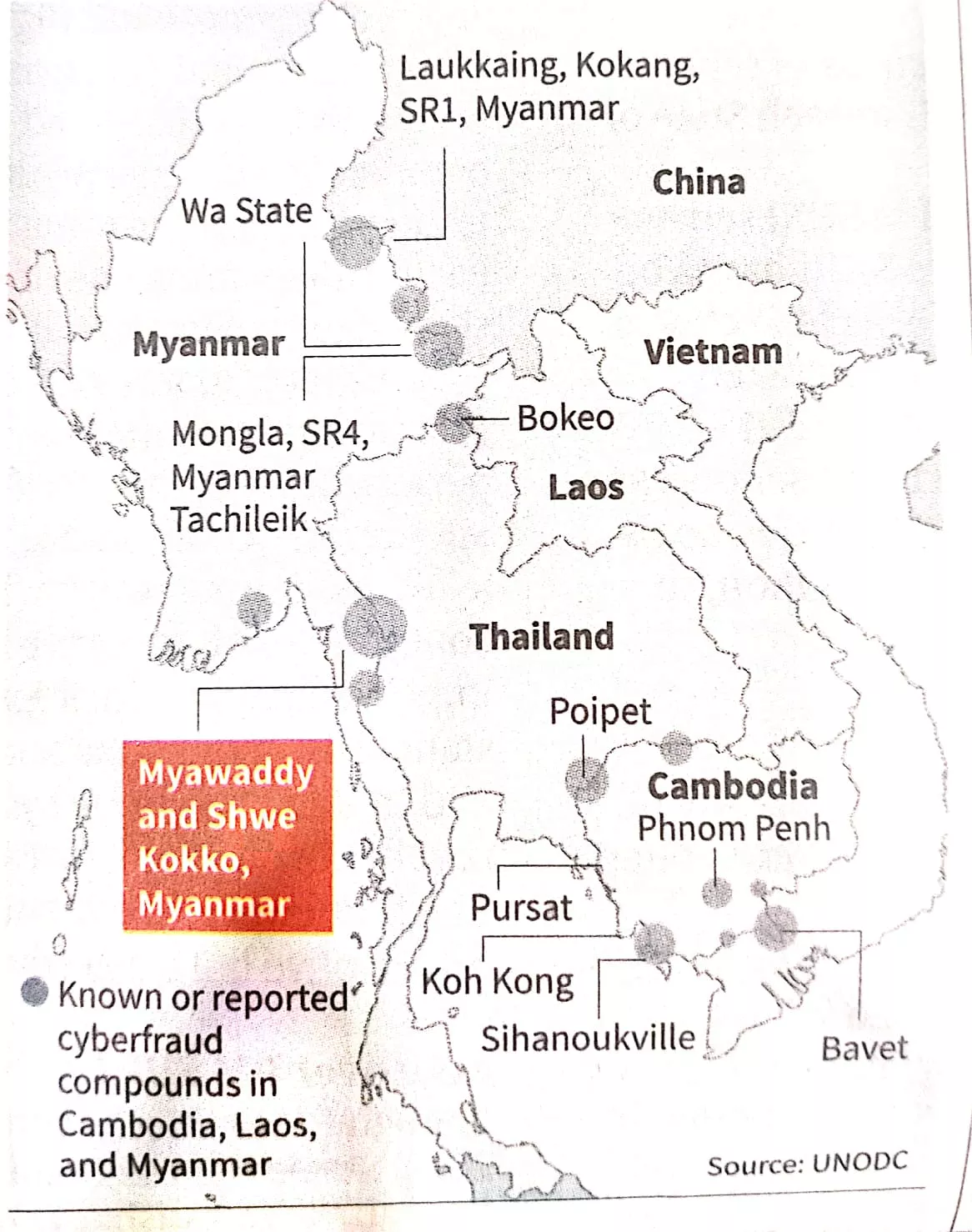
- KK Park is among the most notorious “scam cities” on the Myanmar–Thailand border, located in Karen State’s Myawaddy township.
- It is controlled by the Border Guard Force (BGF), led by warlord Saw Chit Thu, who maintains close links with Myanmar’s junta chief Min Aung Hlaing.
- The S. Treasury sanctioned Saw Chit Thu for forced labour, human trafficking, and criminal operations linked to cybercrime hubs.
Recent Events:
- The junta conducted a supposed “raid” on KK Park, seizing 30 Starlink devices allegedly used for scam operations.
- However, investigative reports suggest the operation was staged to create a positive international image, as senior operatives were forewarned and foreign nationals evacuated before the raid.
- The “raid” coincided with a S. Congressional investigation into the use of Starlink in scam compounds, further exposing the intersection of technology, organized crime, and geopolitics.
The Scam Centre Business Model
According to the Global Initiative against Transnational Organized Crime (GI-TOC), these hubs are “compound crime facilities” — large, fortified complexes functioning like industrial-scale prisons.
Key Features of the Model:
- Victims are lured through fake job advertisements promising IT or marketing roles.
- They are trafficked to Thailand, Myanmar, or Cambodia, their passports confiscated, and told they’ve been “sold” to the compound.
- Forced to work 12-hour shifts, often under threats of torture, electric shocks, starvation, or solitary confinement.
Transnational Organized Crime:
Transnational organised crime (TOC) is the subset of organised crime that crosses national borders — meaning, its planning, execution, or impact involves more than one country.
Definition (as per UNTOC – 2000, Palermo Convention)
“A crime is transnational if it is committed in more than one state; or it is committed in one state but a substantial part of its preparation, planning, direction or control takes place in another state; or it involves an organised criminal group that engages in activities in more than one state; or it has substantial effects in another state.”
So, transnational organised crime = organised criminal activity + cross-border dimension.
Key Characteristics
- Cross-border operation: Smuggling routes, online networks, or money trails move through multiple countries.
- Organised structure: Groups have defined leadership, financing, and coordination systems.
- Use of corruption and violence: They infiltrate legitimate institutions for protection.
- Profit-oriented: Driven by illegal trade, trafficking, or fraud rather than ideology.
- Global networks: Often interlinked with terrorism, cybercrime, and money laundering.
Major Scams Run from These Compounds:
- “Pig Butchering” (Sha Zhu Pan): A combination of romance and investment scams, where victims are emotionally manipulated before being defrauded through fake cryptocurrency platforms.
- Impersonation Frauds: Scammers pose as police officers, bank agents, or government officials.
- Extortion Scams: Victims are blackmailed through personal or financial data leaks.
Scale of the Crisis:
- The UNODC estimates these networks generate billions of dollars annually.
- Victims now span over 110 countries, including India, highlighting the globalized nature of cyber-enabled crime.
Myanmar’s Role in the Crisis
Myanmar’s political instability has made it a safe haven for transnational cybercrime.
Institutional Enablers:
- Since the 2000s, the military has empowered ethnic militias through the Border Guard Force (BGF) scheme, granting them autonomy and arms in exchange for loyalty to the junta.
- Min Aung Hlaing, architect of this system, has rewarded BGF leaders like Saw Chit Thu, turning these zones into lawless enclaves for criminal operations.
- Following the 2021 coup, the junta relied on these illicit economies to finance its war efforts, allowing BGF groups to expand their scam networks
China’s Response:
- Initially, Chinese citizens were the main victims. Public outrage and the 2023 film No More Bets intensified pressure on Beijing.
- China indirectly supported Operation 1027 (2023), an offensive by the Three Brotherhood Alliance aimed at dismantling scam centres in Shan State.
- Myanmar later handed over 41,000 criminal suspects to China, but the crackdown merely pushed operations southward toward the Thai border, expanding the threat to India and other nations.
Other Southeast Asian Scam Hubs
Cambodia has emerged as another major hub, particularly in Sihanoukville, Bavet, and O’Smach, where scam centres operate out of casinos and special economic zones.
- The Huione Group, identified by the UNODC, Bloomberg, and Elliptic, acts as a financial enabler for global scam operations.
- Through its “Huione Guarantee” platform on
Telegram,
the group facilitated:
- Sale of stolen data
- Money laundering
- Torture equipment trade for detaining trafficked workers
- The group’s network received over $91 billion in cryptocurrency in five years.
- Despite S. sanctions in 2025, Huione rebranded, launched its own “USDH” stablecoin, and diversified its criminal ecosystem.
Impact on India
India faces a twofold challenge:
- Source country for trafficking victims.
- Target market for global cyber scams.
Key Data:
- Over 1,600 Indians repatriated from Myanmar since July 2022.
- 283 rescued by the Indian Air Force in March 2025.
- The 500 recent escapees from KK Park are part of this growing pattern.
Official Response:
External
Affairs
Minister S.
Jaishankar acknowledged the concern, stating that the
regional
cyber scam menace has ensnared Indian nationals, turning it
into both a
consular crisis and a national cybersecurity
threat.
Broader Implications
- Human Trafficking: The scam centres combine modern slavery with technological crime.
- Regional Security: These operations undermine state authority, fuel organized crime, and finance armed groups.
- Diplomatic Challenge: Countries like India, China, and Thailand face difficulties in balancing rescue diplomacy, border control, and regional cooperation.
- Digital Governance: The misuse of cryptocurrency, Starlink, and encrypted platforms exposes regulatory gaps in digital financial systems.
Way Forward
For India and the Region:
- Strengthen inter-governmental cooperation through ASEAN and BIMSTEC frameworks.
- Enhance cyber intelligence sharing and blockchain monitoring.
- Crack down on fraudulent recruitment networks targeting Indian youth.
- Support repatriation and rehabilitation of trafficked victims.
- Promote digital literacy and cybersecurity awareness at the grassroots level.
The KK Park episode exposes the dark
intersection
of technology,
organized crime, and human exploitation in Southeast
Asia.
For India,
this is not only a humanitarian concern but also a
national
security imperative.
Addressing it requires
coordinated
diplomacy, cyber governance reforms, and
public
vigilance — ensuring that India’s citizens are
neither
victims nor enablers in the growing web of global
cybercrime.
Prelims Questions:
1. With reference to the “KK Park Cybercrime Hub”, consider the following statements:
- KK Park is located along the Myanmar–Thailand border in Karen State and is controlled by the Border Guard Force (BGF).
- The BGF is directly under Myanmar’s Ministry of Home Affairs and not linked to the military junta.
- The U.S. Treasury has imposed sanctions on BGF leaders for their involvement in forced labour and human trafficking.
Which of the statements given above are correct?
2. “Pig Butchering”, often seen in news, refers to:
- Illegal trade of livestock in conflict regions
- A cyber scam model combining romance and investment frauds
- A cryptocurrency mining practice in the dark web
- A data harvesting technique used by ransomware networks
3. Consider the following regarding the Border Guard Force (BGF) of Myanmar:
- It was formed by incorporating ethnic militias under the Myanmar military structure.
- It receives autonomy and arms in exchange for loyalty to the junta.
- It operates under direct control of ASEAN’s regional peacekeeping framework.
Which of the above statements are correct?
4. Consider the following pairs:
| Initiative / Operation | Associated Country / Organisation |
|---|---|
| Operation 1027 | Myanmar |
| USDH Stablecoin | Huione Group |
| “No More Bets” | China |
| KK Park Cyber Hub | Cambodia |