Snow Leopard Census 2024: Comprehensive UPSC Notes
The Snow Leopard Population Assessment in India (SPAI) Program is India’s first scientific and nationwide estimation of its snow leopard population. Conducted between 2019 and 2023, this landmark study plays a crucial role in understanding the current status of snow leopards, their habitat, and conservation challenges. The findings provide a scientific foundation for long-term conservation strategies, highlighting the need for consistent monitoring, community involvement, and habitat protection.
Introduction
- Event: Release of Snow Leopard Census 2024 Report
- Date: January 30, 2024
- Occasion: National Board for Wildlife meeting, New Delhi
- Released By: Bhupender Yadav, Union Minister of Environment, Forest, and Climate Change (MoEFCC), Government of India
- Coordinators: Wildlife Institute of India (WII) as the National
Coordinator, supported by:
- Nature Conservation Foundation (NCF), Mysuru
- WWF-India
Objectives of the SPAI Program:
- Population Estimation: Conduct India’s first comprehensive and scientific estimation of snow leopard populations.
- Habitat Assessment: Map the spatial distribution of snow leopards using systematic methods across their range.
- Conservation Strategy: Provide scientific data to support conservation efforts, address threats, and guide policy decisions.
- Long-Term Monitoring: Establish a baseline for future population assessments and conservation planning.
Key Highlights of the Census
- Total Snow Leopard Population in India:718 individuals
- Geographic Coverage:120,000 km² across
India's trans-Himalayan region,
including:
- Union Territories: Ladakh, Jammu & Kashmir
- States: Himachal Pradesh, Uttarakhand, Sikkim, Arunachal Pradesh
- Spatial Distribution:
- Occupancy recorded in 93,392 km²
- Estimated presence in 100,841 km²
- First Scientific Assessment: This is the first large-scale scientific assessment covering more than 70% of the potential snow leopard range.
Methodology and Data Collection
The SPAI program used a meticulous, two-step framework for population estimation:
Step 1: Spatial Distribution Assessment
- Objective: Identify the spatial distribution of snow leopards using occupancy-based sampling methods.
- Approach:
- Surveys were conducted across snow leopard habitats using standardized protocols.
- Habitat covariates, such as elevation, terrain, vegetation, and prey availability, were integrated into the analysis.
- This step aligned with the guidelines from MoEFCC’s 2019 National Population Assessment of Snow Leopards.
Step 2: Population Estimation Using Camera Traps
- Objective: Estimate the abundance of snow leopards using camera traps deployed in stratified regions.
- Field Efforts:
- 13,450 km of trails were surveyed to record snow leopard signs (pugmarks, scat, and scratch marks).
- 1,971 camera trap locations were strategically selected across snow leopard habitats.
- Cameras operated for a total of 180,000 trap nights, capturing photographic evidence of snow leopards.
- 241 unique snow leopards were photographed, providing a robust dataset for population estimation.
State-wise Snow Leopard Population Estimates
| Region | Population |
|---|---|
| Ladakh (UT) | 477 (Largest population) |
| Uttarakhand | 124 |
| Himachal Pradesh | 51 |
| Arunachal Pradesh | 36 |
| Sikkim | 21 |
| Jammu and Kashmir (UT) | 9 |
| Total | 718 |
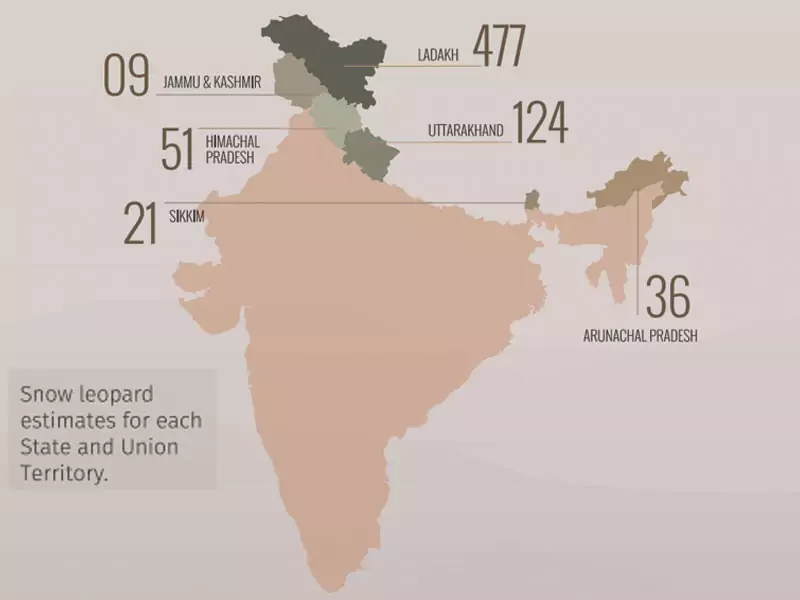
- Ladakh accounts for the highest number of snow leopards, owing to its vast and rugged terrain.
- Uttarakhand has the second-highest population, followed by Himachal Pradesh and Arunachal Pradesh.
Historical Context and Evolution of Snow Leopard Research
- Pre-2016: Limited research, covering only 5% of the potential snow leopard range (approx. 100,347 km²).
- 2016-2023: Scientific surveys expanded coverage to 79,745 km², accounting for 80% of the potential range.
- SPAI Program: The current assessment covers more than 70% of the snow leopard range, marking a significant leap in scientific knowledge.
Significance of the SPAI Program
- Scientific Benchmark: First comprehensive, scientific assessment of snow leopard populations in India.
- Global Conservation Impact: Contributes to global efforts to conserve this vulnerable species, listed as Vulnerable on the IUCN Red List.
- Policy Implications: Provides essential data for formulating conservation policies at national and regional levels.
- Baseline for Monitoring: Establishes a scientific baseline for long-term monitoring and future population assessments.
Challenges Identified
- Habitat Loss: Infrastructure development, urbanization, and climate change are shrinking snow leopard habitats.
- Human-Wildlife Conflict: Increasing conflicts with local communities due to livestock predation, leading to retaliatory killings.
- Poaching and Illegal Wildlife Trade: Demand for snow leopard fur, bones, and body parts poses a persistent threat.
- Climate Change: Rising temperatures and changing precipitation patterns impact prey availability and habitat suitability.
- Data Deficiency: Despite recent progress, certain remote areas remain under-researched, requiring more comprehensive surveys.
Conservation Recommendations
- Establishment of a Dedicated Snow Leopard Cell
- Proposed at WII under MoEFCC to focus on:
- Long-term population monitoring
- Structured study designs and consistent field surveys
- Coordinating with states and UTs for effective conservation
- Proposed at WII under MoEFCC to focus on:
- Periodic Population Estimation
- States and UTs should conduct population estimations every 4 years to monitor trends, address emerging threats, and guide conservation efforts.
- Enhancing Habitat Connectivity
- Strengthening wildlife corridors to ensure genetic diversity and prevent habitat fragmentation.
- Human-Wildlife Conflict Mitigation
- Reducing conflicts through community involvement, compensation schemes, and awareness programs.
- Promoting sustainable livestock management to minimize predation.
- Strengthening Anti-Poaching Measures
- Enhancing law enforcement, using advanced surveillance technology, and increasing patrolling in vulnerable areas.
- Community Involvement and Eco-Tourism
- Promoting eco-tourism as a sustainable livelihood option, encouraging local communities to support conservation.
- Ensuring that eco-tourism activities are regulated to minimize environmental impact.
- Climate Resilience and Habitat Restoration
- Developing climate-resilient conservation strategies to mitigate the impact of climate change.
- Restoring degraded habitats to support prey populations and maintain ecosystem balance.
Conservation Policies and Legal Framework
- Wildlife Protection Act, 1972: Provides legal protection to snow leopards and their habitats.
- National Wildlife Action Plan (2017-2031): Focuses on climate-resilient conservation and community involvement.
- Project Snow Leopard (2009): Launched by MoEFCC to protect snow leopards and their habitats, emphasizing community participation.
- International Collaboration: India is a member of the Global Snow Leopard and Ecosystem Protection Program (GSLEP), promoting transboundary conservation.
Future Directions and Sustainable Conservation
Short-Term Goals (Next 5 Years)
- Establish the Snow Leopard Cell at WII for coordinated conservation efforts.
- Conduct population assessments every 4 years to monitor trends.
- Enhance surveillance and anti-poaching measures using advanced technology.
Long-Term Goals (Next 10-20 Years)
- Ensure habitat connectivity across all snow leopard regions.
- Strengthen community involvement, promoting eco-tourism and reducing human-wildlife conflict.
- Build climate-resilient ecosystems to mitigate the effects of climate change.
The Snow Leopard Census 2024 represents a major milestone in India’s wildlife conservation journey. By scientifically estimating the population and assessing habitat conditions, the SPAI program has laid the foundation for long-term conservation. Moving forward, establishing the Snow Leopard Cell, conducting regular population assessments, and involving local communities are essential for ensuring the survival of this iconic species. With coordinated efforts from government agencies, conservation organizations, and local communities, India aims to sustain its snow leopard population, contributing to global biodiversity conservation.
(All information is based on the official SPAI Report 2024 and verified documents from MoEFCC, WII, WWF-India, and NCF.)