
Rupee Internationalization & BRICS Currency Talks
Global economic dynamics are shifting, with countries seeking to reduce dependence on the US dollar (USD) for international trade. This trend, known as de-dollarization, has gained momentum, particularly among the BRICS nations (Brazil, Russia, India, China, and South Africa). In this context, India is advancing the internationalization of the Indian Rupee (INR) while cautiously approaching BRICS discussions on a common currency.
This analysis explores:
- The process, benefits, and challenges of rupee internationalization.
- The BRICS currency talks, India’s stance, and potential impacts on its economy and global position.
- The way forward for India to maximize opportunities while mitigating risks.
Rupee Internationalization
- Concept and Background
Rupee internationalization refers to increasing the use of the INR in global trade, investments, and financial transactions. Traditionally, international trade is settled in USD, but geopolitical developments—such as US sanctions on Russia—have prompted countries to explore alternatives.
In July 2022, the Reserve Bank of India (RBI) issued a circular allowing invoicing and settlement of exports/imports in INR, marking a significant step toward internationalizing the rupee.
- Key Developments and Mechanisms
- Special Rupee Vostro Accounts (SRVAs):
- Foreign banks can hold SRVAs with Indian banks to settle trade in INR.
- For example, Russian banks use SRVAs to bypass SWIFT restrictions imposed due to Western sanctions.
- Operational Process:
- Imports: Indian importers pay in INR, which is credited to the foreign bank’s SRVA.
- Exports: Indian exporters receive INR payments from the foreign bank’s SRVA.
- Investment of Surplus Funds:
- Foreign banks can invest surplus INR balances in Indian government securities (G-Secs), ensuring better returns compared to holding idle funds.
- Special Rupee Vostro Accounts (SRVAs):
- Benefits of Rupee Internationalization
- Reduced USD Dependency:
- Lower reliance on USD minimizes exposure to exchange rate volatility and US monetary policy shifts.
- Improved Trade Resilience:
- Enables trade with countries facing US sanctions (e.g., Russia, Iran) and mitigates supply chain disruptions.
- Foreign Exchange Reserve Stability:
- Reduces the need to hold large USD reserves, conserving India’s forex reserves (currently around $644.39 billion).
- Lower Transaction Costs:
- Eliminates costs related to currency conversion and hedging, especially benefiting small and medium-sized enterprises (SMEs).
- Enhanced Global Standing:
- A widely used INR increases India’s influence in global trade and financial governance.
- Reduced USD Dependency:
- Challenges of Rupee Internationalization
- Limited Global Acceptance:
- INR is not yet freely convertible, limiting its use in international trade.
- Liquidity and Demand Issues:
- Maintaining liquidity in SRVAs is challenging if India imports more than it exports, leading to excess INR balances
- Regulatory Compliance:
- Trade settlements must comply with Foreign Exchange Management Act (FEMA), UCP 600, and ISBP guidelines, increasing bureaucratic complexities.
- Geopolitical Risks:
- Using INR to bypass USD sanctions could lead to diplomatic friction with the US and Western allies.
- Currency Stability:
- A volatile INR could deter foreign trade partners from accepting it as a settlement currency.
- Limited Global Acceptance:
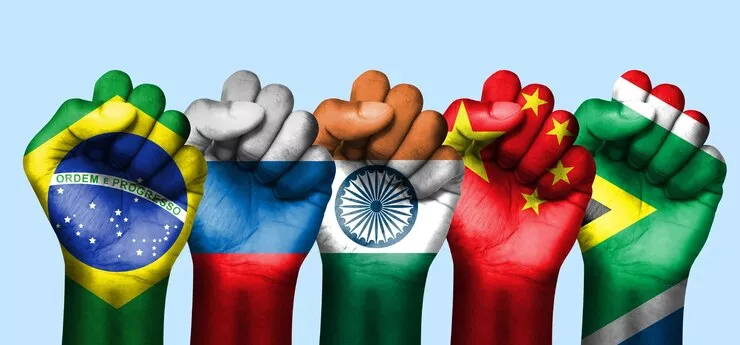
BRICS Currency Talks
- Background and Objectives
- BRICS nations are exploring alternatives to the USD to promote intra-BRICS trade, reduce dependency on Western financial systems, and strengthen their collective economic influence.
- Russia and China are leading the push for a common currency, particularly after US sanctions isolated Russia from the global financial system.
- India’s Position on BRICS Currency and De-Dollarization
- Cautious Approach:
- India supports trade in local currencies but does not aim to replace the USD.
- External Affairs Minister Jaishankar clarified that India has no policy aimed at de-dollarization.
- Balancing Relations:
- India seeks to maintain strong ties with both BRICS nations and the US, avoiding policies that could jeopardize trade relations with Western countries.
- Concerns Over Chinese Dominance:
- India is wary of the yuan’s growing influence within BRICS, given China’s economic size and geopolitical ambitions.
- India has avoided using the yuan for oil imports from Russia, preferring INR-based settlements.
- No Formal Commitment:
- India has distanced itself from proposals for a common BRICS currency, citing differences in monetary policies and economic structures.
- Cautious Approach:
- Potential Benefits of a BRICS Common Currency
- Reduced USD Dependency:
- A BRICS currency would shield member countries from USD fluctuations and reduce exposure to US sanctions.
- Lower Transaction Costs:
- Eliminating currency conversion fees would benefit SMEs and exporters, boosting intra-BRICS trade.
- Enhanced Economic Integration:
- A common currency would strengthen BRICS cooperation and increase the group’s global influence.
- More Efficient Cross-Border Payments:
- A blockchain-based BRICS currency could enable real-time transactions, reducing delays and improving financial transparency.
- Reduced USD Dependency:
- Challenges for India in Adopting a BRICS Currency
- Loss of Monetary Sovereignty:
- A shared currency would limit the Reserve Bank of India’s (RBI) ability to control inflation and interest rates.
- Divergent Economic Conditions:
- BRICS members have varying inflation rates, fiscal deficits, and economic structures, complicating currency management.
- Chinese Economic Dominance:
- China’s economy is five times larger than India’s, raising concerns that a BRICS currency could disproportionately benefit China.
- Geopolitical Risks:
- Border disputes with China and Russia’s sanctions pose risks to long-term BRICS cooperation.
- Lack of Institutional Framework:
- Unlike the European Union (EU), BRICS lacks common institutions to ensure fiscal discipline and manage currency imbalances.
- Loss of Monetary Sovereignty: