
Rise in Milkweed Fiber Use
The rise in the use of milkweed fiber reflects the global shift toward sustainable and eco-friendly materials across various industries. With its unique properties, lightweight nature, and renewable characteristics, milkweed fiber has gained significant attention. In India, the Ministry of Textiles is promoting research and development into this innovative natural fiber as part of its broader sustainability and traceability initiatives. This comprehensive note explores milkweed fiber's origin, properties, applications, benefits, challenges, government initiatives, and future prospects in detail.
Introduction
- Topic: Rise in Milkweed Fiber Use
- Context:
- The Ministry of Textiles is encouraging research and development into natural fibers like milkweed fiber to promote sustainability and innovation in the textile industry.
- This initiative aligns with the government's broader goals of sustainability, environmental protection, and traceability in material sourcing.
- Scientific Name:Asclepias syriaca L.
- Family: Asclepiadaceae
- Common Name: Stubborn weed
- Native Region: North America
- Presence in India: Naturally found in the wild in Rajasthan, Karnataka, and Tamil Nadu.
- Current Trend:
Increasing demand for biodegradable and renewable materials has driven the exploration of milkweed fiber as a sustainable alternative in industries such as textiles, oil spill cleanup, filtration, and water-safety equipment.
Origin and Botanical Description
- Plant Description:
- Milkweed is a perennial herbaceous plant with milky latex sap in its leaves, stems, and seed pods.
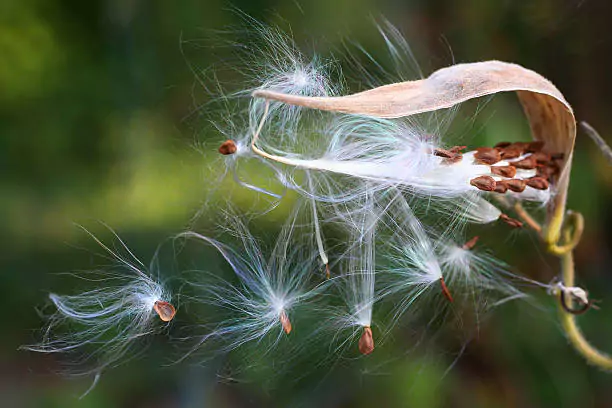
- The fiber is extracted from the seed pods of the plant, which naturally release seeds with silky fibers attached, aiding in wind dispersal.
- Global Distribution:
- Native to North America, particularly in the United States and Canada.
- Found as a wild plant in parts of India, specifically in Rajasthan, Karnataka, and Tamil Nadu.
- Ecological Significance:
- Milkweed plays a vital ecological role, serving as a primary host plant for monarch butterflies (Danaus plexippus), supporting biodiversity and pollinator conservation.
Characteristics and Properties of Milkweed Fiber
Milkweed fiber possesses a combination of physical and chemical properties that make it suitable for various applications:
-
Physical Properties
-
Oily Material and Lignin Content:
- The fiber contains oily substances and lignin, a woody plant polymer that contributes to its rigidity but also makes it brittle and difficult to spin.
- Lightweight and Soft:
- The fiber is extremely lightweight and soft, making it ideal for applications requiring buoyancy and comfort.
-
Biodegradable and Renewable:
- Milkweed fiber is biodegradable and sourced from a renewable plant, aligning with sustainable and eco-friendly manufacturing practices.
-
Oily Material and Lignin Content:
-
Chemical Properties
-
Amphiphilic Nature:
- The fiber exhibits amphiphilic properties, meaning it can both absorb water (hydrophilic) and repel water (hydrophobic) depending on the conditions.
- Hydrophobic-Oleophobic Surface:
- The natural waxes on the fiber’s surface make it hydrophobic (water-repelling) and oleophobic (oil-repelling), allowing it to absorb oil while repelling water.
-
Amphiphilic Nature:
Applications of Milkweed Fiber
Milkweed fiber's unique properties have made it suitable for various industrial and commercial applications, particularly in sustainability-focused sectors:
-
Water-Safety Equipment
- Used as an insulating filling material in life jackets, belts, and other flotation devices due to its lightweight and buoyant properties.
-
Filtration Systems
- The fine fiber structure allows it to trap particles effectively, making it suitable for air and water filtration systems.
-
Oil Spill Cleanup
- Due to its hydrophobic and oleophobic properties, milkweed fiber can absorb oil while repelling water, making it highly effective for cleaning up oil spills.
-
Paper Industry
- Used as a raw material in paper production, contributing to eco-friendly and sustainable manufacturing practices.
-
Potential Use in Textiles
- Although its brittleness currently limits its use in traditional spinning processes, ongoing research aims to develop methods to make milkweed fiber suitable for textile production.
Advantages of Using Milkweed Fiber
- Being biodegradable and renewable, milkweed fiber reduces environmental impact compared to synthetic materials.
- Its lightweight nature and buoyancy make it ideal for water-safety equipment such as life jackets and belts.
- Effective in cleaning up oil spills due to its ability to absorb oil while repelling water.
- Applicable in industries such as textiles, filtration, paper production, and environmental protection.
- Aligns with the Indian government's focus on promoting sustainable and traceable natural fibers.
Challenges and Limitations
- The presence of lignin makes milkweed fiber brittle and difficult to spin using traditional methods, limiting its use in textiles.
- Large-scale commercial production of milkweed fiber is still in its early stages, affecting its availability and affordability.
- Extracting fiber from seed pods and removing the oily material requires advanced processing techniques.
- Awareness and acceptance of milkweed fiber as an alternative to conventional fibers are still limited.
Government Initiatives and Policies
- Ministry of Textiles
- Actively promoting research and development into milkweed fiber as part of its sustainability and traceability initiatives.
- National Textile Policy 2020
- Emphasizes sustainable and eco-friendly textile production, encouraging the use of renewable natural fibers.
- Research and Development Support
- Government funding and collaborations with institutions like ICAR aim to improve the properties and commercial viability of milkweed fiber.
- Sustainability and Traceability Goals
- Aligns with India’s commitment to sustainability in the textile industry, reducing reliance on synthetic fibers, and promoting biodegradable alternatives.