Representation of Women in Loksabha
Syllabus Areas:
GS I - Society
GS II - Polity and Governance
A new book titled "Missing from the House: Muslim Women in the Lok Sabha" by Rasheed Kidwai and Amber Kumar Ghosh is set to release. The book explores the underrepresentation of Muslim women in India's Parliament.
Key Findings from the Book:
- Since Independence, only 18 Muslim women have been elected to the Lok Sabha.
- 13 of these women came from royal families.
- According to the authors, although Muslim women constitute around 1% of the Indian population, their parliamentary representation remains negligible.
- The only Muslim woman MP in the current Lok Sabha is Iqra Hasan from Uttar Pradesh, representing the Samajwadi Party.
Regional Representation Gaps:
- So far, no Muslim woman has ever been elected to the Lok Sabha from
the southern
states of:
- Telangana
- Andhra Pradesh
- Kerala
- Tamil Nadu
- Karnataka
This data reflects a systemic underrepresentation of Muslim women in Indian politics, especially in Parliament. The authors underscore the intersection of gender, religion, and power structures, where even regions with significant Muslim populations (like South India) have never sent a Muslim woman to the Lok Sabha.
Overall Women Representation in Lok Sabha:
Women’s representation in the Lok Sabha is a key indicator of gender equality in political participation. Despite being nearly 50% of India’s population, women have been historically underrepresented in the highest law-making body of the country.
Current Status (as of 18th Lok Sabha, 2024)
- Total seats in Lok Sabha: 543
- Women elected in 2024: 74 women MPs
- Percentage: 6% of the total seats
- Comparison with 2019: In the 17th Lok Sabha (2019), 78 women MPs were elected (14.3%) — highest ever till then.
- India’s global ranking in women’s parliamentary representation fell to around 143rd‑150th, well below the global average (~27%)
Historical Trends
| Lok Sabha | Year | Women MPs | % of Total |
|---|---|---|---|
| 1st | 1952 | 22 | 4.4% |
| 8th | 1984 | 44 | 8.1% |
| 15th | 2009 | 59 | 10.9% |
| 17th | 2019 | 78 | 14.3% |
| 18th | 2024 | 74 | 13.6% |
Article 330: Reservation of seats for SCs and STs in Lok Sabha.
- SC Participation: Out of 84 SC‑reserved seats, only 11 were won by women → ~13.1% women representation on SC seats
- ST Participation: Out of 47 ST‑reserved seats, just 6 were won by women → ~12.8% women representation on ST seats
Trend Over the Years
| Lok Sabha | SC Women MPs | ST Women MPs | Total SC/ST Women |
|---|---|---|---|
| 15th (2009) | 9 | 4 | 13 |
| 17th (2019) | 13 | 4 | 17 |
| 18th (2024) | 12 | 5 | 17 |
- Passed by both Houses of Parliament in 2023.
- Reserves 33% seats for women in Lok Sabha and State Assemblies.
- To be implemented after delimitation and census, likely post-2029.
Comparative International Perspective
| Country | Women MPs % |
|---|---|
| Rwanda | 61% |
| Sweden | 46% |
| South Africa | 45% |
| Bangladesh | 21% |
| India | 13.6% |
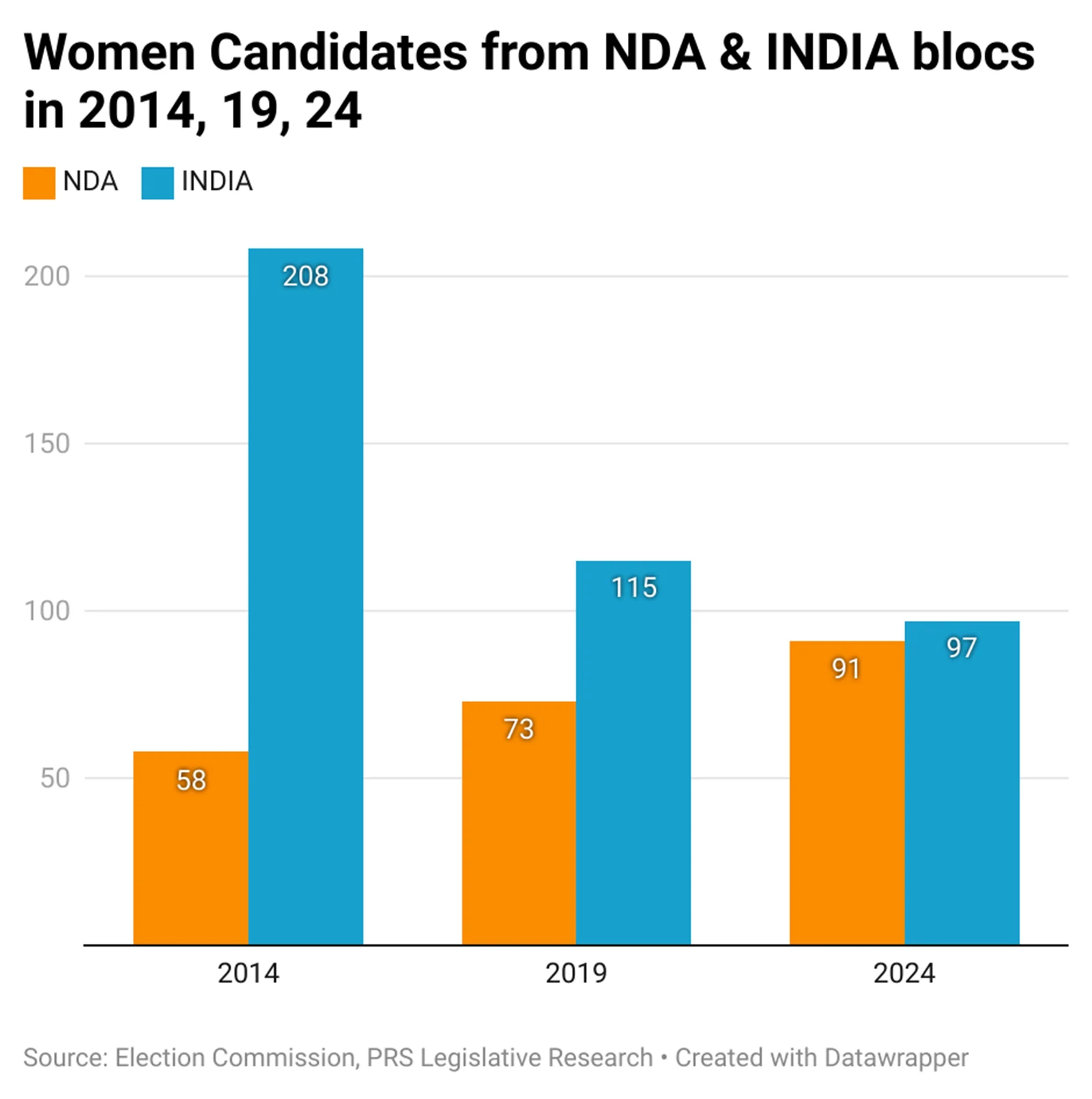
India ranks low globally in terms of female political representation in Parliament.
Reasons for Low Representation of Women in Loksabha:
- Patriarchal Political Structure: Political parties remain male-dominated; women are rarely seen as “winnable” candidates.
- No Legal Mandate (until recently): Until the 106th Constitutional Amendment (2023), there was no legal provision for women’s reservation in Parliament.
- Tokenism in Ticket Distribution: Women are often fielded in unwinnable constituencies or to maintain party image.
- Social & Cultural Barriers: Deep-rooted gender bias, domestic responsibilities, and safety concerns discourage women from public life.
- Economic Constraints: Politics requires financial resources; many women lack independent economic power or backing.
- Lack of Political Grooming: Few opportunities for leadership development, especially for rural and marginalized women.
Measures to Improve Representation
- Implement Women’s Reservation Bill (33%): Fast-track the 106th Amendment Act, including timely delimitation and census.
- Political Party Reforms: Mandate internal gender quotas in ticket distribution and leadership roles.
- Capacity Building & Training: Offer mentorship, political training, and funding support to aspiring women leaders.
- Media & Civil Society Campaigns: Create awareness and normalize women in leadership through storytelling and role models.
- Electoral Finance Reform: Enable state funding or subsidized campaigning for female candidates.
Prelims Questions:
- Who among the following women later became India’s first woman
Chief
Minister after serving as a Member of the 1st Lok Sabha?
- Aruna Asaf Ali
- Sucheta Kripalani
- Renuka Ray
- Durgabai Deshmukh
- Who among the following was known for her contribution in the drafting of the
Hindu Code
Bill and was also a Member of the 1st Lok Sabha?
- Vijayalakshmi Pandit
- Renuka Ray
- Sarojini Naidu
- Kamaladevi Chattopadhyay
Answer: B) Sucheta Kripalani
She became Chief Minister of Uttar Pradesh in 1963.
Answer: B) Renuka Ray
She was a strong advocate for women's rights and involved in legal reforms.
Mains Question:
Q."Despite constituting nearly half the population, women's representation in the Lok Sabha remains low. Examine the structural challenges and suggest viable reforms."