Quad & Indo-Pacific Strategy: India’s Role and Strategic Alignment
Overview of the Quad
- Formation: Formalized in 2007 by then Japanese PM Shinzo Abe.
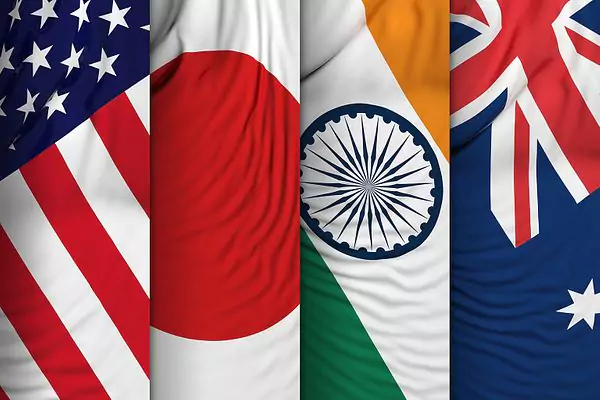
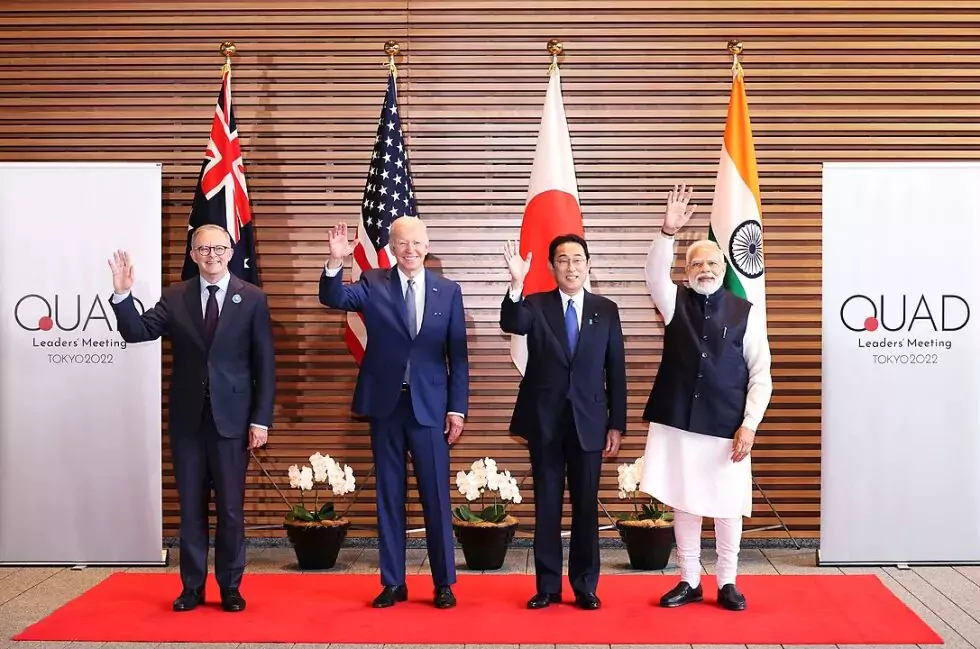
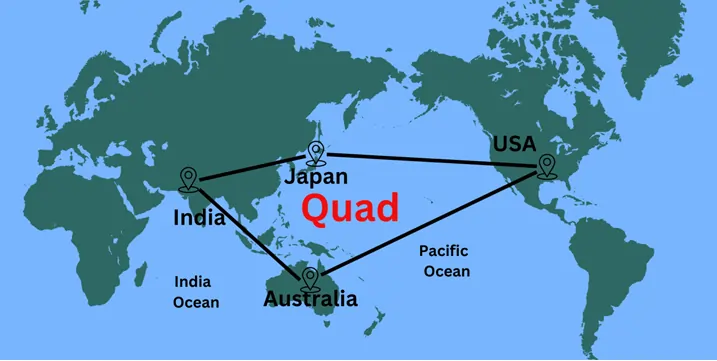
- Members: Australia, India, Japan, and the United States.
- Nature: An informal strategic partnership and an alliance of maritime democracies.
- Purpose: Supports an open, stable, and inclusive Indo-Pacific. Acts as a force for global good, delivering positive and lasting impact.
- Vision: Launched the Vision Statement in 2023, centered around the theme 'Enduring Partners for the Indo-Pacific'.
- Working Groups: Six Leader-level Working Groups in areas like Climate, Critical and Emerging Technologies, Cyber, Health Security, Infrastructure, and Space.
- Global Footprint: Represents 24% of the world’s population, 35% of global GDP, and 18% of global trade.
Changing Dynamics of the Quad: From Military to Economic Alliance
The Quadrilateral Security Dialogue (Quad), composed of the United States, India, Japan, and Australia, has undergone a significant transformation since its inception. Initially conceived as a military alliance aimed at maritime security and defense cooperation, the Quad has evolved into a broader economic and strategic partnership focusing on sustainable development, technological innovation, and regional stability. This shift reflects the changing geopolitical landscape, particularly in the Indo-Pacific region, and the Quad’s efforts to counterbalance China's growing influence through economic and technological collaboration.
A. From Military to Economic Alliance
- Initial Phase: Military Focus
During its early years, the Quad's primary emphasis was on military cooperation, particularly in maritime security. This period saw the strengthening of defense ties through joint exercises, diplomatic engagements, and security-related legislation.
Key Military Initiatives:
- Malabar Exercises
- An annual trilateral naval exercise originally between India and the U.S., later expanded to include Japan (2015) and Australia (2020).
- Aimed at enhancing naval interoperability, anti-submarine warfare, and freedom of navigation in the Indo-Pacific.
- 2+2 Ministerial Dialogue
- A high-level diplomatic engagement that brings together foreign and defense ministers of India and the U.S.
- Strengthens security cooperation, intelligence-sharing, and strategic alignment on regional challenges.
- Japan and Australia also hold similar 2+2 dialogues with the U.S. and India.
- Strengthening the Quad Act (2024)
- A U.S. legislative initiative designed to institutionalize Quad cooperation.
- Established an Intra-Parliamentary Working Group to enhance policy alignment among member nations.
- Encouraged defense technology sharing and increased military interoperability.
- Malabar Exercises
These initiatives reinforced the Quad’s initial security-oriented framework, positioning it as a counterweight to China's maritime assertiveness in the South China Sea and Indo-Pacific.
Recent Phase: Economic Expansion
Post-COVID-19, the Quad has broadened its agenda beyond security, focusing on economic resilience, technology cooperation, infrastructure development, and climate action. This transition was driven by the need for diversified supply chains, digital connectivity, and sustainable growth.
Key Economic & Strategic Initiatives:
- Wilmington Declaration (2024)
- A landmark agreement shifting the Quad’s focus toward economic security, health resilience, and sustainable infrastructure.
- Emphasized supply chain diversification, investment in regional connectivity, and technological cooperation.
- Health Security & Supply Chain Resilience
- Quad Cancer Moonshot Initiative: A collaborative effort to combat cervical cancer through vaccine access and early detection programs.
- Strengthened pharmaceutical and medical supply chains to prevent future pandemic disruptions.
- Indo-Pacific Logistics Network
- A framework enhancing disaster response capabilities through shared airlift, logistics, and supply chain coordination.
- Supports humanitarian assistance and disaster relief (HADR) operations in the Indo-Pacific.
- Quad Ports of the Future
- An initiative promoting resilient and sustainable port infrastructure.
- Focuses on smart port technologies, decarbonization, and reducing supply chain bottlenecks.
- Critical & Emerging Technologies (CET) Collaboration
- Open RAN Deployment: Encourages secure and interoperable 5G networks to reduce dependence on Chinese telecommunications.
- Quad Investors Network (QUIN): A private-public initiative to fund emerging technologies, AI, and quantum computing.
- Clean Energy & Climate Cooperation
- Quad Climate Change Adaptation and Mitigation Package (Q-CHAMP, 2022): Supports regional clean energy projects and sustainable infrastructure.
- Accelerates the adoption of renewable energy sources, particularly in the Indo-Pacific.
- Strengthens secure clean energy supply chains for rare earth elements and lithium-ion batteries.
- Cybersecurity & Digital Infrastructure
- Undersea Telecommunications Cable Protection Action Plan: Ensures the security of global internet infrastructure from cyber threats.
- Promotes secure digital ecosystems and cyber resilience among member states.
- Space Collaboration
- Enhances Earth Observation (EO) data-sharing for climate change mitigation and disaster response.
- Develops satellite-based early warning systems for extreme weather events.
- Counterterrorism & Security Expansion
- Counter Terrorism Working Group (CTWG, 2023): A security
initiative focusing on threats like:
- Counter-Unmanned Aerial Systems (C-UAS) to mitigate drone-based threats.
- Chemical, Biological, Radiological, and Nuclear (CBRN) security to prevent potential attacks.
- Counter Terrorism Working Group (CTWG, 2023): A security
initiative focusing on threats like:
Challenges Faced by the Quad
Despite its growing influence in the Indo-Pacific, the Quad faces significant challenges that hinder its effectiveness as a strategic alliance. These challenges stem from its lack of institutional structure, disparities in burden-sharing, conflicting geopolitical interests, and diverging approaches to China. Additionally, India’s unique geopolitical concerns add complexity to the Quad’s decision-making process.
- Lack of Institutional Framework
One of the most significant challenges facing the Quad is its informal nature. Unlike NATO or the European Union, the Quad lacks a permanent secretariat, charter, or decision-making mechanism.
Implications:
- Limited Crisis Response: Without a formalized structure, the Quad struggles to coordinate decisive actions during crises, such as military conflicts or global emergencies.
- Inconsistency in Engagements: The absence of institutional mechanisms means that policy commitments vary depending on the political leadership in each member country.
- Difficulty in Expanding Scope: While the Quad has broadened its focus from military cooperation to economic initiatives, its informal nature makes it harder to implement long-term projects efficiently.
- Unequal Burden-Sharing
Quad members differ in their economic capacities, military strength, and strategic priorities, creating imbalances in contributions to the alliance.
Key Issues:
- Financial Disparities: The U.S. bears most of the financial burden for defense and technological initiatives, while India, Japan, and Australia have more limited resources.
- Military Capabilities: The U.S. maintains a global military presence, whereas India and Australia primarily focus on regional security. Japan’s pacifist constitution also limits its direct military engagement.
- Strategic Divergences: While the U.S. prioritizes countering China's influence, India emphasizes strategic autonomy, preferring issue-based partnerships over deep military commitments.
Impact on Quad's Effectiveness:
- Burden-sharing inequalities slow down decision-making and resource allocation.
- Some members, particularly Australia and Japan, are more vulnerable to economic pressure from China.
- Conflicting Partnerships
Each Quad member maintains diplomatic and economic relationships that sometimes contradict the group’s objectives, making unified action difficult.
India’s Strategic Dilemma:
- India has strong ties with Russia, which remains a major defense supplier despite Western sanctions.
- India is a member of the Shanghai Cooperation Organization (SCO), which includes China and Russia—both seen as strategic rivals by other Quad members.
Australia’s Economic Dependence on China:
- Trade Dependence: China is Australia’s largest trading partner, particularly for iron ore and other raw materials.
- Economic Coercion: Beijing has used trade restrictions against Australia, such as tariffs on wine and barley, to pressure Canberra’s foreign policy decisions.
Japan and the U.S.: Tensions with Non-Quad Partners
- Japan and the U.S. have military alliances outside the Quad, such as the AUKUS agreement (Australia, UK, U.S.), which does not include India or Japan.
- Japan has strong economic ties with China but remains wary of its military expansion.
Consequences:
- The Quad struggles to form a unified response to Chinese economic influence.
- Conflicting diplomatic ties make it difficult for the alliance to present a cohesive front in global forums.
- Diverging Strategies on China
Although all Quad members recognize China’s assertiveness as a strategic concern, they differ in their responses due to economic and security considerations.
Key Differences:
- Japan and Australia: Rely on China for trade while simultaneously opposing its military expansion in the South China Sea and Indo-Pacific.
- India: Has a direct military rivalry with China due to border disputes but continues economic engagement, making its position more complex.
- United States: Views China as its primary global competitor and has adopted an increasingly confrontational approach.
Challenges for the Quad:
- Different levels of economic reliance on China create hesitation in implementing strong measures like trade restrictions.
- India’s focus on land-based threats (border tensions with China and Pakistan) contrasts with the maritime emphasis of other Quad members.
- Perception as an "Asian NATO"
The Quad is frequently viewed as a security alliance aimed at containing China, drawing comparisons to NATO. While the Quad officially denies being a military bloc, this perception persists.
Implications:
- China’s Narrative: Beijing portrays the Quad as an anti-China alliance, using this rhetoric to justify its own military expansion.
- Southeast Asian Skepticism: ASEAN nations, particularly Indonesia and Malaysia, worry that the Quad could destabilize the region by provoking great-power competition.
- Lack of Expansion: Countries that might benefit from Quad initiatives, such as South Korea or Vietnam, hesitate to join due to concerns about being seen as taking sides in U.S.-China tensions.
Impact on Quad’s Influence:
- Limits diplomatic outreach and partnerships in the Indo-Pacific.
- Makes it harder for the Quad to balance security and economic cooperation without escalating tensions.
- India’s Specific Concerns
- Geopolitical Strains
- Strengthening ties with the Quad could strain India’s relationships with key partners like Iran (which is hostile toward the U.S.) and Myanmar (which is closely aligned with China).
- India must carefully balance its multi-alignment strategy to avoid alienating important regional allies.
- Different Indo-Pacific Visions
- India prioritizes the Indian Ocean, as it faces direct security challenges from China’s presence near Sri Lanka and the Maldives.
- Other Quad members focus more on the Pacific, particularly in countering Chinese influence around Taiwan and the South China Sea.
- Geopolitical Strains
Consequences:
- India’s differing regional priorities create difficulties in aligning the Quad’s strategic goals.
- This divergence limits Quad-led joint military operations in the Indian Ocean.
India’s Role in the Quad and Indo-Pacific Strategy
India plays a pivotal role in the Quad and Indo-Pacific strategy, balancing its commitments to security, economic development, and strategic autonomy. As the only Quad member directly bordering China and having a significant presence in the Indian Ocean Region (IOR), India’s engagement within the Quad is shaped by its geopolitical imperatives and multi-alignment strategy.
This section explores India’s strategic alignment with Quad members and its broader Indo-Pacific strategy, highlighting key areas of cooperation and national priorities.
- Strategic Alignment with Quad Members
India’s relationships with the United States, Japan, and Australia within the Quad are built on defense, economic, and technological cooperation. While security remains a core aspect, economic resilience, clean energy, and infrastructure development are increasingly defining the Quad’s agenda.
- United States: Expanding Defense and Economic Ties
Defense Cooperation:
- 2+2 Ministerial Dialogue: Regular high-level discussions strengthen defense coordination and intelligence sharing.
- Malabar Naval Exercises: Enhances interoperability in anti-submarine warfare, maritime security, and joint operations.
- Basic Exchange and Cooperation Agreement (BECA): Facilitates real-time geospatial intelligence sharing between India and the U.S.
- Co-Production of Defense Equipment: Includes initiatives like India’s purchase of MQ-9B Predator drones and co-development of jet engines under GE-HAL agreements.
Economic & Technological Cooperation:
- Critical Technologies Collaboration: Focus on semiconductors, artificial intelligence (AI), and quantum computing to reduce reliance on China-dominated supply chains.
- Clean Energy & Supply Chain Resilience:
- Partnership in solar energy, electric vehicles (EVs), and hydrogen fuel technology.
- Indo-Pacific Economic Framework (IPEF): Supports economic resilience through trade, clean economy, and digital standards.
- Japan: Infrastructure and Technology Partnerships
Infrastructure Development:
- Quad Ports of the Future Initiative: India and Japan collaborate to develop smart ports, resilient supply chains, and green shipping corridors.
- Japan-India Connectivity Projects:
- Northeast India Infrastructure Development to improve trade routes with Southeast Asia.
- India-Japan Asia-Africa Growth Corridor (AAGC) to counter China’s Belt and Road Initiative (BRI).
Technology Cooperation:
- Open RAN for 5G Networks: India and Japan are working together to develop secure, interoperable telecommunications to counter China’s Huawei dominance.
- Semiconductor Supply Chains: Investment in semiconductor fabrication and chip research to strengthen India’s semiconductor self-reliance.
- High-Speed Rail (Bullet Train Project): Japan is financing India’s first bullet train between Mumbai and Ahmedabad through its Shinkansen technology.
- Australia: Maritime Security and Clean Energy
Collaboration
Maritime Security Cooperation:
- Maritime Domain Awareness (MDA):
- India and Australia are enhancing real-time tracking of vessels in the Indian Ocean and South Pacific.
- Quad Indo-Pacific Maritime Initiative (IPMI) helps track illegal fishing, piracy, and Chinese naval movements.
- Joint Naval Exercises (AUSINDEX & Malabar): Strengthens naval interoperability in anti-submarine warfare and maritime patrols.
Clean Energy Collaboration:
- Hydrogen Production & Renewable Energy:
- India and Australia are exploring green hydrogen partnerships for decarbonization.
- Australia’s critical minerals exports (lithium, rare earths) support India’s battery and EV industry.
- India-Australia Economic Cooperation and Trade Agreement (ECTA): Enhances trade and investment in critical minerals, education, and digital services.
- Maritime Domain Awareness (MDA):
- United States: Expanding Defense and Economic Ties
- India’s Indo-Pacific Strategy
India’s Indo-Pacific strategy is centered on maritime security, economic connectivity, climate resilience, and counterterrorism. Unlike other Quad members that focus on the Pacific, India’s priority remains securing the Indian Ocean Region (IOR) against Chinese expansionism while fostering regional cooperation.
- Maritime Security: Safeguarding the Indian Ocean Region
(IOR)
Key Initiatives:
- Security and Growth for All in the Region (SAGAR):
- India’s doctrine to ensure a free, open, and inclusive Indo-Pacific.
- Enhances coast guard cooperation, naval capacity-building, and disaster relief for smaller IOR nations.
- Indian Navy’s Expanding Role:
- Regular naval patrols in the Strait of Malacca, Bay of Bengal, and Arabian Sea to counter China’s “String of Pearls” strategy.
- Establishment of logistics agreements with Quad members for refueling and interoperability (e.g., U.S., Japan, Australia).
- Military Base Agreements:
- Access to Diego Garcia (U.S.), Andaman & Nicobar Islands (India), and Cocos Islands (Australia) enhances joint operations.
- Security and Growth for All in the Region (SAGAR):
- Economic Integration: Expanding Trade and Investment
- Leveraging Quad’s Economic Initiatives
- Indo-Pacific Economic Framework (IPEF): Strengthens supply chains and economic standards for digital trade, logistics, and clean energy.
- India’s Act East Policy: Enhances trade ties with ASEAN and Japan to counter Chinese economic dominance.
- Emerging Technology Investments:
- India is a key player in critical minerals processing, semiconductor supply chains, and AI innovation within the Quad framework.
- Quad’s Infrastructure Resilience Program ensures that Indo-Pacific nations do not fall into China’s debt-trap diplomacy.
- Leveraging Quad’s Economic Initiatives
- Climate and Clean Energy Leadership
- Quad Climate Change Adaptation and Mitigation Package
(Q-CHAMP, 2022):
- India plays a leading role in renewable energy projects, water security, and disaster resilience.
- Expands climate financing for small island nations vulnerable to climate change.
- Solar and Hydrogen Energy Expansion:
- India’s International Solar Alliance (ISA) partners with Quad nations to deploy solar microgrids and green hydrogen initiatives.
- Strengthens secure and resilient energy supply chains for the Indo-Pacific.
- Quad Climate Change Adaptation and Mitigation Package
(Q-CHAMP, 2022):
- Counterterrorism & Cybersecurity
- Cross-Border Terrorism Cooperation:
- India works with the Quad to monitor terror financing and extremist networks, especially in Pakistan and Afghanistan.
- Counter Terrorism Working Group (CTWG,
2023):
- Strengthens responses to drone-based terror threats (C-UAS).
- Focuses on Chemical, Biological, Radiological, and Nuclear (CBRN) countermeasures.
- Cybersecurity & Undersea Cable
Protection:
- Quad Cybersecurity Partnership enhances digital infrastructure protection against state-sponsored cyber threats.
- Action plan to safeguard critical undersea data cables connecting the Indo-Pacific.
- Cross-Border Terrorism Cooperation:
- Maritime Security: Safeguarding the Indian Ocean Region
(IOR)
Strengthening the Quad
TheQuadrilateral Security Dialogue (Quad) has transitioned from a security-driven grouping to a comprehensive alliance focused on economic cooperation, technological collaboration, and regional stability. However, to maximize its impact and overcome existing challenges, the Quad must refine its strategic vision, expand its regional influence, and strengthen economic and defense cooperation.
- Define a Clear Indo-Pacific Strategy
A well-defined Indo-Pacific strategy is essential to align the Quad’s economic and security objectives while reassuring regional stakeholders of its stabilizing role.
Key Actions:
- Develop a Quad Indo-Pacific Strategy Document
- Clearly outline economic, security, and diplomatic priorities to ensure coordinated policies among members.
- Define how the Quad will address supply chain resilience, infrastructure investment, and maritime security in the Indo-Pacific.
- Reassure Smaller Nations
- Address concerns of ASEAN nations, Pacific Island countries, and South Asian partners by emphasizing economic growth, climate action, and disaster relief rather than purely military objectives.
- Increase engagement with ASEAN through joint infrastructure, digital economy, and maritime security initiatives.
- Institutionalize the Quad
- Establish a Quad Secretariat or a formal coordination mechanism to improve decision-making and long-term policy continuity.
- Develop a Quad Indo-Pacific Strategy Document
- Expand Membership for Greater Regional Credibility
While the Quad is currently limited to India, the U.S., Japan, and Australia, expanding its membership would broaden its legitimacy, increase regional buy-in, and strengthen economic and security cooperation.
Potential New Members:
- Indonesia:
- A major Indo-Pacific power and the largest ASEAN economy.
- Strategically located in the Strait of Malacca, a critical global trade route.
- Strong interest in maritime security, digital economy, and infrastructure development.
- Singapore:
- A global financial hub with expertise in smart cities, digital trade, and logistics.
- Plays a key role in supply chain security and cybersecurity in the Indo-Pacific.
- South Korea:
- A leading technology and semiconductor powerhouse.
- Actively participates in regional security and economic initiatives like the IPEF.
- Vietnam & Philippines (Observer Status):
- Countries with territorial disputes with China in the South China Sea.
- Strong interest in defense partnerships and economic cooperation with the Quad.
Challenges in Expansion:
- China’s Response: Expansion may be perceived as an anti-China coalition, leading to increased regional tensions.
- ASEAN Unity Concerns: Some ASEAN nations fear that joining the Quad could weaken ASEAN’s centrality in Indo-Pacific affairs.
- Divergent Priorities: New members may have differing security and economic interests, requiring careful alignment.
- Indonesia:
- Strengthen India’s Maritime Strategy in the Indo-Pacific
As a maritime power and the only Quad nation in South Asia, India must develop a robust Indo-Pacific maritime doctrine that integrates military, economic, and diplomatic efforts.
Key Actions:
- Develop an Indo-Pacific Maritime Doctrine
- Strengthen India's naval presence in the Indian Ocean Region (IOR) to counter Chinese influence.
- Align Quad Maritime Strategy with India’s Security and Growth for All in the Region (SAGAR)
- Expand maritime domain awareness (MDA) initiatives with Australia, Japan, and the U.S. to counter illegal fishing, piracy, and naval threats.
- Enhance Maritime Infrastructure & Connectivity
- Invest in deep-sea ports, undersea cables, and secure shipping lanes.
- Develop naval logistics hubs in the Andaman & Nicobar Islands to enhance interoperability with Quad partners.
- Strengthen Indian Navy-Quad Cooperation
- Expand joint naval exercises (Malabar, AUSINDEX) to include anti-submarine warfare, cyber warfare, and unmanned naval systems.
- Improve intelligence-sharing on Chinese naval movements and gray-zone activities.
- Develop an Indo-Pacific Maritime Doctrine
- Enhance Economic Cooperation & Technology Collaboration
Economic cooperation remains a critical pillar for strengthening the Quad’s role as a stabilizing force in the Indo-Pacific.
Key Areas of Focus:
- Supply Chain Resilience
- Establish an Indo-Pacific Supply Chain Initiative to reduce dependence on China for semiconductors, rare earth minerals, and pharmaceuticals.
- Encourage Quad-led investments in critical technology industries such as semiconductor fabrication and AI research.
- Infrastructure Development
- Expand Quad Ports of the Future Initiative to improve port resilience and logistics efficiency across the Indo-Pacific.
- Provide an alternative to China’s Belt and Road Initiative (BRI) through transparent, sustainable infrastructure projects.
- Clean Energy & Climate Action
- Strengthen the Quad Climate Change Adaptation and Mitigation Package (Q-CHAMP) to support renewable energy transition.
- Invest in hydrogen energy, solar power grids, and battery storage solutions to create a clean energy corridor in the Indo-Pacific.
- Supply Chain Resilience
- Address Internal Divergences & Align Strategies Toward China
Despite their shared commitment to regional stability, Quad members have different approaches to China and strategic priorities. Addressing these divergences is crucial for the Quad’s long-term success.
Key Actions:
- Develop a Unified China Strategy
- Ensure that Quad members coordinate their policies on China, particularly in trade, military deterrence, and countering economic coercion.
- Strengthen economic and technological cooperation to reduce reliance on Chinese supply chains while maintaining diplomatic engagement.
- Resolve Conflicting Partnerships
- India’s historical ties with Russia and participation in organizations like the Shanghai Cooperation Organization (SCO) must be balanced with its Quad commitments.
- Australia’s economic dependence on China requires strategic diversification in trade and investment.
- Ensure Equitable Burden-Sharing
- The U.S. should not bear the majority of defense and economic contributions—Quad members must commit proportional financial and strategic resources.
- Establish a Quad Infrastructure and Security Fund to jointly finance Indo-Pacific projects.
- Develop a Unified China Strategy
The Future of the Quad
The Quad has evolved from a military-focused alliance to a comprehensive strategic partnership, emphasizing economic resilience, regional stability, and sustainable development.
For India, the Quad presents an opportunity to:
- Strengthen its strategic influence in the Indo-Pacific.
- Address maritime and security challenges in the Indian Ocean.
- Expand economic integration through technology and clean energy partnerships.
To ensure its long-term success, the Quad must:
- Institutionalize its structure with a permanent secretariat and formal decision-making mechanisms.
- Expand regional partnerships to include ASEAN nations, enhancing legitimacy.
- Develop a unified Indo-Pacific strategy that balances security, economic, and diplomatic goals.
- Align its China strategy and ensure equitable burden-sharing among members.
By addressing internal challenges and enhancing cooperation, the Quad can emerge as a key pillar of Indo-Pacific stability and a force for global good.