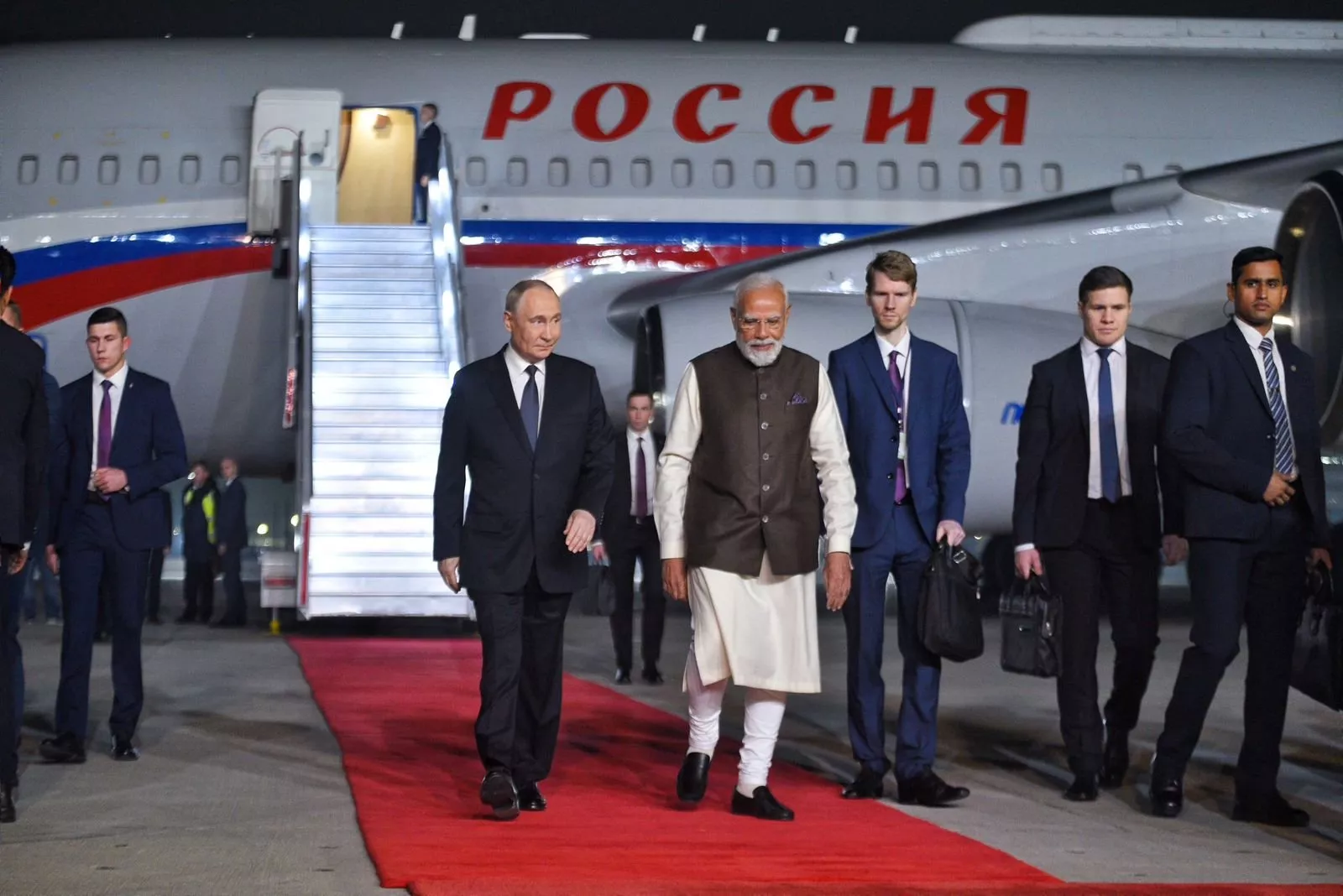
Putin’s Visit to India
Syllabus Areas:
GS II - IR
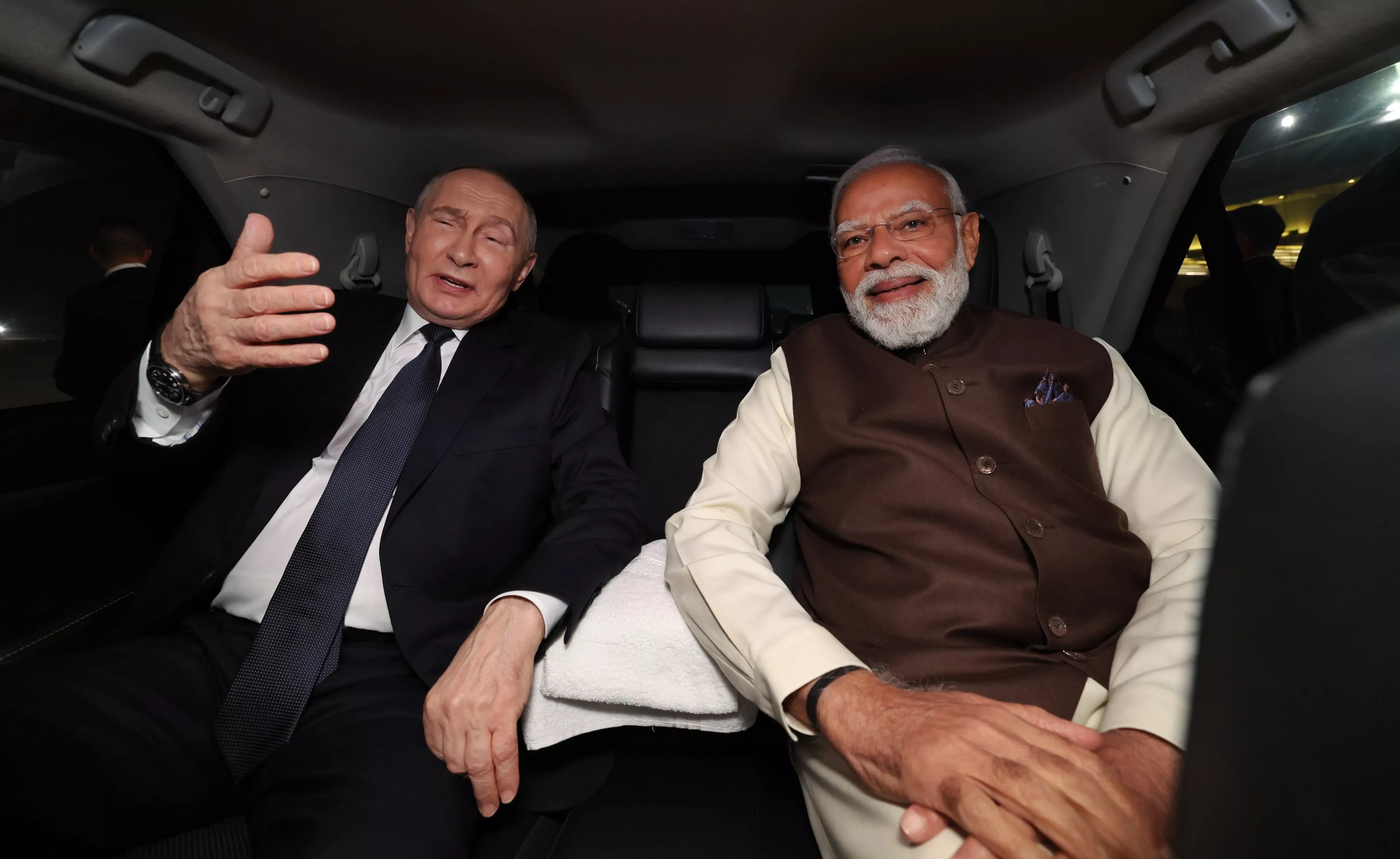
The 23rd Annual India–Russia Summit, held on 4–5 December 2025 in New Delhi, drew intense global attention as Russian President Vladimir Putin made his first visit to India in four years. Beyond symbolism, the summit produced several concrete outcomes across defence, energy, nuclear cooperation, trade, mobility, technology, and global governance — making it one of the most consequential India–Russia engagements in the last decade.
Economic & Trade Cooperation: The ‘Programme 2030’ Roadmap
One of the most significant outcomes was the adoption of the Programme for the Development of Strategic Areas of India–Russia Economic Cooperation till 2030, a forward-looking blueprint designed to diversify and rebalance bilateral trade.
Key Highlights
- Bilateral trade target of USD 100 billion by 2030, up from around USD 70 billion in 2024–25.
- Commitment to reduce tariff and non-tariff barriers, improve logistics, ease customs procedures and ensure predictable payment systems.
- Agreement to accelerate negotiations on a Free Trade Agreement (FTA) between India and the Eurasian Economic Union.
- Encouragement of national-currency settlements and exploration of digital payment interoperability and future CBDC linkages.
- A push to diversify trade beyond oil and defence into pharmaceuticals, food processing, agro-products, minerals, machinery, services, and technology.
This focus on diversification is overdue. India’s imports from Russia have surged primarily due to discounted crude oil, creating a trade imbalance. The roadmap attempts to correct this structural distortion by creating space for Indian exporters — something Indian industry bodies have strongly welcomed.
Defence Cooperation: Moving From Buyer–Seller to Co-Development
Defence remains a central pillar of India–Russia relations, but the nature of cooperation is shifting.
Key Defence Outcomes
- Renewed commitment to joint R&D, co-production, and co-development, consistent with India’s self-reliance goals.
- Strengthening of the Inter-Governmental Commission on Military & Military-Technical Cooperation.
- Focus on joint maintenance, spares, local manufacturing lines and potential exports to third countries.
- Continuation of INDRA joint military exercises and expansion of military-delegation exchanges.
India remains heavily dependent on Russian platforms — from S-400 systems to the nuclear submarine lease program. But geopolitical realities require India to reduce over-dependence. This summit’s emphasis on co-production is a pragmatic evolution that aligns strategic necessity with industrial autonomy.
Energy and Civil Nuclear Cooperation: A Major Expansion
Energy security was a defining theme of the summit, reflecting Russia’s role as a top supplier of crude oil to India.
Energy & Nuclear Highlights
- Russia reaffirmed uninterrupted energy supplies despite global pressures — a signal directed as much at New Delhi as at Western capitals.
- Expansion of cooperation in civil nuclear energy, including:
- Life-cycle support for Kudankulam reactors,
- Collaboration across the full nuclear fuel cycle,
- Potential new nuclear power projects.
India’s goal of achieving 100 GW nuclear capacity by 2047 requires steady partnerships, and Russia remains a reliable collaborator. This cooperation also deepens India’s energy diversification and reduces long-term dependence on fossil fuels.
Connectivity & Eurasian Engagement: Renewed Strategic Push
India and Russia revived momentum on strategic connectivity corridors, recognising that logistics is now central to geopolitics.
Key Connectivity Initiatives
- Faster implementation of the International North–South Transport Corridor (INSTC).
- Advancement of the Chennai–Vladivostok Maritime Corridor, which could significantly reduce freight time.
- India’s expanding engagement in Arctic and Far East projects, especially in energy, mining, and maritime cooperation.
These corridors offer India access to Central Asia, the Arctic, and Europe without relying on Pakistan or China-controlled routes. However, execution has historically been slow.
Science, Technology & Space Collaboration
Recognising the strategic importance of future technologies, the summit outlined cooperation across emerging scientific fields.
Science & Tech Outcomes
- Collaboration in AI, quantum technologies, cybersecurity, robotics, advanced manufacturing and critical minerals.
- Strengthening ISRO–Roscosmos partnership, including:
- Satellite navigation (GLONASS–NavIC cooperation),
- Rocket engine technology,
- Planetary exploration and potential human-spaceflight coordination.
As global technology ecosystems fragment into competing blocs, India’s strategy of multi-alignment requires maintaining diversified technological partnerships. Russia offers India opportunities in areas where Western technology access remains restricted.
Migration & Mobility: New Labour Pathways
A practical and somewhat underrated outcome was the signing of a labour mobility agreement, enabling regulated migration of Indian professionals and workers to Russia.
Mobility Highlights
- Opportunities for Indian workers in construction, healthcare, manufacturing and services.
- Streamlined procedures for recruitment and skill verification.
- India granted free 30-day double-entry e-tourist visas for Russian citizens.
This is not merely a symbolic gesture — it opens new avenues for Indian employment and helps Russia address labour shortages. It also aligns with India’s broader model of creating safe, legal mobility corridors.
Global Governance & Climate Cooperation
The summit reaffirmed cooperation in global platforms, especially at a time when multilateralism is under strain.
Major Diplomatic Outcomes
- Continued strategic cooperation in UN, BRICS, SCO and other global forums.
- Russia reiterated support for India’s claim to a permanent UNSC seat.
- Collaboration on climate finance, clean technologies, low-carbon solutions and environmental frameworks.
- A joint condemnation of terrorism in all forms, with emphasis on combating cross-border terrorism and terror financing.
India values Russia as a consistent supporter in global governance reform. Despite Western pressure, New Delhi’s stance is pragmatic: engagement with all major powers, alignment with none.
What the Summit Means
The 23rd Summit is more than a bilateral meeting; it signals a recalibration of a historic partnership.
Key Strategic Takeaways
- Diversification of Partnership: India and Russia are consciously expanding cooperation into technology, nuclear energy, mobility, and critical minerals — reducing the excessive dependence on defence and hydrocarbons.
- Strengthening Strategic Autonomy: India’s engagement with Russia despite geopolitical pressure underscores its refusal to align rigidly with Western or Eastern blocs.
- Economic Opportunities: The “Programme 2030” roadmap, if implemented earnestly, can give Indian exporters deeper access to Eurasian markets.
- Geopolitical Signalling: By hosting Putin with exceptional warmth, India projects itself as a confident power ready to chart its own path.
- Future Challenges: The real test lies in execution — several Indo-Russian initiatives have historically suffered from slow delivery.
The 23rd India–Russia Annual Summit marks a decisive moment in a partnership navigating global shifts. It blends continuity with transformation: reaffirming long-standing trust while opening new frontiers in trade, technology, nuclear energy, space and mobility. More importantly, it signals India’s commitment to a balanced, multipolar international system and its determination to pursue national interest above external pressures.
In a world of fractured alliances and emerging power coalitions, this summit reinforces India–Russia ties as resilient, adaptive, and strategically significant — shaping regional and global dynamics in the decade ahead.