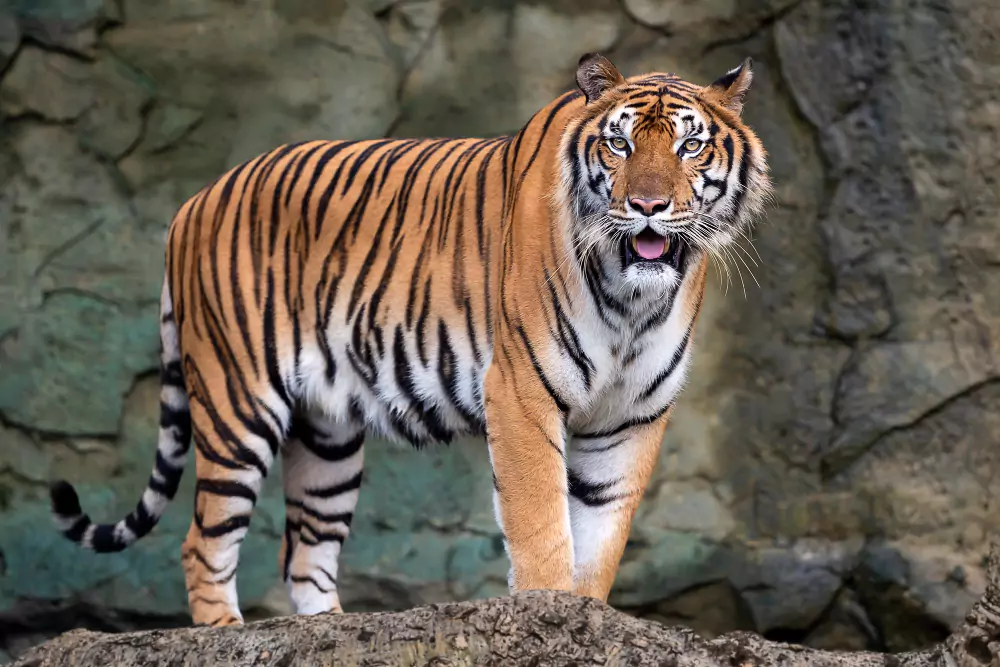
Project Tiger
Syllabus Areas:
GS III - Environment & Ecology
On the occasion of International Tiger Day (29 July), The Times of India published a comprehensive report on the progress, success, and future challenges of Project Tiger—India's flagship wildlife conservation initiative. The series highlights how India revived its dwindling tiger population and became a global leader in big cat conservation.
Project Tiger
- Launched: 1973 by the Government of India.
- Objective: To ensure the survival and maintenance of a viable population of tigers in India.
- Initial Setup: Started with 9 tiger reserves.
- Agency Involved: Ministry of Environment, Forest and Climate Change (MoEFCC); implementation by the National Tiger Conservation Authority (NTCA).
Reasons Behind Launch
- During the 1960s-70s, India’s tiger population had plummeted due to:
- Poaching
- Habitat destruction
- Retaliatory killings
- Tigers were on the brink of extinction, particularly in regions like Sariska (Rajasthan).
Tiger Population Rebound
-
Population Growth
- This represents a 161% increase over 16 years.
- India now holds almost 75% of the world’s wild tiger population.
- Expansion of Protected Areas
- Area under tiger reserves:
- 1973: 14,000 sq km
- 2025: 84,000 sq km (~2.5% of India’s landmass)
- Reserves expanded from 9 to 53.
- Tiger reserves now exist across 18 Indian states.
- Area under tiger reserves:
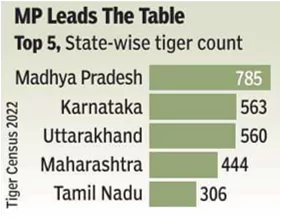
Major Tiger States (2022 Data)
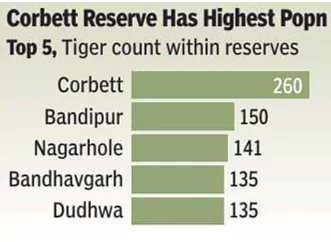
Corbett Reserve (Uttarakhand): Highest number of tigers in any reserve (260 tigers)
Success Factors
- Improved Surveillance
- Camera traps, AI-based tracking, GPS collars, and drones are increasingly used.
- These help identify movement, prevent poaching, and enable real-time monitoring.
- Scientific Habitat Management
- Restoration of degraded habitats.
- Creation of buffer zones to reduce human-wildlife conflict.
- Tiger reintroduction (as done in Sariska and Panna).
-
Increased Funding and Policy Support
- Backing from NTCA, state forest departments, and international collaborations (e.g., WWF, Global Tiger Forum)
-
Community Involvement
- Relocation of forest-dependent communities to reduce pressure on core tiger habitats.
- Compensation for livestock loss and eco-development schemes.
Threats: Cross-border Trade in Tiger Parts
Location: Myanmar's Shan State & Mong La Town
- Emerged as hubs for illegal wildlife trade.
- Tigers poached in India are trafficked via the North-East (e.g., Mizoram, Manipur) to Myanmar and beyond.
The Smuggling Trail
- From India → Mizoram border → Zokhawthar crossing → Myanmar → Tahan/Shan State → China & SE Asia.
- Items traded: tiger skin, bones, claws, teeth, and genitals (used in traditional Chinese medicine).
Significance
- Highlights the need for regional cooperation under platforms like CITES, SAWEN, and Interpol Wildlife CrimeLink.
Key Challenges Ahead
- Human-Wildlife Conflict
- Rising tiger population may clash with humans if not planned properly.
- Habitat fragmentation increases encounters.
- Habitat Degradation
- Urbanization, mining, and infrastructure projects (e.g., roads, canals) disrupt corridors.
- Poaching & Illegal Trade
- Despite success, demand for tiger parts still exists in black markets.
- Climate Change
- Affects prey availability, water sources, and vegetation quality.
- Policy & Coordination Gaps
- Need for better inter-state and international coordination.
- Buffer Zone: An area around the core of a tiger reserve meant to reduce human-wildlife conflict and allow limited sustainable use.
- Core Area: The innermost zone of a tiger reserve with the highest degree of protection and no human activity allowed
India’s success in tiger conservation is globally unmatched, but sustainability requires:
- Continued monitoring
- Strengthened law enforcement
- Community engagement
- Regional and international collaboration
As India holds the largest share of the global wild tiger population, it bears a special responsibility to ensure that this success story continues for future generations.
Mains Question
- Discuss the role of modern technologies in wildlife conservation in India. Illustrate your answer with examples from recent tiger conservation initiatives. 150 Words 10 Marks