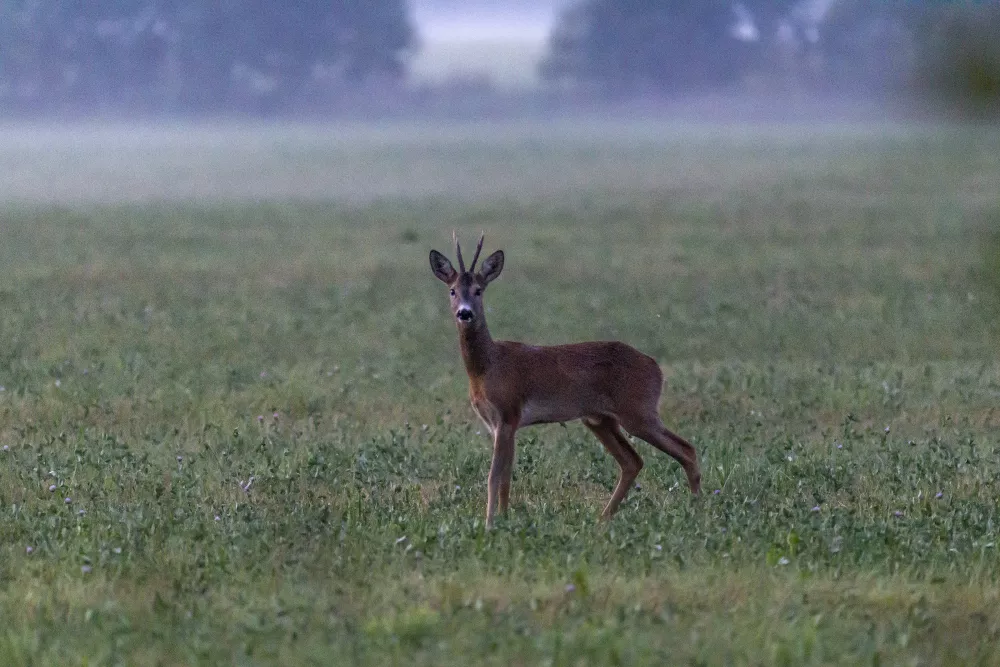
Musk deer (Kasthuri Jinka)
Syllabus Areas:
GS III - Environment and Ecology
In November 2025, scientists captured the first photographic evidence of a musk deer in Neora Valley National Park (West Bengal) — a region where the animal was thought to have disappeared about 70 years ago.
During a camera-trap survey (part of the nationwide “Pan-India Assessment and Monitoring of Endangered Species” programme) that began in December 2023, one camera installed at about 3,112 metres altitude recorded six consecutive images of a deer on December 17, 2024 — images that showed hallmarks typical of musk deer (hare-like long ears, no antlers, visible upper canines).
- The finding ends decades of uncertainty about the deer’s presence in Bengal; previously, the last confirmed sighting in the state dated to 1955 in Singalila National Park.
- Because the images were taken under low light and visibility was limited, researchers could confirm only the genus (Moschus), not the exact species.
- Experts now call for further field-studies: species-level identification, population assessment, and long-term monitoring — alongside stronger habitat protection — to ensure survival of this elusive deer in the Neora Valley landscape.
Musk Deer — biology, species & threats
- Musk deer belong to the genus Moschus. In India, there are four recognised
species drawing conservation concern:
- Black musk deer (Moschus fuscus)
- Himalayan musk deer (Moschus leucogaster)
- Alpine musk deer (Moschus chrysogaster)
- Kashmir musk deer (Moschus cupreus).
- These deer are typically found in high-altitude Himalayan forests and rugged terrain. They are adapted to cold, forested environments.
- Physical characteristics: long, hare-like ears, absence of antlers (unlike many other deer), and distinctive upper canines — these features help distinguish them from other deer species.
- Their musk gland (present in males) is highly prized — used
in traditional medicine and in perfumery.
- This value has historically led to rampant poaching. As a result, all four species are listed as “Endangered” by IUCN.
Beyond poaching, their survival is challenged by habitat degradation, shrinking of forested alpine landscapes, and the difficulty of monitoring such elusive animals — often restricted to remote, rugged terrain.
An additional concern: according to a recent report by Central Zoo Authority (CZA), there has been confusion in identifying certain musk deer species (notably Alpine vs Himalayan) within Indian zoos — meaning that captive-breeding efforts may have inadvertently focused on the wrong species, undermining genuine conservation of some critically endangered populations.
Why this rediscovery matters — ecological and conservation significance
- The Neora Valley belongs to a transboundary Himalayan landscape (linked to the larger Kangchenjunga landscape), with mixed temperate, subtropical and tropical habitats — demonstrating that musk deer may persist beyond traditional “known ranges.”
- Their reappearance after decades suggests that previously assumed “local extinction” may sometimes be premature or driven by lack of data — reinforcing the importance of systematic surveys (e.g. camera traps).
- For conservation policy: this find can trigger targeted efforts — habitat protection, anti-poaching patrols, scientific monitoring, maybe a species-level census. For a country like India, where forest-dwelling species often slip under the radar, such rediscoveries help spotlight forgotten biodiversity.
- From a larger ecological standpoint: musk deer are part of Himalayan mountain-forest ecosystems; their presence indicates ecosystem health and intact habitat connectivity — essential for multiple alpine species.
Challenges ahead — what remains uncertain/what needs urgency
- Species identification still pending: Because of poor visibility at night, the camera images don’t allow researchers to confirm whether the deer belongs to Himalayan musk deer, Alpine musk deer or another species. Without species-level clarity, it is harder to assess the deer’s conservation status and design specific action plans.
- Population unknown: One or a few images don’t reveal whether a viable population exists — the deer could be lone survivors or the sign of an under-noticed small population. Conservation actions require estimates of numbers, distribution, breeding success, threats.
- Poaching risk remains: The underlying threat — demand for musk gland — continues. Without strong protection and monitoring, any rediscovery may be extremely vulnerable.
- Conservation breeding complexity: As highlighted by the CZA report, misidentification problems complicate captive-breeding efforts. If staff mistake species, breeding programmes might not help the species most in danger.
Implications for India’s wildlife policy & what to watch
Policy-relevant takeaways from this event:
- It underscores the value of systematic, long-term wildlife surveys (not just occasional sightings) — efforts like camera traps, perhaps combined with genetic sampling, need to be expanded across Himalayan states.
- There's a need for state-specific conservation plans for musk deer — identification of critical habitats (including “marginal” zones like Neora Valley), corridors, anti-poaching measures, community-based forest management.
- Regular monitoring and scientific documentation — both to update distribution maps and to enable timely intervention before populations collapse irreversibly.
- Review and audit captive-breeding protocols under CZA — to ensure right species are identified and bred; to maintain genetic diversity; to possibly establish ex-situ assurance colonies for extremely threatened species.
- Public awareness and demand reduction — since musk gland trade drives decline, there should be efforts to curb demand, promote alternatives, raise awareness about ecological cost.
This rediscovery — of a “lost” species in a state where it was presumed gone — is a wake-up call. It tells us that our knowledge about biodiversity in many parts of India remains fragmentary. The fact that a small deer — elusive, nocturnal, forest-dwelling — survived unnoticed for decades suggests that many such “extinct” or “rare” species might still survive in pockets, IF we search strategically.
For India — with its rapidly changing land-use patterns — the priority must be: protect habitat, not just species. Conservation should not be reactive (saving species only when threatened) but proactive and landscape-level.
Prelims Questions:
1. Recently, the Musk Deer was in the news due to its rediscovery in India.
With reference to Musk Deer, consider the following statements:**
- Musk deer belong to the family Cervidae.
- Male musk deer possess a musk gland used in traditional medicine.
- The species found in India are listed under Schedule I of the Wildlife Protection Act, 1972.
Which of the statements given above is/are correct?
2. Consider the following regions:
- Neora Valley National Park
- Nanda Devi Biosphere Reserve
- Hemis National Park
- Singalila National Park
In which of the above regions has evidence of musk deer presence been recorded historically or recently?
3. With reference to conservation issues related to musk deer in India, consider the following:
- Difficulty in species-level identification due to nocturnal and elusive behavior.
- Poaching for musk gland is a major threat.
- Captive breeding programmes in Indian zoos have faced species misidentification.
How many of the above statements are correct?
. Which of the following best explains why the rediscovery of musk deer in West Bengal is ecologically significant?
- It indicates that musk deer are expanding into tropical habitats.
- It confirms the existence of a genetically stable large population.
- It shows that lesser-known high-altitude species may persist in marginal or fragmented habitats.
- It suggests that musk deer have adapted to lower-altitude Himalayan plains.