Mizoram Refugee Crisis
Syllabus Area:
GS II - Polity and Governance
GS III - Internal Security
What includes in the Article?
- Why in the News?
- What Triggered the Fresh Influx in July 2025?
- Who are the Chins?
- Ethnic Ties Across Borders
- How Are Foreigners Identified in Mizoram?
- How Mizoram Has Handled Refugees (2021–2025)
- Recent Policy Shifts
- Challenges Faced by Mizoram in Handling the Refugee Crisis
- Conclusion
- Prelims Questions
- Mains Question
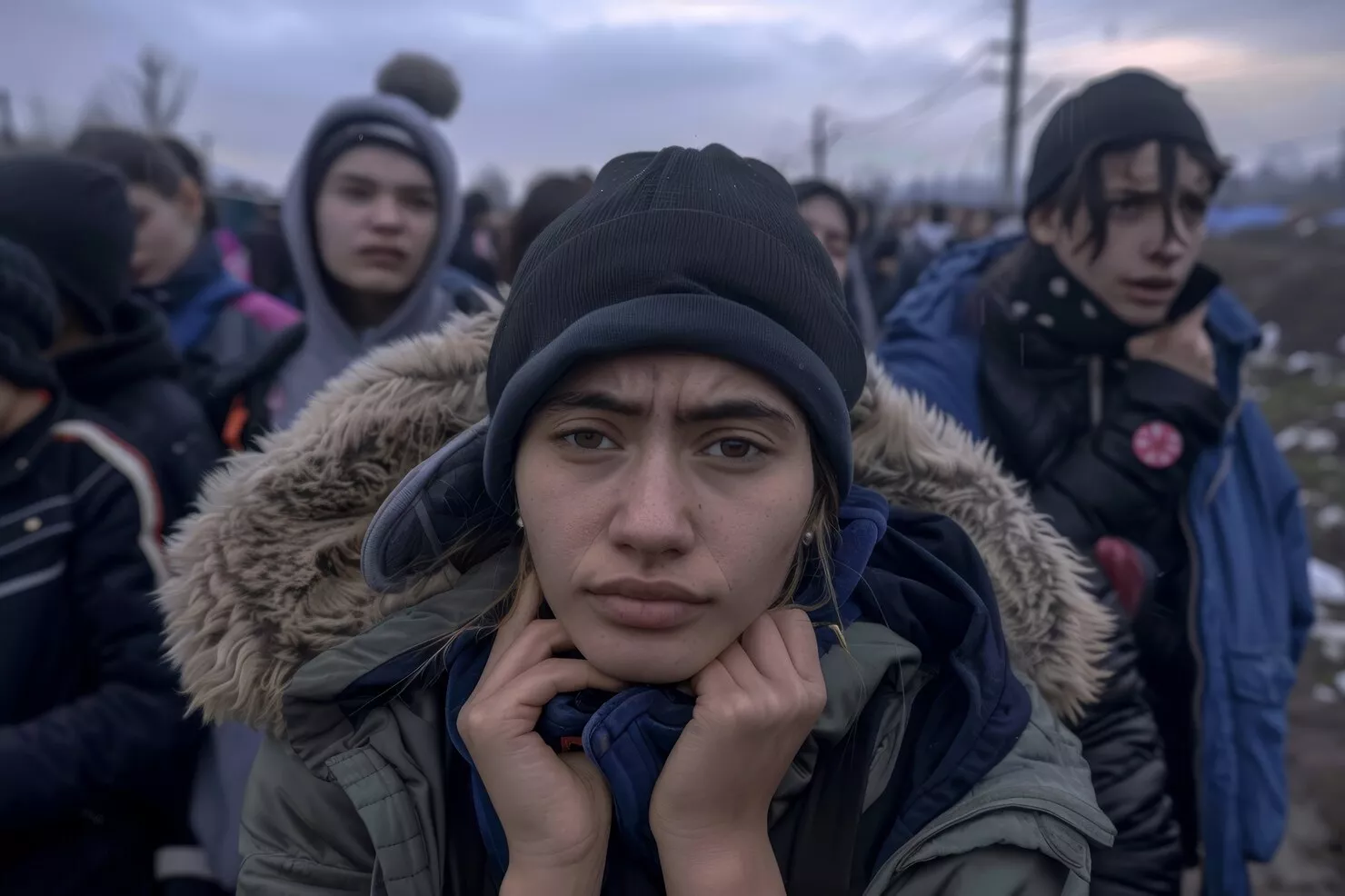
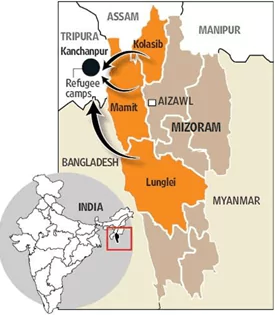
Mizoram has been in the grip of a prolonged refugee crisis since the 2021 military coup in Myanmar, with renewed intensity in July 2025 due to infighting between rebel groups in Chin State. More than 40,000 displaced persons from Myanmar, Bangladesh, and Manipur are now seeking shelter in Mizoram.
What Triggered the Fresh Influx in July 2025?
- A fratricidal battle between two Myanmar-based anti-junta groups — Chin National Defence Force (CNDF) and Chinland Defence Force-Hualngoram (CDF-H).
- CNDF seized strategic camps; around 4,000 refugees fled to Champhai district, Mizoram, particularly to Zokhawthar and Saikhumphai
- Significance: Refugees fear returning due to continued instability and military threats.
Who are the Chins?
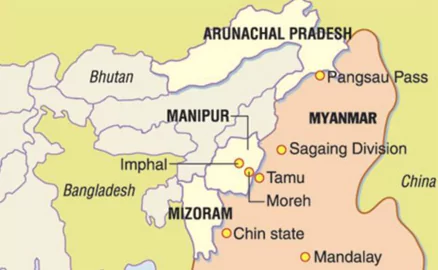
- The Chins are an ethnic group primarily from Myanmar’s Chin State, closely related to Mizoram’s Mizo community.
- They share linguistic, cultural, and familial ties, all part of the larger Zo ethnic group that spans international borders.
Ethnic Ties Across Borders
| Region | Community | Connection to Mizos |
|---|---|---|
| Myanmar | Chins | Linguistically and culturally related |
| Bangladesh | Bawms | Zo ethnic group members, persecuted in CHT |
| India (Manipur) | Kuki-Zo people | Shared ancestry and historical roots with Mizos |
These strong kinship ties are a key reason why Mizoram's civil society and government have extended continuous support.
How Are Foreigners Identified in Mizoram?
- India has no national refugee law, and is not a signatory to the 1951 UN Refugee Convention.
- Mizoram relies on the Mizoram (Maintenance of Household Registers)
Bill, which seeks to:
- Maintain a record of bona fide residents.
- Distinguish foreigners or outsiders from local Mizos.
- Status: Bill awaits Presidential assent.
How Mizoram Has Handled Refugees (2021–2025)
| Year | Inflow | Reason |
|---|---|---|
| 2021 | Thousands | Post-coup violence in Myanmar |
| 2022 | ~2,000 Bawms | Fleeing persecution in Bangladesh’s Chittagong Hill Tracts |
| 2023–2024 | Thousands of Kuki-Zos | Escaping ethnic violence in Manipur |
| 2025 (July) | ~4,000 Chins | Rebel group violence in Chin State, Myanmar |
Recent Policy Shifts
- Initial Response: Welcoming — food, shelter, and protection offered by villagers, YMA, and churches.
- Centre's Stand: Advised NE States to not admit refugees; suspended Free Movement Regime (FMR) in Feb 2024.
- Strain on Resources: Growing local resentment:
- Farkawn, Melthum, and Lawngtlai villages asked refugees to stop trade and movement.
- Threats of eviction issued in March 2025.
- Concerns over smuggling, illegal trade, and demographic shifts.
Challenges Faced by Mizoram in Handling the Refugee Crisis
- Humanitarian Burden: Over 40,000 refugees strain Mizoram’s limited resources—housing, food, healthcare, and sanitation.
- Legal Vacuum: India lacks a refugee law and is not a signatory to the 1951 Refugee Convention, leading to ambiguity in refugee identification.
- Ethnic Pressures: Close kinship between Mizos, Chins (Myanmar), Bawms (Bangladesh), and Kuki-Zos (Manipur) complicates repatriation efforts.
- Security Threats: Increased smuggling, militant infiltration, and demographic shifts pose national security concerns.
- Administrative Strain: Minimal central assistance (₹28 crore) leaves civil society and villagers overburdened.
- Erosion of Public Support: Villages like Farkawn and Melthum have begun restricting refugee movement and trade.
- Free Movement Regime Issues: Suspension of FMR without clear enforcement mechanisms has led to confusion at the border.
Unless India formulates a clear refugee policy or empowers states legally and financially, such crises—driven by regional instability—will continue to test India's federal structure, border security, and humanitarian values.
Prelims Questions:
- Which of the following best explains why India is not legally bound to
accept refugees fleeing from
Myanmar into Mizoram?
- India follows a strict border fencing policy.
- India is not a signatory to the 1951 Refugee Convention and its 1967 Protocol.
- The Indian Constitution prohibits entry of foreigners into tribal areas.
- Mizoram has special autonomy under Article 371G which restricts refugee entry.
- The Free Movement Regime (FMR) between India and Myanmar allowed people
living near the border to travel
up to:
- 40 km inside India and Myanmar
- 16 km inside India and Myanmar
- 10 km inside India and Myanmar
- 5 km inside India and Myanmar
Correct Answer:B
Explanation: India has no national refugee law and is not a party to the 1951 Convention or the 1967 Protocol. Refugees are handled under the Foreigners Act, 1946.
Correct Answer: A
Explanation: Originally, the FMR allowed cross-border ethnic communities to travel up to 40 km without a visa. It was later reduced, and recently suspended in 2024.
Mains Question:
- Critically examine the challenges faced by border States like Mizoram in handling cross-border refugee inflows in the absence of a national refugee policy. (250 words) 15 Marks