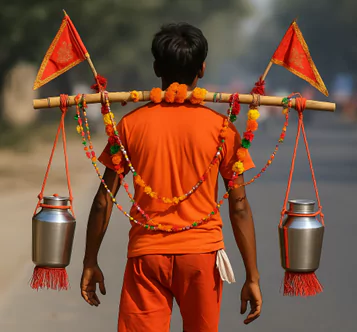
Kanwar Yatra
Syllabus Areas:
- Prelims Point of View
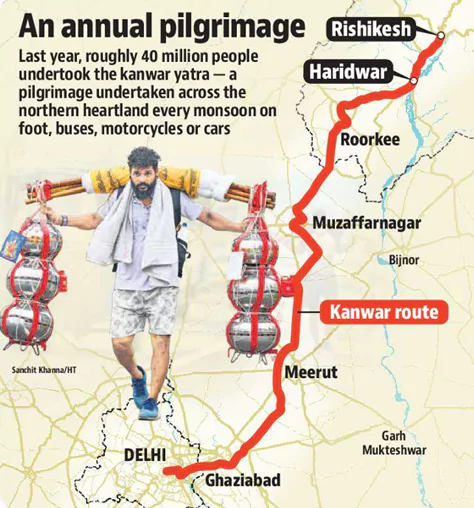
A massive annual pilgrimage in which devotees of Lord Shiva (called Kanwariyas) carry holy water from the Ganges River to their hometowns, especially during the Shravan month (July-August).
Last year, ~40 million people participated in the holy Yatra.
Pilgrims travel on foot, motorcycles, buses, or cars—often barefoot.
Mythological Background:
- Linked to the Samudra Manthan (Churning of the Ocean)
- According to legends, Lord Shiva consumed poison (halahala) to save the universe.
- To soothe the burning effect, Ganga Jal is offered to him—an act replicated by devotees today as symbolic devotion and repayment of cosmic debt.
Major Route:
- Start: Delhi
- Stops include:
- Partapur (UP) – 60 km from Delhi
- Modipuram (UP) – 90 km
- Khatauli (UP) – 115 km
- Muzaffarnagar (UP) – 140 km
- Roorkee (UK) – 190 km
- Haridwar (UK) – 225 km
- Rishikesh (UK) – 250 km
Scale & Growth:
- Started as a small-scale pilgrimage in ancient times.
- Now one of the largest mass pilgrimages globally:
- ~40 million people participate annually (HT 2024 report).
- Huge infrastructural and logistical arrangements are made by state governments.
- Temporary tents, food stalls, toilets, security deployments, and first aid stations are set up along the route.
Unique Cultural Features:
- “Bol Bam” chants, saffron clothing, DJ trucks, music systems, and decorated kanwars.
- Some perform tandav-style dance or travel
barefoot.
Devotees avoid alcohol, non-vegetarian food, and engage in fasting and prayer.
Key Issues Highlighted:
- Law & Order Challenges:
- Use of loud music, DJ trucks, and aggressive behavior by some pilgrims.
- Clashes and complaints from locals due to roadblocks and unruly behavior.
- Businesses often close down for safety.
- Police Deployment & Management:
- Over 25 lakh police deployed in UP and UK.
- Drones, CCTVs, and anti-riot gear used.
- Special arrangements by Disaster Response Forces.
- Concerns from Locals:
- Noise and disturbance, especially at night.
- Fear of confrontations if complaints are made.
- Public infrastructure (toilets, water, roads) under pressure.
- Environmental: Plastic waste, overuse of water, noise pollution
Government Measures:
- Dedicated Kanwar control rooms and Kanwar apps in some states (like UP and Uttarakhand).
- Deployment of disaster response forces, ambulances, mobile toilets, and public announcement systems.
- Restrictions on loud music/DJs after specific hours.
The Kanwar Yatra is a powerful example of faith-driven mass mobilization in India. While its spiritual and cultural dimensions are immense, there’s a need for regulation, behavioral sensitization, and sustainable planning to ensure the yatra remains a peaceful, safe, and environmentally responsible event.
Prelims Questions:
- Which of the following constitutional provisions is most directly related
to managing the law and order during events like Kanwar Yatra?
- Article 15 – Prohibition of discrimination
- Article 25 – Freedom of religion
- Article 19 – Freedom of movement
- Article 355 – Duty of the Union to protect states
Answer: B. Article 25
Explanation: Article 25 guarantees freedom to profess, practice, and propagate religion but is subject to public order, morality, and health.
- The term “Kanwar” in Kanwar Yatra refers to:
- The name of the river where water is collected
- The local name of a Lord Shiva temple
- A bamboo structure used to carry holy water
- A ritual chant used during the Yatra
Answer: C. A bamboo structure used to carry holy water
Explanation: The “Kanwar” is a decorated sling carried on the shoulders.
- Consider the following administrative responses to the Kanwar
Yatra:
- Deployment of drone surveillance
- Creation of exclusive pedestrian corridors
- Ban on playing music after specified hours
- Setting up temporary camps and mobile toilets
Which of the above have been implemented in recent years?
- 1, 2 and 3 only
- 1, 3 and 4 only
- 2, 3 and 4 only
- All of the above
Answer: D. All of the above
Explanation: These measures are increasingly adopted to ensure smooth and safe conduct of the Yatra.