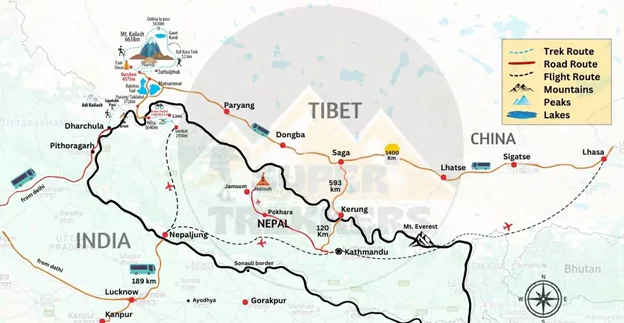
Kailash-Mansarovar Yatra
Syllabus Areas:
GS I - Geography
GS II - IR (Soft Power)
The Kailash-Mansarovar Yatra has resumed in 2025 after a five-year pause due to:
- Covid-19 pandemic
- India-China tensions
The Route & Geography:
- Mount Kailash (6,638 m) and Lake Mansarovar lie in Tibet Autonomous Region, China
Mount Kailash:
- Situated in the Trans-Himalayan range in the Tibet Autonomous Region (TAR) of China
- Near the sources of four major rivers:
- Indus (Sindhu)
- Sutlej (a tributary of Indus)
- Brahmaputra (Yarlung Tsangpo in Tibet)
- Karnali (a major tributary of Ganga)
Religious Significance:
Mount Kailash is one of the most revered spiritual destinations in Asia, sacred to four major religions:
| Religion | Significance |
|---|---|
| Hinduism | Considered the abode of Lord Shiva and Parvati. Known as Kailasa Parvata. Pilgrims perform parikrama (circumambulation) – a spiritual act |
| Jainism | Known as Ashtapada, where the first Tirthankara, Rishabhdeva, attained moksha |
| Buddhism | Associated with Demchok (Chakrasamvara), a deity representing supreme bliss |
| Bon | The native religion of Tibet considers it the seat of spiritual power, central to their cosmology |
Lake Manasarovar
- Located about 20 km southeast of Mount Kailash, also in Tibet Autonomous Region
- Situated at an altitude of 4,590 m (15,060 ft) – one of the highest freshwater lakes in the world
Religious Significance:
| Religion | Belief |
|---|---|
| Hinduism | Created by Brahma; considered the source of purity. Bathing here is said to cleanse sins |
| Buddhism | Regarded as the Lake Anavatapta, where Queen Maya bathed before giving birth to Buddha |
| Jainism | Holy site linked with Tirthankaras |
| Pilgrims | Often take a ritual dip and collect water as a sacred symbol of purity and liberation |
- Pilgrims used to travel via:
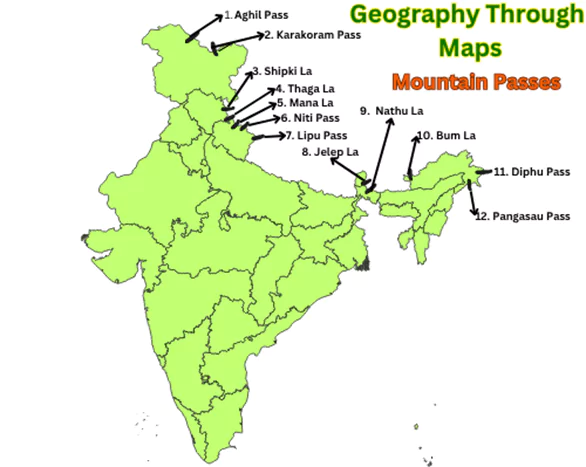
- Lipu Lekh: Pass between India and Tibet at the border on
the Greater Himalayas in
the extreme northeast corner of Uttarakhand
- Lies in the Pithoragarh District
- Pilgrims to the Mansarovar Lake follow this pass
- Nathu La: Located at the Indio-China border connects Sikkim
with Tibet through the
Chumbi Valley
- Closed during the Indo-China War of 1962 was reopened for the trade in 2006.
- Lipu Lekh: Pass between India and Tibet at the border on
the Greater Himalayas in
the extreme northeast corner of Uttarakhand
Historical Significance:
- Pilgrimage revived formally in 1981 by PM Indira Gandhi after Chinese approval
- It holds religious value for:
- Hindus (abode of Lord Shiva)
- Jains (liberation of Rishabhdev)
- Buddhists (home of Buddha Demchok)
- Bön religion followers
The Pilgrimage – Then vs Now:
Earlier:
- Took around 3 weeks
- Travelled to Dharchula → Gunji → Lipulekh Pass → Taklakot (Tibet) by foot
- Restrictions:
- Heavily dependent on bilateral clearances between India and China
- Route often got suspended due to:
- India-China tensions
- Weather conditions
Now:
- More organized batches (~5,000 pilgrims/year)
- Government Involvement:
- Ministry of External Affairs (MEA) oversees complete coordination
- Tied with support from Indo-Tibetan Border Police (ITBP), state governments, and Chinese authorities
- Requires passport & fitness clearance
- Journey now reduced to about 21 days with improved support systems
Digital Inclusion:
- Dedicated online portal by MEA
- Pre-yatra training and briefings
While the yatra earlier reflected spiritual resilience through rugged, solitary treks across Himalayan passes, the current model is a state-supported, structured pilgrimage reflecting modern diplomacy and infrastructure intervention in faith-based journeys.
Mount Kailash and Lake Mansarovar are more than just geographical entities—they represent sacred geography that binds the spiritual beliefs of multiple Asian civilizations. While the region is revered as a center of cosmic power in Hindu, Buddhist, Jain and Bon traditions, it also reflects the strategic interplay between India, Nepal, and China, where border diplomacy intersects with faith-based diplomacy.
Prelims Questions:
- Which of the following passes are used in the Kailash-Mansarovar
Yatra?
- Zoji La and Nathu La
- Rohtang Pass and Shipki La
- Lipulekh Pass and Nathu La
- Niti Pass and Bomdi La
- Mount Kailash is revered in which religion(s)?
- Hinduism only
- Hinduism and Buddhism
- Hinduism, Buddhism, Jainism, and Bon
- Only Bon and Buddhism
Answer: c)
Answer: c)
Mains Question:
Q. Discuss the cultural, diplomatic and strategic significance of the Kailash-Mansarovar Yatra in India-China relations. 250 Words 150 Marks