Jet Streams
Jet streams have recently gained attention due to their erratic shifts causing extreme weather—heatwaves, cold snaps, and monsoon irregularities. Scientists link this to climate change and Arctic warming, making jet streams a critical element in understanding global climate instability, disaster risks, and agriculture vulnerabilities—especially for countries like India.
WHAT ARE JET STREAMS?
Jet streams are fast flowing, narrow air currents found in the upper levels of the atmosphere (mainly in the tropopause—the boundary between the troposphere and stratosphere).
- They are typically westerly winds (flowing west to east).
- Wind speeds can exceed 150–300 km/h.
- Jet streams are formed due to temperature gradients between different air masses, especially polar and tropical.
TYPES OF JET STREAMS
| Type | Latitude | Altitude | Key Characteristics |
|---|---|---|---|
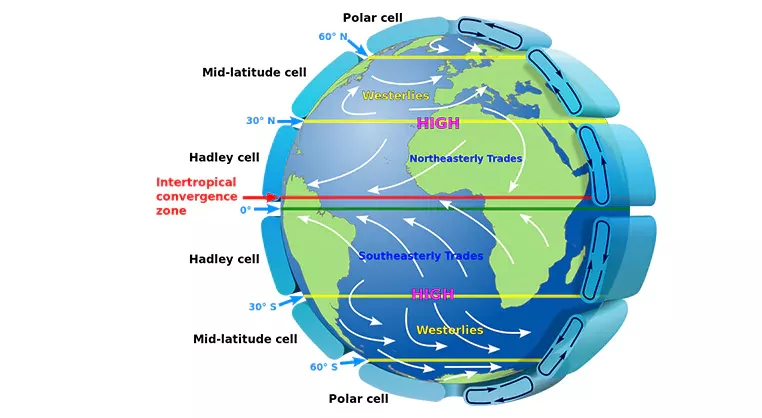
| Polar Jet Stream | ~60° N & S | 9–12 km | Strongest, affects cyclones, forms at boundary of Polar and Ferrel cells. |
| Subtropical Jet Stream | ~30° N & S | 10–16 km | Persistent, associated with Hadley-Ferrel cell boundary, affects Indian monsoon. |
| Tropical Easterly Jet (TEJ) | ~10°–20° N (in summer) | 14–17 km | Develops over Indian Ocean during SW monsoon; critical for rainfall in India. |
| Mid-Latitude Jet | 30°–60° | Variable | Steers mid-latitude depressions and temperate cyclones. |
| Polar Night Jet | Winter Polar Regions | ~50 km (stratosphere) | Associated with polar vortex; strong in winters. |
MECHANISM OF FORMATION
- Unequal heating of Earth: Equator is warmer than poles → creates pressure and temperature gradients.
- Coriolis Effect: Deflects moving air to the right in the Northern Hemisphere and left in the Southern.
- Geostrophic Winds: Balance between Coriolis force and pressure gradient → results in fast, narrow westerly winds at high altitudes.
- Conservation of Angular Momentum: Air moving poleward accelerates → forming jet-like streaks.
STRUCTURE & LOCATION
- Core zone: Wind speed maximum at the center (jet core).
- Vertical structure: Width ~100–200 km, height ~1–2 km.
- Found between 9–16 km altitude (tropopause region).
- Migrate northward in summer and southward in winter.
IMPORTANCE OF JET STREAMS
- Weather Systems
- Steer temperate cyclones, western disturbances, and monsoonal flows.
- Position determines high/low-pressure zones on surface.
- Indian Monsoon
- Subtropical Jet withdrawal (northward shift) → sets the stage for monsoon onset.
- Tropical Easterly Jet (TEJ) strengthens monsoon currents.
- Western Disturbances in winter—guided by Polar Jet Stream—cause rainfall/snowfall in North India.
- Aviation
- Aircraft flying with jet stream (west to east) → faster, fuel-efficient.
- Against jet stream (east to west) → turbulence, more fuel use.
- Climate Patterns
- Anomalies in jet stream paths linked to El Niño, La Niña, Arctic oscillations.
IMPACTS OF ABNORMAL JET STREAMS
- Extreme Weather: Heatwaves, cold waves, floods, and droughts.
- Blocking Patterns: Persistent ridges or troughs in jet stream → weather systems stall.
- Sudden Stratospheric Warming (SSW): Polar vortex collapse → intense cold in mid-latitudes (e.g., North America, Europe).
GLOBAL EVENTS & JET STREAMS
| Event | Jet Stream Role |
|---|---|
| El Niño | Alters Pacific jet stream → affects rainfall in India, Africa, Americas. |
| Western Disturbances | Travel with subtropical westerly jet → winter rainfall in North India. |
| Heatwaves in Europe | Wavy jet streams trap high-pressure systems. |
| Arctic Amplification | Melting polar ice weakens polar jet → increases waviness → unstable weather. |
INDIAN MONSOON & JET STREAMS – A SPECIAL FOCUS
Subtropical Jet Stream
- Present during winter.
- Its northward retreat in June enables low-pressure formation over NW India → onset of SW monsoon.
Tropical Easterly Jet (TEJ)
- Develops over the Indian Ocean.
- Key driver of intense SW monsoon rainfall over India.
Western Disturbances
- Travel eastwards along mid-latitude westerlies/polar jet.
- Crucial for Rabi crop irrigation in North India.
CLIMATE CHANGE & JET STREAM VARIABILITY
- Weakened polar jet streams due to Arctic warming.
- Leads to long-lasting weather events (e.g., prolonged droughts, floods).
- 2023: Heat dome in US and floods in Germany—linked to jet stream stalling.
Jet streams are not just high-speed winds; they are climate controllers, monsoon switchboards, and disaster influencers. Understanding their behavior is vital for India's agriculture, weather forecasting, and disaster preparedness.
In a warming world, the changing jet stream dynamics could be one of the most important yet under-discussed threats to climate resilience
Mains Practice Question:
Q1. What are Jet Streams? Explain their role in influencing global weather patterns and their importance in the Indian monsoon system. (250 words)
Q2. The weakening and meandering of jet streams have become more frequent in recent years. Analyse the implications for global climate and weather extremes. (250 words)