
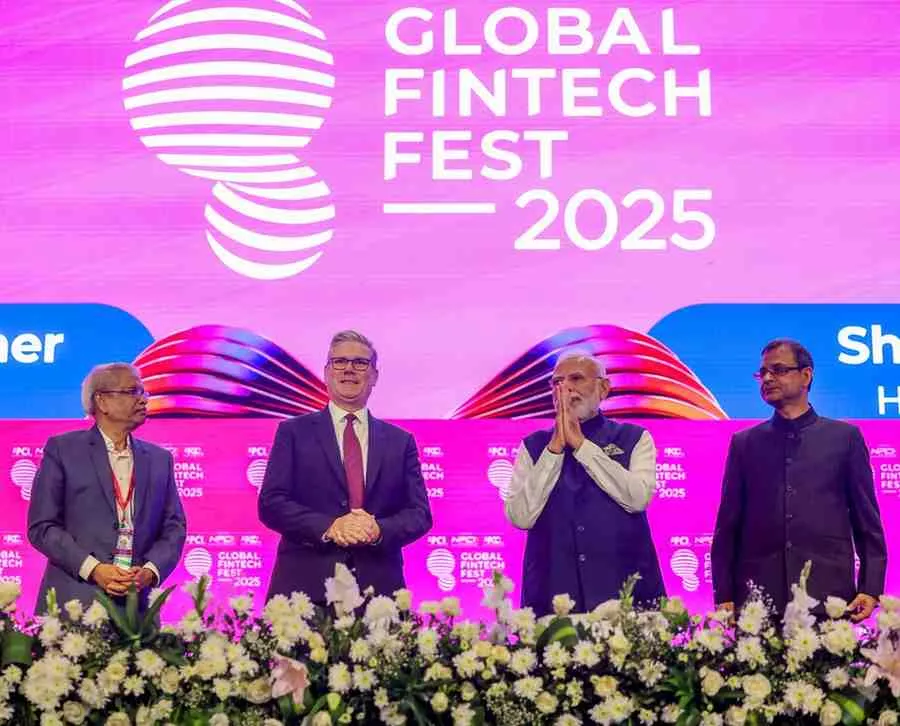
Global Fintech Fest 2025
Syllabus Areas:
GS III - Economy
The Global Fintech Fest 2025 (GFF 2025), held from 7th to 9th October 2025 at the Jio World Convention Centre, Mumbai, marked a major milestone in India’s financial innovation journey. Organized jointly by the Payments Council of India (PCI), National Payments Corporation of India (NPCI), and the Fintech Convergence Council (FCC), the 6th edition carried the theme “Empowering Finance for a Better World Powered by AI.”
With India now accounting for nearly 50% of global real-time digital transactions, the fest served as a platform for regulators, policymakers, and industry leaders to discuss the next phase of the country’s fintech revolution. The Reserve Bank of India (RBI), represented by Governor Sanjay Malhotra, set the tone by outlining a vision of responsible innovation—balancing inclusion, trust, and financial stability.
Discussions and Deliberations
The central discussions revolved around the future of digital finance, AI integration, and data governance. Key themes included:
- Digital Public Infrastructure (DPI): India’s fintech model, built on layers like Aadhaar, UPI, and Account Aggregator, was highlighted as the foundation for scalable, inclusive growth.
- Five Priority Areas set by RBI:
- Data aggregation and responsible use of financial data.
- Integration of Artificial Intelligence in payments and credit systems.
- Digital Rupee (CBDC) development and retail pilot expansion.
- Asset tokenisation as the next step in digital asset management.
- Strengthening digital fraud detection and cybersecurity
- Financial Inclusion and Consumer Protection: RBI stressed that inclusion cannot compromise trust. Innovation must serve underserved populations—especially rural and semi-urban sectors—without risking systemic stability.
- Regulatory Approach: The RBI reaffirmed its “innovation-friendly but vigilant” posture, promising regulatory sandboxes and flexible frameworks while warning against misuse of AI and data.
Key Innovations and Announcements
-
Digital Currency Sandbox – Expanding CBDC Use Cases
The Reserve Bank of India (RBI) announced the expansion of its Central Bank Digital Currency (CBDC) pilot through a retail sandbox framework.
What this means:
A sandbox is a controlled environment where fintech firms can test new digital products under RBI’s supervision without fully launching them in the market. The CBDC sandbox allows banks, payment companies, and fintech startups to test real-world applications of the digital rupee (e₹)—for example:- Offline CBDC payments in remote or low-internet regions.
- Smart contract–based transactions for automatic bill payments or micro-lending.
- Integration with UPI and digital wallets, allowing users to seamlessly switch between UPI and CBDC.
Why it matters:
India’s CBDC pilot started with select banks and cities in 2022. The 2025 sandbox signals phase-two testing, where RBI aims to explore how a sovereign digital currency could work for retail consumers, merchants, and government payments.
This also brings transparency and traceability—important for curbing money laundering and improving fiscal transfers. - Foreign Currency Settlement System on UPI
At GFF 2025, the Finance Minister unveiled a foreign currency settlement mechanism integrated with the Unified Payments Interface (UPI).
What it does:
This allows cross-border payments—remittances, business transactions, or tourism expenses—to be settled directly in foreign currencies using the UPI platform.
For example, an Indian traveling to Singapore could pay through UPI in rupees, while the merchant receives equivalent Singapore dollars instantly.Technical shift:
- Uses NPCI’s upgraded UPI-Link framework connected to partner payment networks abroad (like Singapore’s PayNow, UAE’s Aani, or France’s Lyra).
- Settlements occur through RBI’s foreign currency settlement hub, ensuring regulatory oversight.
Why it matters:
India processes nearly half of the world’s real-time digital payments, but cross-border transactions are costly and slow.
This feature turns UPI into a global payment rail, positioning India as an exporter of fintech infrastructure—similar to what the U.S. did with Visa/Mastercard in the 20th century. - AI-Driven Payment Assistants
Several fintech players showcased AI-based digital payment assistants at the festival. These are voice-activated or chat-based tools that can perform financial operations through natural conversation.
Examples of demonstrated features:
- Voice-based UPI payments in regional languages (“Pay ₹200 to Ramesh via UPI”).
- Smart budgeting and reminders that track user spending and suggest savings plans.
- Integration with micro-insurance and credit scoring via AI-driven insights.
- Use of small language models (SLMs) trained on Indian dialects to ensure local accessibility.
- Reports and Research Papers by NPCI & BCG
The National Payments Corporation of India (NPCI), in collaboration with Boston Consulting Group (BCG) and Fintech Convergence Council (FCC), released a series of research reports at GFF 2025.
Key focus areas of the papers:
- AI in Financial Services: Examined how machine learning can improve credit scoring, fraud detection, and customer support while maintaining data privacy.
- Tokenization Frameworks: Explored how blockchain-based tokens can represent assets (e.g., bonds, mutual funds) for faster and secure digital trading.
- Global Scalability of UPI: Analysed how India’s UPI model can be replicated across developing nations, strengthening India’s digital public infrastructure diplomacy.
- Data Empowerment Architecture: Suggested frameworks for secure data sharing through consent-based systems (like the Account Aggregator network).
Digital Currency vs. Virtual Currency
| Aspect | Digital Currency (CBDC) | Virtual Currency / Cryptocurrency |
|---|---|---|
| Issuer | Central Bank (RBI) | Private entities or decentralized systems |
| Legal Status | Legal tender under RBI’s authority | Not legal tender in India |
| Backing | Fully backed by sovereign guarantee | Backed by market demand and speculation |
| Volatility | Stable, pegged to national currency | Highly volatile in market value |
| Control & Regulation | Regulated by RBI | Outside formal regulation (often banned/restricted) |
| Purpose | To improve payment efficiency, transparency | Often used for speculative trading or private transfers |
In short: Digital Currency (CBDC) is state-controlled money in electronic form, while Virtual Currency is private digital value not backed by any authority.
About NPCI and PCI
- National Payments Corporation of India (NPCI):
- Established in 2008 under the joint initiative of the RBI and Indian Banks’ Association (IBA).
- Acts as the umbrella organisation for retail payments in India.
- Key products: UPI, RuPay, FASTag, Bharat Bill Payment System, AEPS.
- Objective: To create robust, interoperable, and inclusive digital payment systems accessible to every Indian.
- Payments Council of India (PCI):
- Founded in 2009 under the Internet and Mobile Association of India (IAMAI).
- Represents non-bank payment service providers and fintech companies.
- Works closely with RBI and government to shape policies, address industry challenges, and drive innovation in digital payments.
Challenges Involved
- Data Privacy and Cybersecurity Risks: Rapid digitalisation exposes user data to breaches and misuse, especially with AI-based credit assessment tools.
- Digital Divide: Technological literacy and connectivity gaps persist in rural and low-income populations.
- Regulatory Lag: Innovation in AI and tokenised assets often outpaces the creation of robust regulatory mechanisms.
- Fraud and Consumer Protection: Increase in phishing, identity theft, and transaction fraud demands better risk-management systems.
- Inter-agency Coordination: Fintech overlaps multiple regulators—RBI, SEBI, MeitY—requiring harmonised frameworks for seamless governance.
Way Forward
- Responsible AI and Data Governance: RBI’s push for ethical AI in financial systems must translate into transparent algorithms and consent-based data use.
- Strengthen Cyber Resilience: Implement multi-layered security protocols and consumer education on safe digital practices.
- Deepen Financial Inclusion: Leverage fintech to serve small traders, farmers, and micro-enterprises through local-language, low-bandwidth platforms.
- Regulatory Sandboxes and Collaboration: Encourage startups to innovate under monitored environments, fostering creativity within controlled risk zones.
- Global Fintech Cooperation: With India’s DPI success, the next step is international interoperability of UPI and cross-border CBDC pilots.
Fintech Fest 2025 captured India’s transition from a digital payment leader to a comprehensive fintech powerhouse. The RBI’s vision of integrating AI, data, and digital currency within a secure, inclusive framework signals a new chapter in India’s financial governance.
If executed with caution and coordination, this could indeed be India’s fintech revolution—driven not just by technology, but by trust and responsibility.
Prelims Questions
1. Which of the following statements about the Global Fintech Fest 2025 (GFF 2025) is/are correct?
- It was jointly organised by the RBI, NITI Aayog, and NPCI.
- Its central theme was “Empowering Finance for a Better World Powered by AI.”
- It marked the launch of India’s foreign-currency settlement feature on UPI.
Select the correct answer using the code below:
2. Consider the following statements regarding Digital Currency and Virtual Currency:
- Digital Currency issued by a central bank is considered legal tender.
- Virtual Currency is typically backed by sovereign assets.
- Both currencies operate under identical regulatory frameworks in India.
Which of the statements given above is/are correct?
3. In his address at Fintech Fest 2025, the RBI Governor identified five priority domains. Which of the following was not among them?
- Digital fraud prevention and cybersecurity
- AI-based financial governance
- Asset tokenisation
- Cryptocurrency exchange regulation
4. With reference to the National Payments Corporation of India (NPCI), consider the following statements:
- It functions as an umbrella organisation for retail payment systems in India.
- It was established jointly by the RBI and the Indian Banks’ Association.
- Its product suite includes AEPS, RuPay, and UPI.