India Achieves a Major Milestone - Photonic Radar
Syllabus Areas:
GS III - Environment and Ecology
A recent study by the CSIR-Centre for Cellular and Molecular Biology (CCMB), Hyderabad, published in Ecology Letters, explores how Peninsular India's unique biodiversity evolved over millions of years. The study integrates evolutionary biology, ecology, and climate history using mathematical models to trace speciation and extinction patterns.
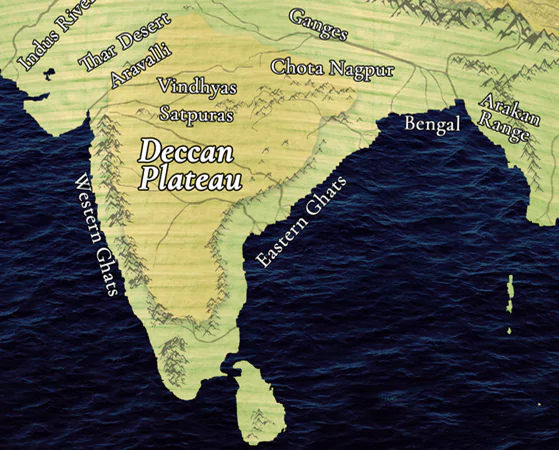
Geographical Focus Area
- Peninsular India: From Aravalli mountains to Western
Ghats, including:
- Satpura and Vindhya ranges
- Eastern Ghats
- Deccan Plateau
- Western Ghats (Global Biodiversity Hotspot)
Key Highlights of the Study
- 33 animal and plant groups
- Used mathematical models to track:
- Speciation (formation of new species)
- Extinction (disappearance of species)
- Evolution observed in relation to ecosystem stability and climatic fluctuations.
What is Ecosystem?
An ecosystem is a functional unit of nature where living organisms (biotic) interact with non-living components (abiotic) of the environment to form a self-regulating system.
What is Ecosystem Stability?
Ecosystem stability refers to the ability of an ecosystem to maintain its structure and function over time, even when exposed to external stress or disturbances (like natural disasters, climate change, or human interference).
Patterns Identified
- Two major evolutionary drivers:
- Stable Tropical Forests → Gradual accumulation of species.
- Climate Shifts (11–3 million years ago) → Abrupt speciation/extinction.
- Period between 11–3 million years ago marked by:
- Increased aridification
- Stronger monsoon seasonality
- Expansion of grasslands
- Retreat of evergreen forests to Western & Eastern Ghats’ hilltops
Aridification:
Aridification is the gradual process by which a region becomes drier over time, leading to a long-term reduction in available water and moisture. It is often driven by climate change, land degradation, and deforestation.
Experts says:
- Forest ecosystems served as refugia during climatic instability.
- Despite India’s turbulent geo-climatic history (e.g., drift from Gondwana, Himalayas formation), biodiversity evolved steadily.
- Closely related species diversified uniquely due to localised habitat stability.
- Lizards and related taxa showed similar evolutionary trends.
Historical-Geological Context
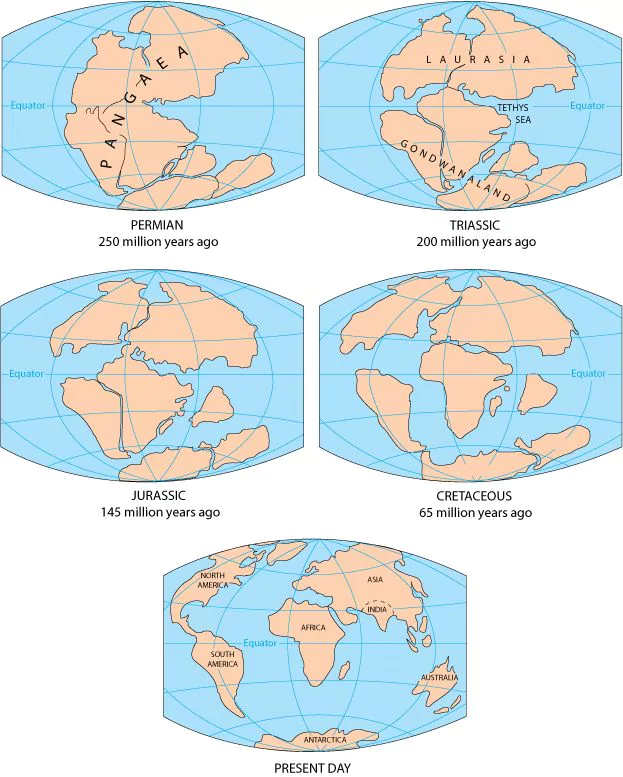
- Peninsular India was part of Gondwana, later drifted and collided with Asia forming Himalayas.
- Despite tectonic movements and temperature fluctuations, forest stability preserved biodiversity.
Quote:
“The more diverse an ecosystem, the more stable it is in the face of change.” – E.O. Wilson
The study underlines the complex interplay between stable ecosystems and climatic shifts in shaping biodiversity. Peninsular India is a critical evolutionary hub, hosting high endemic diversity. Conservation of evergreen forests and ecosystem stability is essential to sustain this evolutionary legacy, especially in the context of climate change.
Prelims Questions:
- With reference to ecosystem stability, consider the following
statements:
- Ecosystem resistance refers to its ability to recover after a disturbance.
- High biodiversity contributes to greater ecosystem stability.
- Tropical forests are more resilient to aridification than grasslands.
- 1 and 2 only
- 2 and 3 only
- 2 only
- 1, 2 and 3
- Statement 1 is incorrect: Resistance = ability to withstand change; Resilience = ability to recover.
- The recent study by CSIR-CCMB on Peninsular India's biodiversity revealed
which of the
following?
- Stable tropical forests supported gradual speciation over millions of years.
- Climatic shifts between 11–3 million years ago led to expansion of evergreen forests.
- Geological isolation and habitat shifts contributed to endemism in the region.
- Speciation and extinction patterns were uniform across all species groups studied.
- 1, 2 and 3 only B. 1 and 3 only
- 1, 3 and 4 only
- 2 and 4 only
- Statement 2 is incorrect: That period saw expansion of grasslands and reduction of evergreen forests.
- Statement 4 is incorrect: Speciation/extinction rates varied significantly across groups.
- Which of the following correctly defines aridification?
- A short-term process of reduced rainfall due to El Niño.
- A long-term climatic trend leading to increased humidity and vegetation.
- A permanent shift of a region towards drier conditions with declining soil moisture and biodiversity.
- A seasonal drying of wetlands due to natural evapotranspiration.
- Aridification is a long-term, often irreversible trend involving drying of ecosystems, caused by climate change, land use, and loss of vegetation.
Which of the statements given above is/are correct?
Answer:B
Explanation:
Select the correct answer using the code below:
Answer:B
Explanation:
Answer:C
Explanation:
Mains Question:
"How have long-term geological and climatic processes influenced speciation and extinction in Peninsular India? Explain with examples from recent scientific studies."