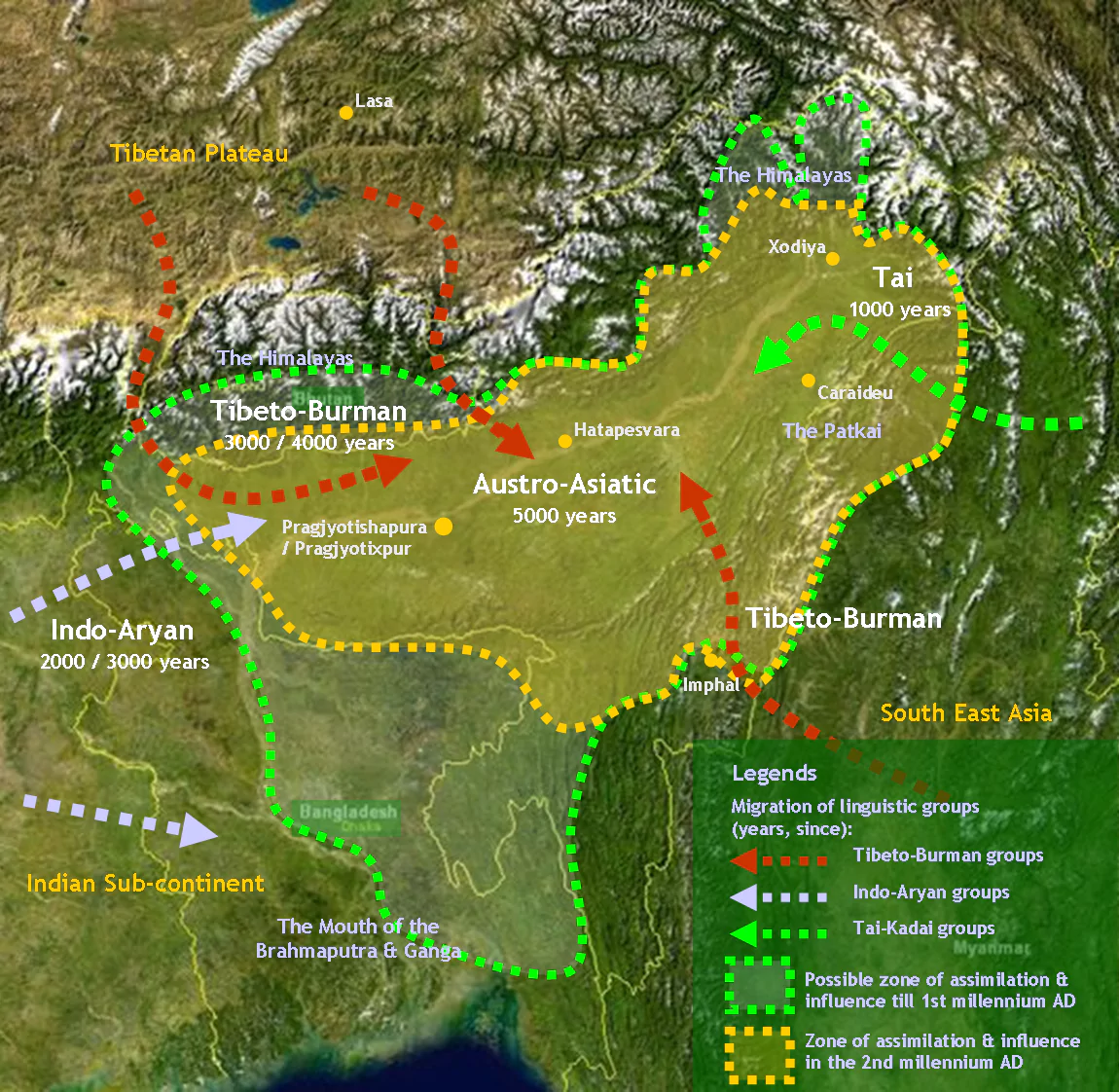
Ethnic Mosaic of Pre-1979 Assam
Syllabus Areas:
GS II - Governance
Assam’s ongoing eviction drives targeting encroachers—particularly Bengali-speaking Muslims from forest and government lands—have gained national attention. The issue intensified after the resumption of large-scale evictions in June 2025, coinciding with corruption charges against the ruling BJP government.
What makes this significant is that the eviction operations are now affecting interstate relations, as neighbouring northeastern States have begun resisting the potential spillover of displaced persons. The matter also links deeply with ethnic identity politics, border disputes, and environmental governance
Ethnic and Political Context in Assam
- Assam has historically been a multi-ethnic, multi-lingual State, with periodic fears of demographic change, especially due to migration from Bangladesh.
- The Assam Agitation (1979–1985) was a mass movement against so-called “foreigners,” leading to the Assam Accord. This accord set March 24, 1971, as the cut-off date for detecting and deporting illegal immigrants.
- Post-agitation, the political discourse in Assam became deeply polarised along ethnic and religious lines, particularly targeting Bengali-speaking Muslims, many of whom have lived in the State for generations.
Evictions and the Political Agenda
- The BJP came to power in Assam in 2016, promising to protect jaati (identity), maati (land), and bheti (hearth).
- Using High Court orders and environmental pretexts, the State government has initiated periodic eviction drives to reclaim encroached forest and satra (monastic) lands.
- However, these operations are seen as selective and polarising, disproportionately affecting Muslims of Bengali origin—often referred to derogatorily as Miya or Bangladeshi.
When Did the Eviction Drive Begin?
- First large-scale eviction occurred in September 2016, shortly after BJP’s first electoral victory.
- A violent incident in Gorukhuti in 2021 resulted in two deaths during evictions—this intensified scrutiny.
- The latest round began in June 2025, amid corruption scandals, leading to suspicion that the drive may also be politically motivated to distract attention.
Legal and Administrative Basis
- Gauhati High Court directives have provided judicial legitimacy to the drives, calling for the removal of encroachments from forestlands, wetlands, and government revenue lands.
- The Forest Rights Act, 2006 provides protection to tribal communities settled before 2005, and the CM has stated they will not be evicted.

Who is Being Targeted?
- Although eviction operations have affected other communities (e.g., Ahom, and some non-Muslims at Silsako Beel), the primary target is perceived to be Bengali-speaking Muslims, who are labelled as "illegal infiltrators".
- Over 1,080 families were evicted from Paikan Reserve Forest in Goalpara (July 2025), leading to fear, displacement, and fatalities (at least 5 deaths since 2016).
Why is the Drive Perceived as Aggressive?
- The Chief Minister and BJP leaders have publicly termed the operation as part of a fight against "land jihad", giving the process an ideological overtone.
- The administration claims 3,620.9 sq km of forest area is encroached, and 15,288.52 bighas of satra lands are illegally occupied.
- CM has declared a 10-year plan to make Assam encroachment-free—indicating this is a long-term and sustained policy push.
Interstate Spillover and Tensions
- Assam’s neighbours—Nagaland, Mizoram, Meghalaya, Arunachal Pradesh, Manipur—have ramped up border vigilance fearing influx of evictees.
- Nagaland Police intercepted 200 vehicles, while civil society and militant groups are forming border patrols to prevent perceived infiltration.
- Other States have made inner-line permit rules stricter to block outsiders.
Linkage with Interstate Border Disputes
- The eviction issue is tangled with long-standing border disputes between Assam and its neighbours. These States were carved out of Assam between 1963–1972.
- Assam claims 83,000 hectares of land occupied by other States.
- Some of these States accuse Assam of settling migrants along disputed borders to alter ground realities.
- Over 350 deaths have been reported in past inter-State clashes.
- In July 2025, the Gauhati HC directed the five NE States to form a high-level committee for coordinated action to remove encroachments.
Way Forward / Suggestions
- Humanitarian Rehabilitation Policy:
- Evictees must be given alternative land or shelter, especially vulnerable groups like women, children, and landless agricultural families.
- Transparent Identification Mechanism:
- Use objective criteria to identify illegal encroachments, avoiding communal profiling or targeting based on identity.
- Inter-State Coordination:
- Implement the High Court’s directive to form joint committees for border settlement and eviction monitoring.
- Revisit Land Use Policy:
- Encourage community forest governance, in line with the Forest Rights Act and sustainable land management
- Depoliticise the Process:
- Evictions should be framed as land governance and environmental restoration, not as ideological warfare.
- Engage Civil Society and Local Institutions:
- Include NGOs, community leaders, and local administration in dialogue and grievance redressal.
- Review Electoral Implications:
- The Election Commission and civil society should ensure that such operations do not become tools for voter polarisation.
The eviction drives in Assam reflect a complex intersection of legal mandates, demographic fears, electoral politics, and environmental concerns. While removal of encroachments may be legally justified, the selective targeting, lack of rehabilitation plans, and political overtones risk deepening social alienation and inter-State hostility.
Mains Question:
- Discuss the implications of Assam’s eviction drives on federal relations and internal migration in Northeast India.(150 words) 10 Marks