Election of Vice President
Syllabus Areas:
GS II - Polity
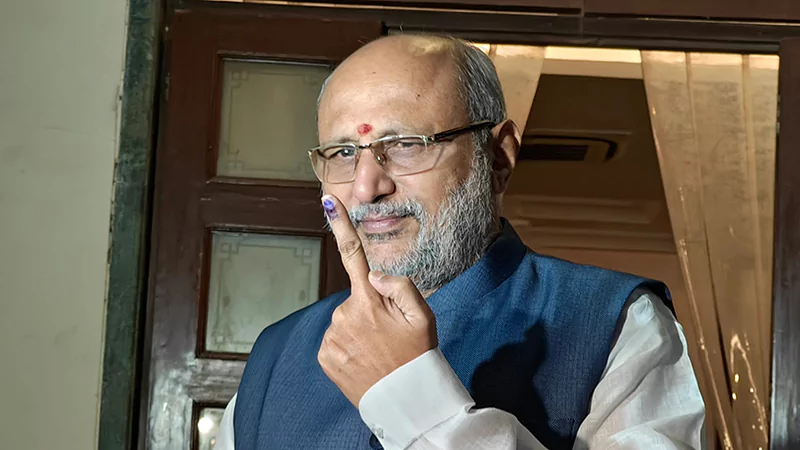
P. Radhakrishnan (NDA candidate) was elected as the 15th Vice-President, securing 452 votes against opposition’s B. Sudershan Reddy, who received 300 votes. There was a high voter turnout of about 96%.
Radhakrishnan brings a robust political career: former Governor of Maharashtra and Jharkhand, MP from Coimbatore, BJP Tamil Nadu state president, and Coir Board Chair. He is known for his RSS background and non-confrontational style. His appointment underscores the NDA’s parliamentary strength and strategic choice for continuity in constitutional decorum.
Beyond the immediate horse-race, the episode has revived debates on the political neutrality of the Vice-President as Rajya Sabha Chairman and on limits to the office’s powers.
Historical Background:
- Under the Government of India Act, 1935 (the main constitutional law before Independence), there was provision for a Governor-General (representing the British Crown) and provincial legislatures, but no parallel post like Vice-President
- The British system didn’t see a need for such an office because:
- The Governor-General functioned as the executive head.
- The Council of States (precursor to Rajya Sabha) was presided over by the Governor-General’s nominees.
After Independence
- During the Constituent Assembly debates, framers wanted:
- A stand-in for the President in case of vacancy.
- A presiding officer for the Rajya Sabha (to ensure federal balance, unlike Lok Sabha which had the Speaker).
- Hence, Article 63 created the post of Vice-President.
Do You Know?
- India borrowed the idea of the Vice-President’s office from the United States Constitution.
Role and Functions of the Vice-President in India
The Constitution places the Vice-President in two distinct capacities:
- Ex-officio Chairman of the Rajya Sabha (Upper House)
- Presides over Rajya Sabha sittings when present and is responsible for maintaining order and parliamentary procedure in the Upper House. (Unlike the Speaker of Lok Sabha, the Vice-President is not a member of the House.)
- Constitutional stand-in for the President
- When the President is absent, dies, resigns or is otherwise unable to discharge duties, the Vice-President acts as President until the vacancy is filled or the President resumes duties.
Important Functions
- Ceremonial and Representational Roles:
- Represents the nation at certain official functions and events when delegated by the President.
- Ensuring Legislative Continuity:
- By presiding over Rajya Sabha, ensures federal balance in Parliament and smooth functioning of the legislative process.
- Guardian of Parliamentary Conventions:
- Expected to remain politically neutral while conducting House business, similar to the Speaker of Lok Sabha.
- Plays a crucial role in managing disruptions and enabling debates on national issues.
- Succession Role:
- Provides constitutional continuity by being the immediate stand-in for the President, ensuring no power vacuum at the Union’s highest level.
Constitutional provisions
Part V: “The Union”, relevant Articles:
- Article 63 — Establishes the office of Vice-President.
- Article 64 — The Vice-President acts as ex-officio Chairman of the Council of States (Rajya Sabha).
- Article 65 — Vice-President to act as President in certain contingencies.
- Article 66 — Manner of election of the Vice-President (electoral college of both Houses of Parliament; single transferable vote; secret ballot).
- Article 67 — Term of office (five years) and removal (see §5 below).
- Article 68 — Time for holding election to fill vacancy in office of Vice-President and term of person elected to fill casual vacancy.
- Article 69–72 — Oath/affirmation, salaries, etc.; Article 72 deals with pardons by the President—note when the Vice-President acts as President, the functions under these articles flow to them while acting.
Practical notes: The Vice-President continues in office after the expiry of term until a successor enters office (to avoid vacancy). Also, nominated members of Parliament participate in Vice-Presidential elections (unlike Presidential elections where nominated state MLAs do not vote)
Prelims Fact:
- The first Vice-President took oath on 13 May 1952, choosing Sarvepalli Radhakrishnan, a distinguished philosopher and diplomat
- Mohammad Hamid Ansari holds the record for the longest tenure—he served two full consecutive terms from 11 August 2007 to 11 August 2017.
- V. V. Giri served from 13 May 1967 to 3 May 1969 before becoming Acting President, serving just under two years.
Election of the Vice-President
- Who votes: All members of both Houses of Parliament — elected and nominated (Lok Sabha + Rajya Sabha).
- Voting method: Proportional representation by means of the single transferable vote(STV) and by secret ballot. The Election Commission of India conducts the poll and lays down procedure and counting.
- Eligibility:
- Must be an Indian citizen
- At least 35 years old and
- Qualified to be a member of Rajya Sabha (i.e., meet qualifications for Parliament).
- Must not hold an “office of profit” under the Government of India.
- Nomination and scrutiny: Candidates file nominations; a returning officer scrutinizes nominations and declares valid candidates. Deposit and security requirements mirror other parliamentary elections.
- Filling casual vacancies: If the Vice-President’s office becomes vacant (resignation, death, removal), Article 68 mandates the time and manner of holding the election to fill the vacancy; the person elected to fill the vacancy serves the remainder of the term.
Removal and re-election
- Removal:
- There is no impeachment procedure for the Vice-President like the President’s.
- Instead, Article 67(b) provides for removal by a resolution of the Rajya Sabha passed by an effective majority of “all the then members” of the Rajya Sabha;
- That resolution must be agreed to by the Lok Sabha.
- A 14-day notice period is required before such a motion can be moved.
- Re-election:
- The Vice-President holds office for five years but is eligible for re-election;
- There is no constitutional bar on serving multiple terms.
- A Vice-President also continues until a successor assumes office.
Jagdeep Dhankhar in July 2025 was the first Vice-President of India ever to resign mid-term.
Comparison with vice-presidential offices in other countries
Short, pointed comparisons (practical differences):
India vs United States
- India: VP is mainly a legislative officer — ex-officio Chairperson of Rajya Sabha; role is largely procedural and ceremonial, with acting-President duties on contingencies. Elected indirectly by Parliament.
- United States: VP is part of the executive branch — elected on a joint ticket with the President (popular Electoral College vote), has clear succession powers (becomes President on vacancy) and an active political/executive role (cabinet duties, policy influence). The VP of the US also presides over the Senate with a tie-breaking vote. The 25th Amendment provides a clear nomination/confirmation route to fill a vacant VP post.
Other variants globally:
- Some countries (e.g., Brazil, many democracies) have VPs who are active members of the executive and typically run on a joint ticket with the President — stronger integration into day-to-day governance.
- Parliamentary democracies often omit a strong VP entirely (they rely on other succession mechanisms) or confer the presiding role in the upper house on a separate office. (Contextual sources: comparative constitutional literature.)
Bottom line: The Indian Vice-President’s role is closer to a parliamentary/ceremonial model (with limited executive power) rather than the U.S. model of an executive deputy with active succession and policy functions.
Challenges & criticisms:
- Political partisanship vs constitutional neutrality: The Vice-President should be an impartial Chairman of Rajya Sabha. Recent events (clashes, allegations of partisanship during Jagdeep Dhankhar’s tenure and even an opposition impeachment move) revived concerns that the office has been politicised, undermining parliamentary neutrality.
- Ambiguous accountability & weak checks: Because the VP is indirectly elected by MPs and continues in office until a successor takes over, there can be gaps in accountability and clarity about how to address misconduct — the removal route (Article 67(b)) is politically difficult to use.
- Limited mandate & public legitimacy: The VP is not directly elected by the people and so lacks a direct democratic mandate, even while occupying the second highest constitutional office — critics argue this constrains moral authority.
- Role confusion in crises: Unlike the U.S. 25th Amendment clarity on succession and incapacity, India’s mechanisms involve short-term acting arrangements and elections; this can complicate continuity planning in crises.
- Operational constraints: The Vice-President’s effectiveness as Rajya Sabha Chairman is shaped by parliamentary rules and customs; repeated disruptions, frequent suspensions, and adversarial politics make maintaining decorum difficult.
Committees and their suggestions regarding the Vice-President
Swaran Singh Committee (1976)
- Suggested that the Vice-President’s acting period as President should be time-bound to ensure quick election of a new President.
National Commission to Review the Working of the Constitution
(NCRWC),
2000–2002 (Justice M.N. Venkatachaliah Commission)
- Observed that the Vice-President’s dual role
(as
Rajya Sabha
Chairperson and potential Acting President) can cause conflicts.
- Suggested clearer conventions to ensure impartiality of the
Vice-President
in the Rajya Sabha.
- Recommended exploring codification of parliamentary
conventions so
that rulings from the Chair are not perceived as partisan.
Second Administrative Reforms Commission (ARC,
2005–2009)
- Did not directly propose restructuring of VP’s office but
emphasised that
presiding officers of legislatures must maintain strict
political
neutrality.
Suggested code of conduct for
presiding
officers – by implication, this includes the
Vice-President as
Chairman of the Rajya Sabha.
Supreme Court observations on neutrality
- In multiple rulings about Speakers/Presiding Officers’
powers
(e.g., Kihoto Hollohan v. Zachillhu, 1992 – Tenth
Schedule case), the
Court stressed that presiding officers must act
impartially. By
extension, this principle applies equally to the Vice-President in
his
role as Rajya
Sabha Chairman.
Way forward:
Suggested code of conduct for presiding officers – by implication, this includes the Vice-President as Chairman of the Rajya Sabha.
If you want reform that is sensible, implementable and protects institutions:
- Adopt a Vice-Chair code of conduct (statutory or parliamentary rule): Define limits on public political speech, set conflict-of-interest rules and outline penalties for breach. (Fast, low-cost, high impact.)
- Set up a non-partisan procedural advisory cell for the Chairman: Professional advice reduces the chance of procedural errors and ensures rulings are defensible and documented.
- Transparency in chair rulings: Publish short written reasons for controversial rulings (like suspensions) within a fixed time to build public trust.
- Clarify removal procedure detail in rules: While Article 67 sets the broad outline, Parliament should adopt standing orders spelling out notice requirements, evidence rules and a time-bound process for fairness.
- Use appointment norms: Encourage selection (or at least cross-party consultation) of candidates with strong credentials in parliamentary procedure/consensus politics rather than purely partisan figures.
- Public education and communication: Because the Vice-President is largely unknown to the public, a small outreach program explaining the office and its impartial duties will raise legitimacy.
These are practical steps that protect the institution without constitutional surgery.
The Vice-President’s office, though often understated, is vital for constitutional stability and parliamentary integrity. Ensuring neutrality, strengthening rules, and adopting committee recommendations will preserve its dignity, prevent politicisation, and enable it to act as an impartial guardian of democratic functioning.
Prelims Questions:
1. Which of the following statements about the Vice-President of India is/are correct?
- The Vice-President is elected by an electoral college consisting of elected members of both Houses of Parliament.
- The Vice-President is the ex-officio Chairman of the Rajya Sabha.
- The Vice-President exercises a casting vote in case of a tie in the Rajya Sabha.
Select the correct answer using the codes below:
2. Consider the following regarding the removal of the Vice-President of India:
- A resolution for removal must originate in the Rajya Sabha.
- The resolution requires a simple majority in the Rajya Sabha and concurrence of the Lok Sabha.
- A 14-day notice must be given before moving the resolution.
Which of the above is/are correct?
Mains Question:
- “Unlike the Vice-President of the United States, the Indian Vice-President is a parliamentary presiding officer rather than an executive deputy.” Compare and contrast the roles of the Vice-President in India and the United States. (15 marks)(250 W0rds)