
Concerns Raised Over EIA of Great Nicobar Infrastructure Project
Syllabus Topic:
Mains GS Paper III – Environment and Economy (Infrastructure)
The ₹1.72 lakh crore Great Nicobar Infrastructure Project (GNIP) has come under scrutiny for downplaying seismic risks despite being located in a highly earthquake- and tsunami-prone zone. Experts and scientists have raised serious concerns over the adequacy and scientific basis of the Environmental Impact Assessment (EIA) report.
What is EIA?
- Environmental Impact Assessment (EIA) is a formal process used to evaluate the likely environmental consequences (positive or negative) of a proposed project or development before granting approval.
- Its Major objective is to ensure informed decision-making by identifying: Potential environmental risks, Mitigation strategies, Alternatives with minimal ecological damage.
Legal Framework in India:
- Governed under the Environmental Protection Act, 1986.
- EIA Notification 2006 by the Ministry of Environment, Forest and Climate Change (MoEFCC) is the core regulation.
- Projects are categorized into:
- Category A: National-level clearance (via MoEFCC)
- Category B: State-level clearance
Stages of EIA Process:
- Screening: Is EIA needed?
- Scoping: What impacts to assess?
- Public Consultation: Stakeholder feedback.
- Impact Assessment and Mitigation: Technical analysis and solutions.
- Review and Decision: Clearance granted or denied.
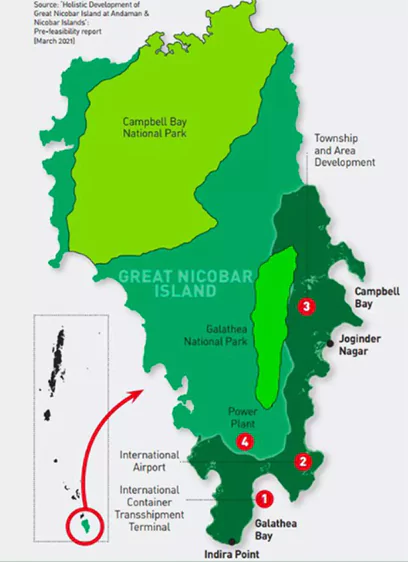
What is Great Nicobar Infrastructure Project?
- Development of a transshipment port
- Construction of an international airport
- Township development
- Establishment of a 450 MVA gas and solar-based power plant
What Environment Impact Assessment done by Vimta Labs says in its report?
- Main claim is that, low probability of a mega-earthquake like the 2004 (9.2 magnitude) event.
- While acknowledging the region’s proximity ans susceptibility to
massive earthquakes, primarily
draws on a
2019 study by scientists of the IIT kanpur, suggesting a Return Period of
- 420–750 years for mega-earthquakes (Magnitude ≥ 9)
- 80–120 years for large earthquakes (Magnitude ≥ 7.5)
Criticism on EIA:
The EIA omits key findings from the IIT Kanpur study:
- Strain accumulation in the Andaman segment.
- Evidence of seven tsunami events in the last 8,000 years.
- A 2,000-year gap in sediment history, increasing uncertainty.
- No site-specific seismic studies were conducted for Great Nicobar.
- Experts warn that seismic impact depends on the epicenter, and GNIP lies in
a highly dynamic earthquake
zone.
- And also warns that location-specific dynamics (like 2004 tsunami centered in Banda Aceh vs. Nicobar) can change impact.
- Describes Great Nicobar as an "extremely geodynamic" zone and unsuitable for major infrastructure like ports.
Environmental and Social Concerns:
- Biodiversity loss due to tree felling.
- Threat to indigenous tribes like Shompen Tribe, Nicobarese Tribe, etc and their ecosystems
- The project has received environmental and preliminary forest
clearance, but:
- National Green Tribunal (NGT) has called for a review, citing these concerns.
Prelims Questions:
- With reference to Environmental Impact Assessment (EIA) in
India, consider the
following
statements:
- EIA is a constitutional requirement under Article 48A of the Directive Principles of State Policy.
- EIA Notification 2006 categorizes projects into Category A and Category B based on potential environmental impact.
- Public consultation is mandatory for all projects under EIA, including those involving national security.
- 1 and 2 only
- 2 only
- 1 and 3 only
- 1, 2 and 3
- Article 48A is a directive principle, not a legal requirement—but EIA draws strength from it.
- EIA 2006 divides projects into Category A (MoEFCC clearance) and Category B (SEIAA).
- Projects related to national security or strategic considerations are exempt from public consultation.
- Which of the following best describes the purpose of conducting an Environmental Impact Assessment (EIA)?
- To measure the carbon footprint of ongoing development projects.
- To estimate the cost-benefit ratio of industrial projects.
- To predict and mitigate environmental damage before the project is approved.
- To calculate the profit-loss analysis of infrastructure investments.
- Which of the following are steps involved in the EIA process in
India?
- Screening
- Scoping
- Public Hearing
- Post-clearance Monitoring
Which of the statements given above is/are correct?
Answer:A
Explanation:
Answer:C
Explanation:
EIA aims to predict and reduce negative environmental impacts before project execution, promoting sustainable development.
- 1, 2 and 3 only
- 2, 3 and 4 only
- 1, 2, 3 and 4
- 1 and 4 only
Answer:C
Explanation:
The EIA process involves screening, scoping, public consultation, impact analysis, appraisal, and post-clearance monitoring.
Mains Question:
- The Great Nicobar Infrastructure Project (GNIP) has received environmental clearance despite being located in a highly seismic and ecologically sensitive zone. In light of this, critically examine the role and limitations of the Environmental Impact Assessment (EIA) process in ensuring sustainable development in India. 150 Words. 10 Marks