1931 Kashmir Uprising
Syllabus Areas:
GS I - Modern History
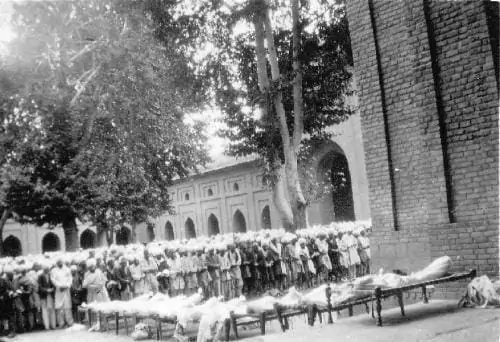
Martyrs' Day was historically observed on
July 13 in Jammu & Kashmir to commemorate 22
Kashmiri Muslims killed in 1931 during protests against the
Dogra rule.
It was a state holiday until
2019, when J&K’s special status was revoked
under Article 370.
Dogra Rule Background
- The Dogra dynasty ruled the princely state of Jammu and Kashmir from 1846 to 1947.
- It was founded by Gulab Singh, a Dogra Rajput and general in the Sikh empire.
- After the First Anglo-Sikh War, under the Treaty of Amritsar (1846), the British sold Kashmir to Gulab Singh for 75 lakh rupees.
- This made J&K a princely state under British suzerainty, with the Dogras as hereditary rulers.
Key Features of Dogra Rule
| Aspect | Details |
|---|---|
| Rulers | Gulab Singh (1846–1857), followed by Ranbir Singh, Pratap Singh, Hari Singh (last ruler) |
| Language & Culture | Ruling elite were Dogra Hindus, while the majority population in Kashmir Valley were Muslims. |
| Administrative Setup | Feudal and centralized; heavily tilted towards Dogra elites |
| Religious Divide | Kashmiri Muslims often faced discrimination, lack of political rights, and poor socio-economic conditions. |
| Revenue System | Harsh land taxes; economic oppression of peasants, especially Muslim cultivators |
| No Representation | Political rights were nearly absent for the general population till the 1930s |
Martyrs’ Day Background
- On July 13, 1931, during the trial of Abdul Qadeer Khan, thousands of Kashmiri Muslims gathered outside Srinagar Central Jail.
- Khan openly criticised the Dogra monarchy for its discriminatory policies and oppression of Kashmiri Muslims, He was arrested by Dogra authorities and charged with sedition.
- The protest turned violent when Dogra police opened fire, killing 22 people.
- The martyrs were buried near the shrine of Khwaja Bahauddin Naqshband in Srinagar.
- Sheikh Mohammad Abdullah later declared July 13 as Martyrs' Day.
Political Controversy
- After abrogation of Article 370 in 2019, official commemoration ended.
- September 23 (birth anniversary of Maharaja Hari Singh) was declared a public holiday by the L-G in 2022.
- Recent controversy (2025):
- Elected government in J&K (Omar Abdullah’s NC) wanted to visit the martyrs' grave.
- Police refused permission; some leaders were put under house arrest.
- Omar called it a "blatantly undemocratic move"
Prelims Questions:
-
Which of the following statements regarding the 1931 Kashmir uprising is/are
correct?
- It was triggered during the trial of Abdul Qadeer Khan.
- It led to the killing of 22 unarmed protesters by Dogra forces.
- The event led to the formation of the Bharatiya Jan Sangh in Kashmir.
- 1 and 2 only
- 1 and 3 only
- 2 and 3 only
- 1, 2 and 3
-
Which of the following leaders played a pivotal role in transforming the
Muslim Conference into the
secular National Conference in 1939?
- Maulana Abul Kalam Azad
- Mirwaiz Yusuf Shah
- Sheikh Mohammad Abdullah
- Syed Mir Qasim
Answer: C
Explanation: Sheikh Mohammad Abdullah transformed the Muslim Conference into the Jammu & Kashmir National Conference to represent all communities.
-
What was the primary aim of the land reforms introduced by Sheikh Abdullah’s
government after
1947?
- Industrialisation of Kashmir
- Ending landlordism and redistributing land to tillers
- Protecting forest lands from encroachment
- Promoting tourism in rural areas
Answer: A
Explanation: The 1931 uprising was triggered during Abdul Qadeer Khan’s trial and led to the death of 22 Kashmiris. Bharatiya Jan Sangh has no link to this event.
Answer: B
Explanation: The “land to the tiller” reform abolished jagirdari and redistributed land to cultivators, without compensation to landlords.
Mains Questions:
Q . "Discuss the historical significance of the 1931 Kashmir uprising and its political implications in the post-Article 370 era." 150 Words 10 Marks