New Clues to the Origins of Life
Syllabus Areas:
GS III - S & T
Prelims
The Puzzle of Life’s Beginning
Every living cell works because of a partnership between two key molecules:
- RNA – stores and carries genetic instructions.
- Proteins – do the work of building and running the cell.
But here lies a big mystery:
- To make a protein, amino acids must be linked together in the right order, and that job is handled by proteins themselves (enzymes).
- This creates a chicken-and-egg problem → proteins are needed to make proteins, but they can’t exist without RNA.
Modern biology solves this with the ribosome (a massive molecular machine) that reads RNA and links amino acids into proteins. But how did this process begin on a lifeless early Earth billions of years ago, when no ribosomes or enzymes existed?
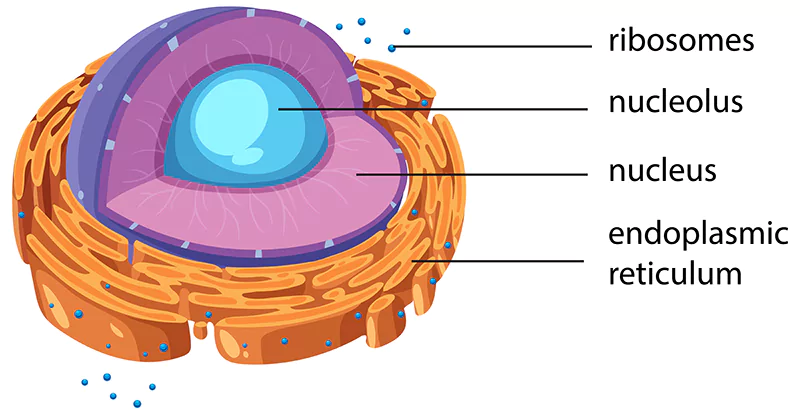
What are Ribosomes?
- Ribosome is a complex molecular machine found in all living cells.
- Its main function is to make proteins by linking amino acids in the order specified by the instructions carried in messenger RNA (mRNA).
- Because of this role, ribosomes are often called the “protein factories of the cell.”
The New Discovery
A study published in Nature by researchers at University College London (UCL) offers a breakthrough.
- They found that simple molecules called aminoacyl-thiols can link amino acids directly to RNA without enzymes.
- This means the earliest connection between RNA and proteins might have started with pure chemistry, not biology.
Think of it like this:
- RNA = thread
- Amino acids = beads
- Today, enzymes = skilled hands that string beads onto thread.
- But this study shows that, under early Earth conditions, the beads could stick themselves to the thread in plain water.
Why It’s So Surprising
- Normally, RNA is not very reactive.
- Yet, the study found that aminoacyl-thiols favoured attaching to RNA over other, more reactive molecules.
- This unexpected selectivity shocked chemists because it mirrors the way life still works today, where amino acids specifically link to RNA before forming proteins.
Recreating the Two Steps of Protein Synthesis
In modern biology, protein synthesis happens in two key stages:
- Charging: Amino acids get attached to RNA.
- Linking: Amino acids join together to form peptides (chains → proteins).
The UCL team found that these two steps could also be separated with a simple chemical switch:
- With thioesters, amino acids stick to RNA.
- With thioacids, amino acids link to each other as peptides.
This means that even in a single solution, chemistry could naturally switch between RNA charging and protein linking—a process very similar to what ribosomes do today.
Could This Happen on Early Earth?
The next question was whether these reactions required rare conditions.
- The experiments showed aminoacyl-thiols could form from simple raw materials like nitriles and thiols.
- Even under cold, frozen conditions (like icy ponds), the reactions worked faster because the molecules were concentrated.
This suggests such chemistry could have happened in ordinary environments on young Earth—ponds, shallow pools, or even frozen surfaces.
What This Means for Life’s Origins
- For decades, scientists studied RNA and amino acids separately: how RNA could copy itself or how amino acids could form peptides.
- But this study connects the two worlds: it shows RNA and amino acids could directly interact without enzymes.
- This is important because it could mark the very first step in coded protein synthesis, where RNA began to guide the formation of proteins.
Limitations and Next Steps
- The peptides produced so far in the lab are very short.
- The challenge ahead:
- How to extend peptide chains.
- How RNA could gradually evolve to control which peptides are made.
- Scientists believe there was a slow evolution: from simple uncontrolled reactions → to RNA having more control → to the complex genetic code we know today.
This breakthrough shows that the partnership between RNA and proteins—so central to life—may have started with simple, selective chemical reactions in ordinary early Earth conditions. By proving that amino acids can attach directly to RNA without enzymes, scientists have taken a major step towards explaining how life could emerge from non-living matter.
Prelims Questions:
1. Consider the following statements regarding Ribosomes:
- Ribosomes are composed of proteins and ribosomal RNA (rRNA).
- Ribosomes are bounded by a lipid membrane like mitochondria.
- In eukaryotic cells, ribosomes are larger (80S) than in prokaryotic cells (70S).
- Ribosomes are the site of protein synthesis in all living cells.
2. In the context of origin of life studies, the term “aminoacyl-thiols” recently seen in news refers to:
- Enzyme complexes found in modern ribosomes.
- Simple molecules that can attach amino acids directly to RNA without enzymes.
- A type of nucleotide precursor used in RNA self-replication.
- Protein chains formed by spontaneous peptide bonding in the absence of RNA.
Mains Question:
- Scientific discoveries on the origins of life often use laboratory simulations of early Earth conditions. How can such research deepen our understanding of evolution and what ethical or philosophical debates does it raise? (250 words, 15 marks)