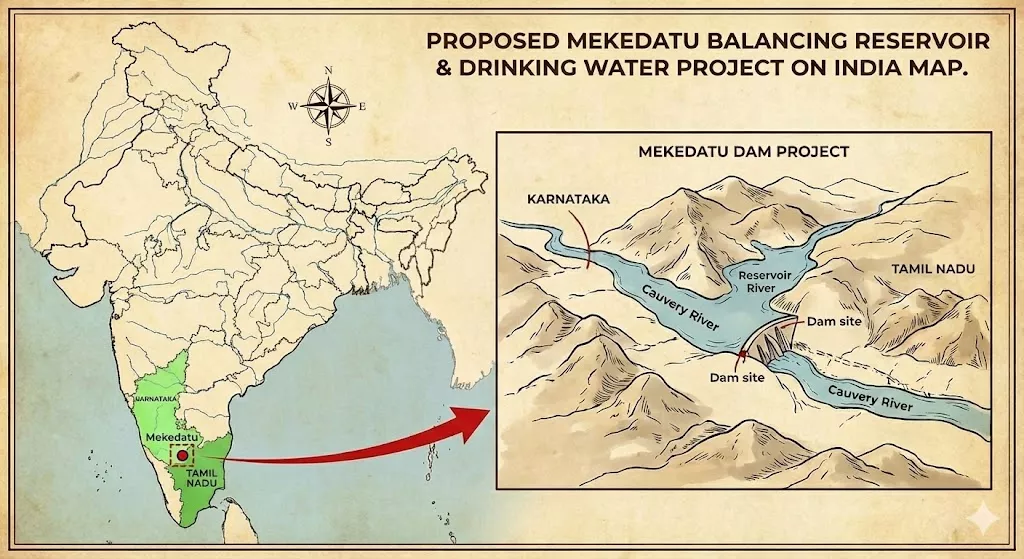
Mekedatu Dam Project
Syllabus Areas:
GS I - Geography
GS II - Polity & Governance
GS III - Environment and Ecology
The Mekedatu balancing reservoir project has again moved to the centre of inter-State water politics after Karnataka announced on November 18 that it would submit a revised Detailed Project Report (DPR) to the Central government. This came days after the Supreme Court termed Tamil Nadu’s application challenging the project as “premature,” effectively clearing the way for technical scrutiny by the Cauvery Water Management Authority (CWMA) and the Central Water Commission (CWC).
The development revives a longstanding debate over water sharing, ecological impacts, and inter-State trust deficits between Karnataka and Tamil Nadu.
Background of the Mekedatu Dam Project
The States Involved
- Karnataka (upper riparian State)
- Tamil Nadu (lower riparian State)
Both States depend heavily on the Cauvery River, and any intervention in its natural flow immediately becomes politically and legally sensitive.
River & Geography
- The Cauvery River originates in Talakaveri, Kodagu (Karnataka), flows through Tamil Nadu, and ultimately reaches the Bay of Bengal.
- The Mekedatu site is located in Ramanagara district, ~100 km from Bengaluru.
- Geographically, the area lies at the confluence of:
- Cauvery River
- Arkavathi River (a tributary)
- The river valley here is narrow and deep — known as Mekedatu Gorge — which makes it a suitable location for a large reservoir.
- The project area also falls within a forest-rich belt, adjoining wildlife regions of the Cauvery Wildlife Sanctuary.
Historical Context
- Idea first mooted in 1948, but remained dormant for decades.
- Gained relevance due to:
- Rapid urbanisation of Bengaluru
- Escalating summer water shortages
- Pressure on groundwater
- Rising population projections
Current Developments
Supreme Court’s Position
- The SC termed Tamil Nadu’s challenge as
“premature”, meaning:
- Karnataka’s DPR can now be examined by CWMA and CWC.
- No final approval has yet been granted for construction.
Karnataka’s Move
- Karnataka will submit a revised DPR for the ₹29,000-crore balancing reservoir.
- Planned features:
- Storage capacity:16 TMC
- Hydropower generation: 400 MW
- Forest submergence: ~4,996 hectares
- Objective:
- Use the additional 4.75 TMC allocated by the SC (2018 judgment).
- Provide drinking water security for Bengaluru.
Tamil Nadu’s Reaction
- Opposition accused the State government of inaction.
- TN Water Resources Minister Durai Murugan clarified:
- The Court has not allowed the dam.
- TN will resist Karnataka’s attempts at every stage.
- Tamil Nadu fears:
- Karnataka may impound excessive water, especially during June–September.
- Existing non-compliance episodes may repeat.
Why the Project Is Contentious
- Deep-rooted trust deficit in Cauvery water sharing.
- TN argues:
- The reservoir may delay or alter water releases.
- Karnataka argues:
- The project will ensure controlled releases even in poor rainfall years.
- It is financed from Karnataka’s own resources.
- Environmental concerns:
- Large-scale forest submergence.
- Potential impact on wildlife corridors in the region.
Importance for Bengaluru
- Current demand: 2600 MLD
- Current availability: 2100 MLD → Shortfall of 500 MLD
- Future demand (by 2030): 4000 MLD (population ~20 million)
- SC allocation of only 75 TMC/year → approx. 370
MLD
- This covers only a portion of the deficit.
Are There Alternatives?
According to IISc expert T.V. Ramachandra:
- Bengaluru receives 15 TMC potential water from rainfall (1,160 MLD).
- 16 TMC (1,240 MLD) possible through treated wastewater reuse.
- Thus, local urban water management could solve much of the crisis.
Centre’s Role
- 2019: Karnataka submitted DPR to CWC → forwarded to CWMA.
- 2019 (MoEFCC): Expert Committee insisted on an “amicable solution.”
- 2024 (Feb 1): CWMA referred project back to CWC.
- With the SC calling TN’s petition premature, CWC and CWMA can now:
- Examine Karnataka’s DPR
- Facilitate inter-State dialogue
Way Forward
- Strengthening Inter-State Trust
- Transparent data-sharing on reservoir levels and releases.
- Open, real-time monitoring accessible to both States.
- Independent Environmental Assessment
- A neutral, science-based EIA is essential:
- Forest loss
- Wildlife corridors
- Downstream flow impacts
- A neutral, science-based EIA is essential:
- Bengaluru’s Urban Water Management
- Aggressive rainwater harvesting.
- Mandatory treated wastewater reuse.
- Fixing distribution inefficiencies and leakages.
- Centre as a Neutral Arbiter
- CWMA and CWC must ensure:
- Fair deliberation
- Conflict resolution
- Compliance with 2018 Tribunal + Supreme Court orders
- CWMA and CWC must ensure:
- Long-Term Cauvery Basin Planning
- Basin-wide hydrological modelling.
- Climate-change adaptation strategies.
- Joint flood-drought management between States.
The Mekedatu project sits at the intersection of water
security, environmental
sustainability, and inter-State federalism. Karnataka views it as essential
for Bengaluru’s future; Tamil Nadu fears it could upset an already delicate
Cauvery balance. With the Supreme Court clearing the way for technical evaluation, the
responsibility now lies with CWMA and CWC to handle the process transparently and
fairly.
A lasting solution requires cooperation, scientific assessment,
and trust-building, ensuring that both States’ needs are met without
compromising ecological integrity or legal obligations.
Prelims Questions:
1. Consider the following statements regarding the Central Water Commission (CWC):
- It is an attached office under the Ministry of Jal Shakti.
- It is the apex technical organization in India for water resources development.
- Its Chairperson is ex officio Chairman of the Cauvery Water Management Authority (CWMA).
Which of the above statements is/are correct?
- 1 and 2 only
- 2 and 3 only
- 1 and 3 only
- 1, 2 and 3
2. Which of the following constitutional provisions deals specifically with Inter-State water disputes?
- Article 249
- Article 262
- Article 263
- Article 246A
3. With reference to the Inter-State River Water Disputes Act (ISRWD), 1956, consider the following statements:
- The Act provides for the constitution of tribunals for water dispute resolution.
- The decision of a tribunal is binding on the States unless modified by Parliament.
- Appeals against tribunal awards lie directly with the Supreme Court.
Which statements are correct?
- 1 only
- 1 and 2 only
- 2 and 3 only
- 1, 2 and 3
4. Consider the following bodies:
- Cauvery Water Management Authority
- Godavari River Management Board
- Krishna River Management Board
- Narmada Control Authority
How many of the above are statutory bodies?
- Only one
- Two
- Three
- All four
5. Which of the following is/are true regarding Environmental Impact Assessment (EIA) for river projects?
- Projects affecting inter-State rivers must necessarily obtain consent from all riparian States.
- EIA clearance comes under the Ministry of Environment, Forest and Climate Change (MoEFCC).
- Terms of Reference for EIA are issued before the final EIA report preparation.
Correct answer:
- 2 only
- 2 and 3 only
- 1 and 3 only
- 1, 2 and 3
6. Consider these pairs of river water dispute tribunals and States involved:
| Tribunal | States Involved |
|---|---|
| 1. Mahadayi Tribunal | Karnataka, Goa, Maharashtra |
| 2. Krishna Tribunal | Karnataka, Maharashtra, Andhra Pradesh, Telangana |
| 3. Ravi-Beas Tribunal | Punjab, Haryana, Rajasthan |
How many pairs are correctly matched?
- 1 only
- 2 only
- All three
- None