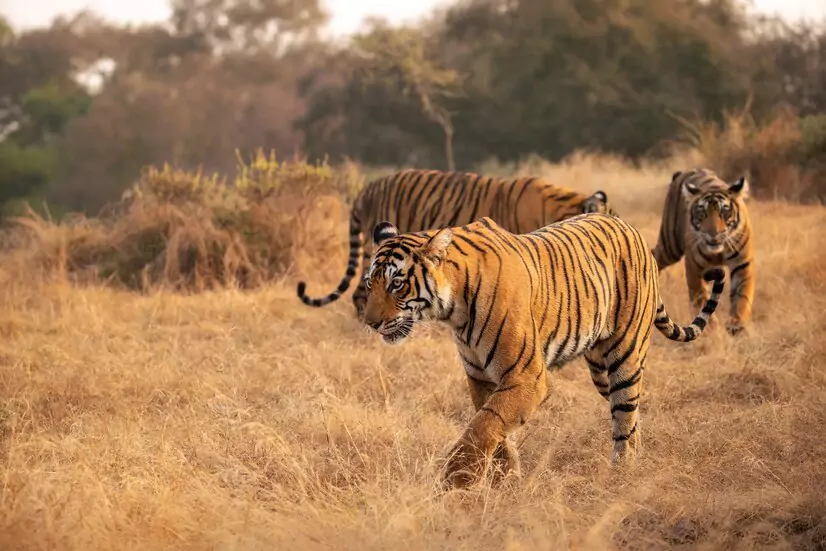
Goa Tiger Reserve
Syllabus Areas:
GS III - Environment and Ecology
In July 2023, the Bombay High Court directed the Goa government to notify five Protected Areas as a tiger reserve within three months.
- The areas included:
- Mhadei Wildlife Sanctuary (WLS)
- Bhagwan Mahavir WLS
- Bhagwan Mahavir National Park
- Netravali WLS
- Cotigao WLS
- The HC also ordered the State to:
- Prepare a Tiger Conservation Plan
- Settle rights/claims of Scheduled Tribes and forest dwellers
- The order stemmed from:
- A petition by Goa Foundation after the poisoning deaths of a tigress and her three cubs in 2020.
- Context: NTCA (2016) had already recommended declaring these areas a tiger reserve.
Goa government’s response
- Filed a Special Leave Petition (SLP) in the Supreme Court against the HC order.
- Main arguments:
- Designating a tiger reserve would affect 1 lakh people — which their own affidavit later contradicted.
- Later admission: only 1,274 households (≈5,000–6,000 people) across 33 villages are located inside these areas.
- Goan government’s shifting stance on tiger presence:
- Claimed no resident tigers, only transient
- Contradiction exposed:
In 2018, before the Mhadei Water Disputes Tribunal, Goa claimed it did have a resident tiger population and the forests formed a contiguous tiger corridor to Karnataka and Maharashtra.
- The Supreme Court, noticing inconsistencies, directed the Central Empowered
Committee (CEC) to:
- Conduct a site visit
- Examine the issue
- Submit a report

What the CEC report concluded
- Acknowledged local fears of displacement — said the State must proactively allay apprehensions.
- Recommended a phased establishment of the tiger reserve:
- Phase 1 – Core Zone (High tiger presence & contiguity with Kali
Tiger Reserve, Karnataka)
- Netravali WLS – 50 households
- Cotigao WLS – 41 households
- Total: 7 sq km
- Reason: Known permanent tiger presence, low human habitation.
- Phase 1 – Buffer Zone
- Northern part of Bhagwan Mahavir WLS – 9 households
- Bhagwan Mahavir National Park – 2 households
- Reason: Contiguous with Kali Tiger Reserve buffer, important for landscape connectivity.
- Logic behind phased approach:
- Minimises disturbance to communities
- Prioritises ecologically sensitive, least-inhabited areas
- Strengthens inter-state tiger landscape (Goa–Karnataka–Maharashtra)
Why this matters
- Declaring a Tiger Reserve brings:
- Greater funding (central assistance under NTCA)
- Better scientific monitoring
- Higher conservation priority
- But it also creates:
- Core zones — must be “inviolate”; residents can only be voluntarily relocated (no forced displacement allowed under law).
- Buffer zones — allow controlled human activity (agriculture, tourism, sustainable livelihood).
- For Goa specifically:
- Provides formal protection to a critical Western Ghats tiger corridor.
- Strengthens conservation after the 2020 tiger poisoning case.
- Balances tribal rights, habitat continuity, and state concerns.
Prelims Questions:
1. With reference to a Tiger Reserve under the Wildlife Protection Act, 1972, consider the following statements:
- Village relocation from the core area is mandatory once it is declared inviolate.
- Buffer areas allow certain livelihood activities such as NTFP collection.
- Tiger reserves receive financial assistance from NTCA even if no tiger is present
Which of the statements given above is/are correct?
- 1 and 2 only
- 2 only
- 2 and 3 only
- 1, 2 and 3
2. With reference to a Tiger Reserve under the Wildlife Protection Act, 1972, consider the following statements:
- Village relocation from the core area is mandatory once it is declared inviolate.
- Buffer areas allow certain livelihood activities such as NTFP collection.
- Tiger reserves receive financial assistance from NTCA even if no tiger is present.
Which of the statements given above is/are correct?
- 1 and 2 only
- 2 only
- 2 and 3 only
- 1, 2 and 3
3.Consider the following statements regarding Goa's forest landscape:
- It forms a connectivity corridor between Kali Tiger Reserve and Sahyadri Tiger Reserve.
- Goa's sanctuaries host India’s densest tiger population in the Western Ghats.
- The State earlier claimed its tiger population was resident in certain belt regions.
Which of the above statements are correct?
- 1 and 3 only
- 1 only
- 2 and 3 only
- 1, 2 and 3