AI in Schools
Syllabus Areas:
GS II - Governance
GS III - Science and Technology
GS IV - Ethics
Should Artificial Intelligence Be Introduced as Part of the School Curriculum?
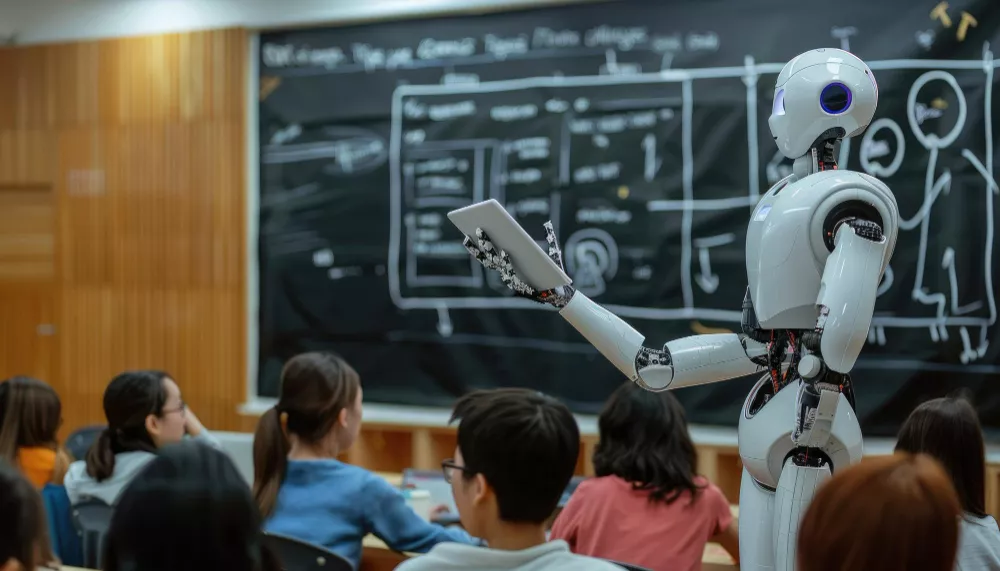
India stands on the brink of an educational transformation as the government prepares to integrate Artificial Intelligence (AI) into the school curriculum from Class 3 onwards, beginning in the academic year 2026–27.
- Earlier, the “Skilling for AI Readiness Initiative” was launched to equip CBSE schools to offer AI as a skill subject from Class 6.
- This move has sparked nationwide discussion about the timing, scope, and structure of AI education in schools.
- This ambitious step, guided by the National Education Policy (NEP) 2020, reflects a vision to align India’s education system with the demands of a rapidly evolving digital economy.
- The initiative aims not only to teach AI as a subject but to embed AI thinking and tools across the K–12 system, preparing students for a future where technology and intelligence coexist seamlessly.
Understanding the Proposal
The idea of introducing AI education in schools must be viewed through two distinct lenses — AI literacy and AI skills.
- AI Literacy means helping students understand how AI works, its capabilities, and its limitations. It focuses on developing critical thinking, ethical understanding, and responsible usage.
- AI Skills, on the other hand, include technical competencies such as Python programming, data analysis, and natural language processing, enabling students to build or work with AI systems.
At younger ages, the emphasis should ideally be on AI literacy rather than technical skill development. For primary grades (Classes 3–5), the curriculum should integrate AI through stories, games, and real-world examples that cultivate curiosity and ethical awareness rather than coding or tool-making. Only at higher levels—around Classes 9–12—should technical skills be formally introduced.
Appropriate Age to Introduce AI
- Children are already interacting with AI — through chatbots, social media algorithms, and digital assistants. The question is not whether to introduce AI, but how and when to do it responsibly.
- At early ages (below 12), foundational literacy, numeracy, and critical thinking should take priority.
- AI exposure at this stage should be conceptual and ethical — helping children understand what AI can and cannot do.
- Middle school (Classes 6–8) can introduce structured AI literacy modules — focusing on understanding algorithms, fairness, privacy, and misinformation.
- High school (Classes 9–12) may progressively include AI skill development — coding, data handling, and project-based applications — depending on infrastructure and student interest.
- This gradual approach ensures that cognitive maturity aligns with technological exposure.
Teacher Training and Institutional Preparedness
- However, integrating AI into classrooms is far from a plug-and-play process.
- The real challenge lies in preparing India’s vast teaching workforce—over one crore educators—to confidently impart AI-related concepts and use AI tools effectively.
- The government, recognizing this, has launched pilot projects in collaboration with major technology companies like Intel and IBM, as well as institutions such as the National Institute of Electronics and Information Technology (NIELIT).
- These pilots train teachers to design AI-enabled lesson plans, create interactive teaching resources, and apply data-driven insights in the classroom.
- So far, more than 10,000 teachers have received training since 2019, setting the foundation for large-scale adoption.
- Yet, the key question remains: Are India’s teachers ready to evolve into AI mentors?

Teacher Preparedness and Capacity Gaps
Introducing AI in schools cannot succeed without preparing the teachers who will deliver it. India’s school ecosystem is diverse — about 9% of schools operate with only one teacher, and over one-third have fewer than two teachers. Many educators lack both technological tools and formal training.
For effective implementation:
- Continuous teacher training and coaching must be built into the system.
- The curriculum should be context-sensitive — usable even in schools with limited electricity or internet connectivity (“unplugged AI learning”).
- Teachers must be trained not only in using AI tools but also in evaluating AI-generated content, guiding students in ethical use, and fostering analytical thinking.
Teachers should be viewed as innovators, capable of adapting content and pedagogy as AI evolves. A one-size-fits-all approach will not work in India’s diverse educational landscape.
Personalised Learning: From Uniformity to Adaptability
- The introduction of AI in education signifies a fundamental shift from uniformity to personalisation.
- Traditional schooling often follows a “one-size-fits-all” approach, where every student learns the same content at the same pace.
- AI disrupts this pattern by offering adaptive learning experiences tailored to each student’s strengths, weaknesses, and pace of learning.
- AI-driven platforms can analyze student behavior, performance trends,
and
comprehension levels to provide customized learning
paths.
- For instance, a student struggling with mathematics can receive additional explanations, interactive exercises, or visual aids;
- whereas a student excelling in science can be challenged with advanced modules.
- Such personalised learning can increase engagement, reduce dropouts, and enhance inclusivity, especially for learners with disabilities or language barriers.
- It has the potential to democratize access to quality education in a country as diverse as India.
AI as a Partner, Not a Replacement
- Despite its transformative promise, AI is not intended to replace teachers but to augment their capabilities.
- The technology can automate repetitive administrative tasks such as grading, attendance tracking, and performance evaluation, allowing educators to focus more on creative, emotional, and analytical aspects of teaching.
- Teachers can use AI-powered insights to understand their students’ learning styles and tailor classroom strategies accordingly.
- By reducing administrative burden, AI gives teachers more time to engage meaningfully with students—nurturing critical thinking, empathy, and curiosity.
- The goal is to build a symbiotic relationship between human educators and intelligent tools—where AI becomes an assistant enhancing the teacher’s effectiveness rather than a competitor threatening their role.
Opportunity Amid Workforce Disruption
- AI’s influence extends beyond the classroom into the future job market.
- According to a NITI Aayog report, while AI could displace around 2 million existing jobs in India’s technology sector within the next five years, it is projected to create nearly 4 million new roles by 2030.
- These emerging opportunities will demand new skill sets—data literacy, problem-solving, ethical reasoning, and adaptability.
- Embedding AI education from early schooling ensures that India’s youth are not just consumers of technology but creators and innovators within it.
- This initiative is as much about safeguarding employability as it is about national competitiveness in the era of automation and global digitalization.
Generative AI in Indian Classrooms
- A noteworthy development within this movement is the rapid rise of Generative AI in higher education.
- Over half of India’s universities and colleges have already adopted AI tools that support teaching and learning.
- These tools include chatbots that provide 24×7 academic support, platforms that generate quizzes, summarize lessons, or even create customized study material based on student data.
- Such innovations make education more interactive and personalised, especially in large classrooms where individual attention is scarce.
- However, this growth must be accompanied by ethical safeguards to ensure responsible use of data and prevent over-reliance on automated systems.
What is Generative AI?
Generative AI is a branch of artificial intelligence that can create new content—such as text, images, music, videos, or even code—by learning from existing data patterns.
Unlike traditional AI systems that only analyze data or make predictions, generative AI produces original outputs that resemble human creativity. It uses advanced models like Large Language Models (LLMs) and Generative Adversarial Networks (GANs) to do this.
Driving Inclusivity and Accessibility
- One of the most transformative potentials of AI lies in its ability to foster inclusivity.
- In a country like India, with linguistic diversity and socio-economic disparities, AI can help bridge long-standing educational gaps.
- Natural language processing tools can translate content into multiple regional languages, while speech-to-text and adaptive interfaces support students with disabilities.
- This personalised adaptability ensures that every learner—regardless of geography, ability, or background—has a fair chance to thrive.
- If implemented thoughtfully, AI could emerge as a great equaliser, helping realize the NEP 2020 vision of equitable and inclusive education.
Impact on Learning and Work Ethic
- AI has immense potential to assist in personalized learning, assessment, and doubt resolution.
- However, over-reliance can erode students’ ability to think independently.
- Recent studies have shown that when students use AI-generated answers, they often fail to explain or replicate the reasoning behind them.
- This trend raises concerns of “dis-education” — a term describing the loss of intrinsic motivation to learn or think critically because an AI can do the task faster.
- If students rely too heavily on AI to complete assignments or think on their behalf, it could diminish creativity, curiosity, and self-driven inquiry — the very foundations of learning.
- Therefore, integrating AI into education must be accompanied by strong pedagogical safeguards, ensuring that technology supports, not replaces, the process of thinking and understanding.
Addressing Psychological and Ethical Concerns
Children’s interaction with AI brings psychological and privacy risks. Many young users already use AI tools not just for study assistance but also for personal conversations — revealing data and emotions that can be exploited.
Guardrails are essential.
- Chatbots used in education must comply with data protection norms and age-appropriate interaction guidelines.
- AI systems should be transparent, explainable, and culturally sensitive, especially in a multilingual country like India.
- Parents and teachers should play a supervisory role in children’s engagement with AI, ensuring emotional and digital safety.
Legal frameworks, such as data protection laws and ethical AI guidelines, must evolve alongside educational initiatives.
Challenges on the Road Ahead
While the vision is bold, several obstacles must be overcome for AI integration to succeed:
- Teacher Preparedness: Training millions of teachers uniformly remains a formidable challenge.
- Infrastructure Gaps: Many schools, especially in rural India, still lack basic digital infrastructure and internet connectivity.
- Equitable Access: Ensuring that AI tools are not restricted to elite institutions is vital to avoid widening the digital divide.
- Ethical and Privacy Concerns: Protecting student data, preventing algorithmic bias, and ensuring transparency in AI systems are crucial policy priorities.
- Curriculum Design: Integrating AI concepts meaningfully within existing subjects without overwhelming students requires careful curricular planning.
The Way Forward
Introducing AI in schools is a progressive and necessary step, but the approach must be thoughtful and phased. The goal is not to produce millions of coders, but to raise a generation capable of understanding, questioning, and coexisting with AI responsibly.
India’s education policy must emphasize:
- AI literacy before AI skills,
- Teacher capacity building,
- Equitable access to digital infrastructure, and
- Ethical safeguards and continuous evaluation.
Ultimately, the purpose of AI education should not be to replace human intelligence, but to enhance human judgment, empathy, and adaptability. The ability to learn, unlearn, and innovate will remain the most valuable skill in an AI-driven world.
Conclusion
India’s decision to integrate Artificial
Intelligence into
early education marks a
historic leap forward in reimagining the purpose and
practice of
learning. If executed with vision and inclusivity, this reform can produce a
generation
that is technologically fluent, ethically grounded, and globally
competitive.
Yet,
the success of this initiative will rest not on algorithms or tools but on
people—teachers, policymakers, and students—who
must adapt
to this transformation with resilience and curiosity.
AI may indeed be
the
pen rewriting the rules of education, but the human
mind must remain the author guiding its narrative toward
equity,
creativity, and progress.